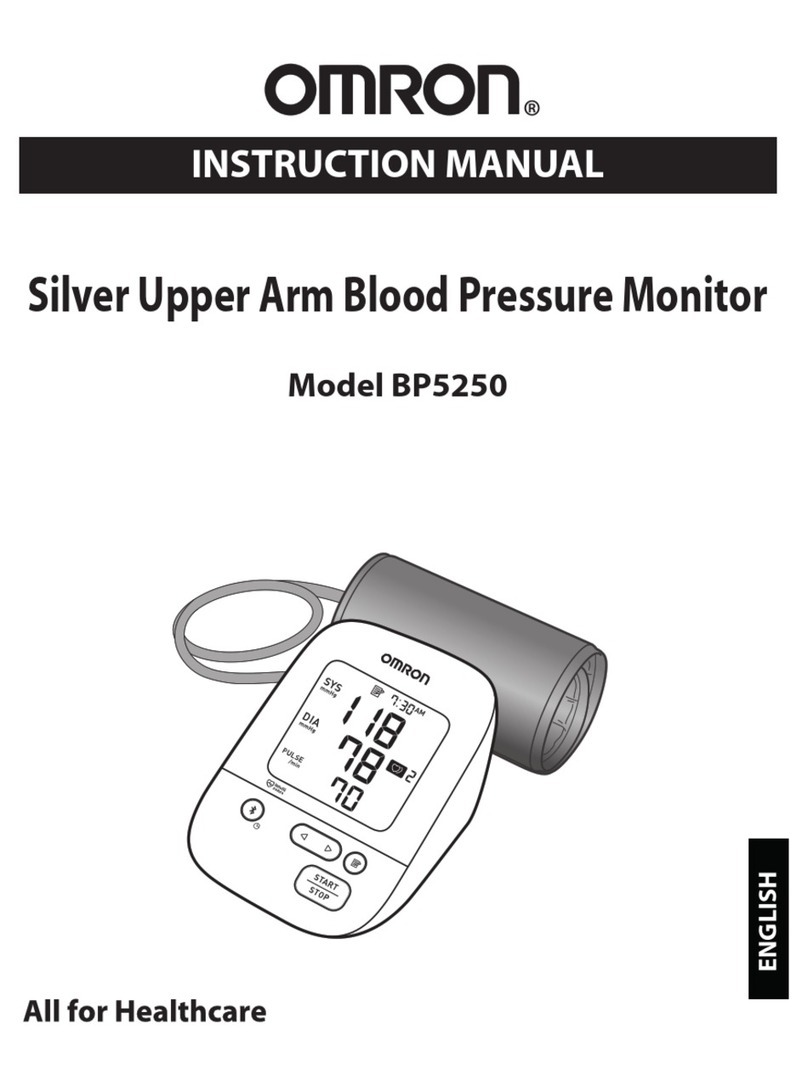
1. With the cuff wrapped around your arm, press the START/STO button.
Do not inflate the cuff unless it is wrapped around your arm. All digits will light
up to check the display functions. The checking procedure will be completed
after about 2 seconds. The arrow will appear momentarily and then the
display will show a “0”. The monitor is “Ready to Measure” at this point.
2. Using the hand of the arm that does not have the cuff on it (this will be your right
hand if wearing the cuff on your left arm), squeeze the inflation bulb and
continue pumping until the pressure reading on the display reaches 170 mmHg.
The cuff will then begin slowly deflating as part of the measurement process.
If the pressure in the cuff is not enough, an upward arrow ( ) will appear,
directing you to continue pumping. It is recommended that you pump until the
pressure reading on the display reaches 200 mmHg.
3. When the measurement is completed, the cuff will deflate
entirely. Systolic pressure, diastolic pressure and pulse will
be shown simultaneously on the LCD screen.
The measurement is then automatically stored
into memory.
NOTE:
1. This monitor automatically turns off approximately 1 minute after last operation.
You may also press the START/STO button to turn the unit off.
2. To interrupt the measurement, you may press the START/STO
(recommended), “MEM”, or Date/Time Set buttons. The cuff will deflate
immediately after a button is pressed.
17
Main Artery
NOTE:
If it is not possible to fit the cuff to your
left arm, it can also be placed on your
right arm. However, all measurements
should be made using the same arm.
To use on the right arm, you must
position the artery symbol “ ” over the
main artery. Locate the main artery by
pressing with two fingers approximately
2 cm (1") above the bend of your elbow on the inside of your right arm.
Identify where the pulse can be felt the strongest. This is your main artery.
MEASUREMENT PROCEDURE
Important Notes:
• Blood pressure changes with every heartbeat and is in constant fluctuation
throughout the day.
• Blood pressure measurement can be affected by the position of the user, his or
her physiologic condition and other factors. For greatest accuracy, wait 1 hour
after exercising, bathing, eating, drinking
beverages with alcohol or caffeine, or smoking
to measure blood pressure.
• Before measurement, it is suggested that you sit quietly for 15 minutes as
measurements taken
during a relaxed state will have greater accuracy. You should not be physically
tired or exhausted while taking a measurement.
• During the measurement, do not talk or move your arm or hand muscles.
• See page 20 for additional notes regarding your blood pressure measurement.
16