GB-10
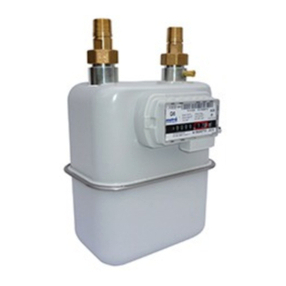
Electrical pulse output
WARNING
Risk of explosion in explosion-hazard areas!
– As a general rule, maintenance and repair work
should be avoided in explosive atmospheres.
– Check that the electrical system complies with
the special electrical explosion protection re-
quirements.
– When working on electrical equipment in an
explosion-hazard area, only design-approved
electrical operating equipment may be used.
– This pulse output is not suitable for metrolo-
gical testing purposes, but for monitoring the
consumption.
▷The generated pulses correspond to the values
shown in the technical data, see page 14
(Technical data).
▷
When gas consumption is higher than the output
can transmit its pulses, the pulses are buffered
and will be transmitted afterwards when con-
sumption is low.
Pin assignment:
Pin 1, 2, 4, 6: not connected
Pin 3: output +
Pin 5: output -
3
6
4
5
2
1
▷To connect the pulse output, use a socket type
IEC 60130-9.
Check test
Directive 2014/32/EU (MID) prescribes that it must
be possible to check the meter.
▷
The requirements and test methods must comply
with national laws and regulations.
▷
The following tests describe the check tests
which are carried out by accredited testing
agencies.
▷
Always conduct a pressure and temperature
correction in accordance with established pro-
cedures (unit under test against master meter).
▷
Measurement accuracy class, see page 14
(Technical data).
▷
The unit under test must be acclimatized and
installed on the test rig.
▷
Maintain the climatic conditions constant dur-
ing the entire test duration. Otherwise, the test
results will be inaccurate.
▷Immediately before commencing the test, pass
the quantity of test air, which corresponds to at
least 50times the cyclic volume of the unit under
test, through the meter at a flow rate of Qmax
(maximum flow rate of a gas meter).
▷
To conduct the tests, the thermowell and the
pressure test point (if available) can be used as
a reference for the temperature and pressure
measured by the index.
Cyclic test
The manual test is described below.
Legend
ΔtN= total master meter testing time in s
ΔtP= testing time of the unit under test in s
Qmax = maximum flow rate of a gas meter
Qmin = minimum flow rate of a gas meter
QN= flow on master meter in m³/h based on
the displayed volume VN
Qact,N = actual flow rate on master meter in m³/h
QP= flow determined on unit under test based
on VPin m³/h
VN= displayed volume on master meter in m³
Vact,N = actual volume having flowed through the
master meter in m³
VP= displayed volume on unit under test in m³
Value after C or U in display, depending
on device configuration and test method.
See test procedure below for further
details.
FN= error of the master meter in %
FP= error of the unit under test in %
pN= absolute pressure on the master meter in
mbar
pP= absolute pressure on the unit under test in
mbar
TN= absolute temperature on the master meter
in K
TP= absolute temperature on the unit under
test in K
tb= base temperature in °C
Vb= converted volume with reference to tb and
pb
pb= base pressure in mbar
Cyclic test at a constant flow rate
▷The test rig is in pre-trial operation.
▷Maintain the flow rate constant.
Test load and minimum test volumes for the test with
index readout:
Type
Qmax
in
m3/h
Cyclic
volume
in dm3
Test volume in dm3at
Qmin 0.2 Qmax Qmax
BK-G6 10 6 6 60 300
BK-G10 16 6 6 60 300
BK-G16 25 6 6 60 300
BK-G25 40 12 12 120 600
BK-G40 65 18 18 180 900
▷
The minimum test volumes are recommended
guide values. The measurement uncertainty of
the complete system (test rig plus unit under
test) must not exceed 1/3 of the maximum per-
missible error (MPE). The testing time must be
at least 10 s.