9
EN
Consult local laws and ordinances before choosing
a location to fly your aircraft.
We recommend flying your aircraft outside in calm
conditions. Always avoid flying near houses, trees,
wires and buildings. You should also be careful to
avoid flying in areas where there are many people,
such as busy parks, schoolyards or soccer fields.
For additional tips on flying, refer to the product
page at horizonhobby.com.
Hand Launching
When hand-launching your aircraft alone, hold the
aircraft in one hand and the transmitter in the other.
For first flights, glide to check the trim. Hold the
aircraft on the underside and throw the aircraft
directly into the wind, angled slightly up (5 to
10 degrees above the horizon). Once the trim is
adjusted, begin exploring the flight envelope of
the aircraft.
This aircraft may be launched side-arm, with or
without a full 360-degree discus launch. The aircraft
may be launched right- or left-handed. Grip the
wing with the end of the carbon rod between thumb
and forefinger. Avoid twisting your wrist and try to
keep your arm straight when launching.
Tip: In a computerized transmitter, program a mix
of elevator and/or rudder with launch flight mode
to get straight hand launches with your launching
style. Start with a 5% mix, then adjust upwards to
get to desired results.
Soaring
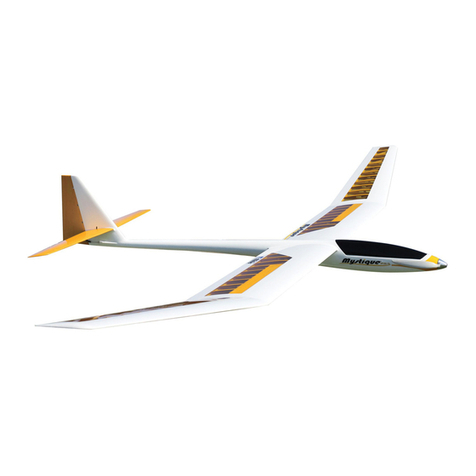
Your aircraft can ascend on thermals and other
updrafts to prolong its flight. There are many ways
to stay aloft with a sailplane, such as ridge lifts and
thermals. A thermal is simply a column of rising
warm air. Once you get your aircraft into the air,
watch your aircraft for a response to thermals.
If the airplane randomly rolls on its own, it is likely
that you only flew through the edge of the thermal,
causing one side of the airplane to rise, rather than
the entire airplane. Enter the thermal by turning
your aircraft directly into it, circling to stay in the
center of the thermal. Slow your forward speed by
increasing up elevator trim so that your aircraft is
moving just faster than stall (minimum sink speed).
Make easy banking turns to find the area of highest
lift (the thermal’s core).
When you find the core of lift, tighten your turns to
stay near this position. Sometimes thermals drift
downwind. It is best that you search for thermals
upwind, so that you can follow a thermal downwind
if it is pushed downwind.
With practice, you will find it easier to locate and
anticipate the movement of thermals. Although
thermals cannot be seen, you can see dust, insects
or birds riding an updraft. Air movement of a
thermal may be felt, so movement in an otherwise
calm spot may show you the location of a nearby
thermal. A shift in the wind (in a light breeze) can be
airflow into a thermal.
Landing
Make sure to land into the wind. Due to the high
lifting efficiency of the sailplane design, landing
requires a large landing area. While on your
downwind leg, remember that the sailplane glides
much better than other aircraft. You will need to
setup for landing lower and with a more shallow
descent than you may be used to. As you are
on approach for landing, ensure that the model
is descending slowly, but also not accelerating.
Maintain this descent and speed, and, as the model
nears the ground (approximately 6 inches (15 cm)),
slowly apply a small amount of up elevator.
NOTICE: Crash damage is not covered under the
warranty.
Repairs
Repair the aircraft using foam-compatible CA
(cyanoacrylate adhesive) or clear tape. Only use
foam-compatible CA, as other types of glue can
damage the foam. When parts are not repairable,
see the Replacement Parts List for ordering by
item number.
For a listing of all replacement and optional parts,
refer to the list at the end of this manual.
NOTICE: When you are finished flying, never leave
the aircraft in direct sunlight or in a hot, enclosed
area such as a car. Doing so can damage the foam.
Flying Tips and Repairs