Page 2 of 3
3940 Dr. Martin Luther King Drive
St. Louis, MO 63113
P/N 00911851 FORM NO. K0602 R03/04 ECO 8-030-017
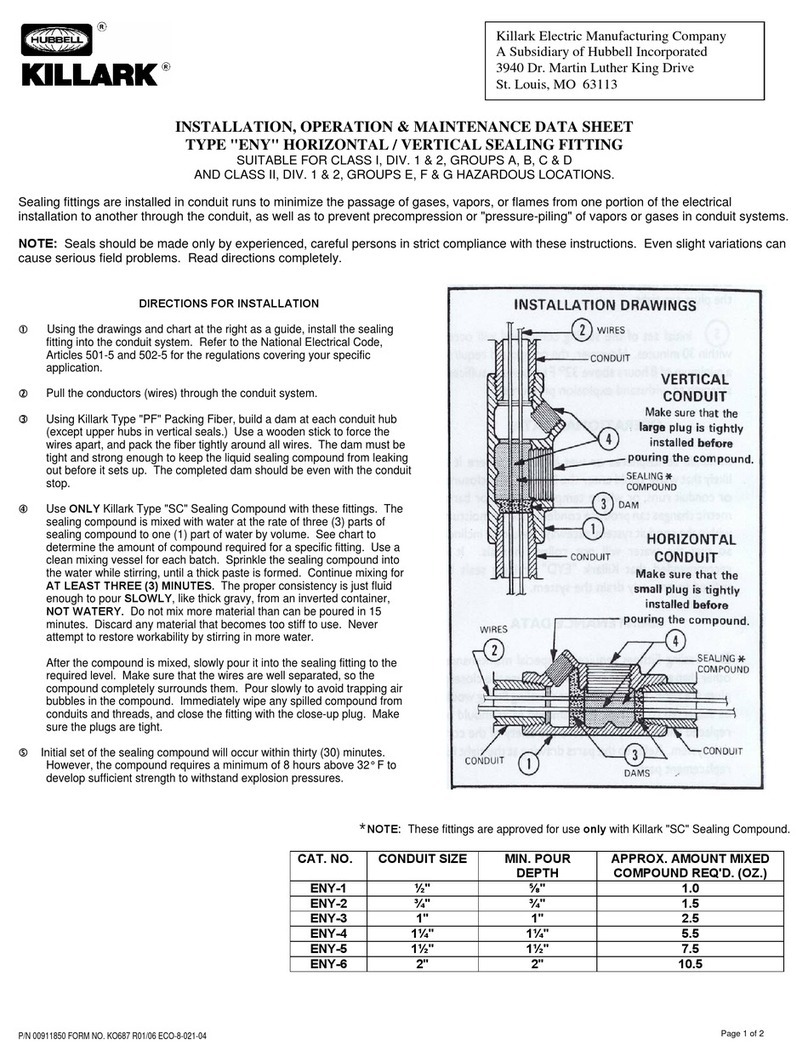
1. DIRECTIONS FOR INSTALLATION
Seals are installed in conduit runs to minimize the
passage of gases, vapours or ames from one
portion of the electrical installation to another through
the conduit; also, to prevent pre-compression or
“pressure-piling” of vapours or gases in conduit
systems.
Sealing ttings should be installed in the conduit
system in accordance with Articles 501-5 and 502-5
of the National Electrical Code.
Series EYS sealing ttings may be installed vertical
or horizontal in conduit runs. If used horizontal, the
tting must be positioned so that the cover is facing
upward. Remove cover and pour sealing compound
ush to the top of the cover opening.
Prepare the tting by separating the conductors and
making a dam to hold the uid sealing compound
with Killark type “PF” packing ber. Dams even with
the conduit stop are required in the lower hub vertical
ttings and both hubs of horizontal ttings. Pack the
packing ber tightly between the conductors and
between the conductors and the hubs. Use care so
as not to damage the conductor insulation. Be sure
to push any shreds of packing ber away from the
conductors to prevent leakage paths.
Use ONLY Killark Type “SC” sealing compound
with these ttings. The compound is mixed with
water at the rate of 3 parts of compound to 1 part
of water by volume. Chart A shows the amount of
compound required for your tting. Fittings with
fewer conductors will require more compound. Use
a clean mixing vessel for every batch. Sprinkle the
compound into the water while stirring, until a thick
paste is formed. Continue mixing for AT LEAST
3 MINUTES. The proper consistency is just uid
enough to pour SLOWLY, like thick gravy, from an
inverted container; NOT WATERY. Do not mix more
material than can be poured in 15 minutes. Discard
any material that becomes too stiff to use. Never
attempt to restore workability by stirring in more
water.
Slowly pour the uid compound into the sealing tting
to the level indicated in drawing. Be careful to pour
slowly so as not to trap air bubbles in the poured
seal. Immediately wipe off any spilled compound
and close the seal with the close-up plug or cover.
Initial set of the sealing compound will occur within
30 minutes, however, the compound requires a
minimum of 8 hours above 40o F to develop sealing
strength. Once fully cured, (min. 7 days) there is
no lower temperature limit to which “SC” could be
exposed.