manuals.online logo
Brands
  1. Home
  2. •
  3. Brands
  4. •
  5. Katronic
  6. •
  7. Measuring Instrument
  8. •
  9. Katronic KATflow 210 User manual

Katronic KATflow 210 User manual

Other Katronic Measuring Instrument manuals

Katronic KATflow 230 Instruction manual

Katronic

Katronic KATflow 230 Instruction manual

Katronic KATflow 150 User manual

Katronic

Katronic KATflow 150 User manual

Katronic KATflow 170 Quick guide

Katronic

Katronic KATflow 170 Quick guide

Katronic KATflow 170 Quick guide

Katronic

Katronic KATflow 170 Quick guide

Katronic KATflow 200 User manual

Katronic

Katronic KATflow 200 User manual

Katronic KATflow 150 Instruction manual

Katronic

Katronic KATflow 150 Instruction manual

Katronic KATflow 150 Instruction manual

Katronic

Katronic KATflow 150 Instruction manual

Katronic KATflow 230 User manual

Katronic

Katronic KATflow 230 User manual

Katronic KATflow 230 Instruction manual

Katronic

Katronic KATflow 230 Instruction manual

Katronic KATflow 200 User manual

Katronic

Katronic KATflow 200 User manual

Katronic KATflow 200 Instruction manual

Katronic

Katronic KATflow 200 Instruction manual

Katronic KATflow 200 Instruction manual

Katronic

Katronic KATflow 200 Instruction manual

Katronic KATflow 200 Instruction manual

Katronic

Katronic KATflow 200 Instruction manual

Popular Measuring Instrument manuals by other brands

Powerfix Profi 278296 Operation and safety notes

Powerfix Profi

Powerfix Profi 278296 Operation and safety notes

Test Equipment Depot GVT-427B user manual

Test Equipment Depot

Test Equipment Depot GVT-427B user manual

Fieldpiece ACH Operator's manual

Fieldpiece

Fieldpiece ACH Operator's manual

FLYSURFER VIRON3 user manual

FLYSURFER

FLYSURFER VIRON3 user manual

GMW TG uni 1 operating manual

GMW

GMW TG uni 1 operating manual

Downeaster Wind & Weather Medallion Series instruction manual

Downeaster

Downeaster Wind & Weather Medallion Series instruction manual

Hanna Instruments HI96725C instruction manual

Hanna Instruments

Hanna Instruments HI96725C instruction manual

Nokeval KMR260 quick guide

Nokeval

Nokeval KMR260 quick guide

HOKUYO AUTOMATIC UBG-05LN instruction manual

HOKUYO AUTOMATIC

HOKUYO AUTOMATIC UBG-05LN instruction manual

Fluke 96000 Series Operator's manual

Fluke

Fluke 96000 Series Operator's manual

Test Products International SP565 user manual

Test Products International

Test Products International SP565 user manual

General Sleep Zmachine Insight+ DT-200 Service manual

General Sleep

General Sleep Zmachine Insight+ DT-200 Service manual

Sensa Core Lacto Spark user manual

Sensa Core

Sensa Core Lacto Spark user manual

VOLTCRAFT UTS-1980 operating instructions

VOLTCRAFT

VOLTCRAFT UTS-1980 operating instructions

EBCHQ 94915 Operation manual

EBCHQ

EBCHQ 94915 Operation manual

Balluff BIP LD2-T017-01-EP-S4 Series user guide

Balluff

Balluff BIP LD2-T017-01-EP-S4 Series user guide

Pulsar IMP Lite Series instruction manual

Pulsar

Pulsar IMP Lite Series instruction manual

ETCR 6800 user manual

ETCR

ETCR 6800 user manual

manuals.online logo
manuals.online logoBrands
  • About & Mission
  • Contact us
  • Privacy Policy
  • Terms and Conditions

Copyright 2025 Manuals.Online. All Rights Reserved.



Integrated Clamp-On Ultrasonic Flowmeter

Operating Instructions
© Copyright Katronic Technologies Ltd. 2 19 | Katronic® and KATflow® are registered trademarks of Katronic AG & Co. KG.
Subject to changes without prior notice. All rights reserved. | Soware version: 5. 5-7565 | Issue: OI_KF21 _V2 EN_1911
Katronic Technologies Ltd.
Earls Court
Warwick Street
Coventry CV 5 6ET
United Kingdom
Tel. +44 ( )2476 714 111
Fax +44 ( )2476 715 446
E-mail info@katronic.co.uk
Web www.katronic.com

TABLE OF CONTENTS
TABLE OF CONTENTS
1 SAFETY INSTRUCTIONS, LEGAL REQUIREMENTS,
WARRANTY, RETURN POLICY 4
1.1 Symbols 4
1.2 Safety instructions 4
1.3 Warranty 5
1.4 Return policy 5
1.5 Legislative requirements 5
2 INTRODUCTION 6
2.1 Clamp-on transit-time flowmeter 6
2.2 Measuring principle 6
3 INSTALLATION 7
3.1 Unpacking and storage 7
3.1.1 Unpacking 7
3.1.2 Storage 7
3.1.3 Identification of components 8
3.2 Clamp-on sensor installation 9
3.2.1 Acoustic propagation 9
3.2.2 Straight pipe lengths 9
3.3 Installation location 1
3.4 Pipe preparation 12
3.5 Sensor mounting configurations
and separation distance 13
3.5.1 Reflection Mode 13
3.5.2 Diagonal Mode 13
3.5.3 Transducer separation distance 13
3.6 Flowmeter installation 14
3.6.1 Outline dimensions 14
3.6.2 Electrical connections 15
3.7 Clamp-on sensor mounting 15
3.7.1 Acoustic coupling gel 16
3.7.2 Correct positioning of the sensors 16
3.7.3 Sensor mounting with fixtures
and chains 17
4 OPERATION 18
4.1 Switching On/O 18
4.2 Battery charging 18
4.3 Keypad and display 19
4.3.1 Keypad key functions 19
4.3.2 Display icons and functions 21
4.4 Quick Setup Wizard 22
4.5 Measurement 25
4.5.1 Main process value display 25
4.5.2 Three-line display 25
4.5.3 Diagnostic display 25
4.5.4 Totaliser 26
4.5.5 Data logger 26
5 COMMISSIONING 27
5.1 Menu structure 27
5.2 Output configuration 35
5.2.1 Serial interface 36
5.2.2 Modbus RTU 36
5.2.3 HART® compatible output 37
5.2.4 Analogue current output /4 ... 2 mA 37
5.2.5 Analogue voltage output ... 1 V 38
5.2.6 Analogue frequency output (passive) 38
5.2.7 Digital open-collector output 38
5.2.8 Digital relay output 39
5.3 Input configuration 4
5.3.1 Pt 1 inputs 4
5.3.2 Analogue current input /4 ... 2 mA 4
5.4 Temperature compensation 41
5.5 Heat quantity measurement 41
5.6 Sound velocity measurement 41
5.7 Wall thickness measurement 41
5.7.1 Wall Thickness Gauge Wizard 42
5.8 Scope function 42
5.9 KATdata+ soware 42
6 MAINTENANCE 43
6.1 Service/Repair 43
7 TROUBLESHOOTING 44
7.1 Measurement diiculties and error messages 44
7.2 Data download diiculties 46
8 TECHNICAL DATA 47
8.1 Sound speed of selected pipe materials 47
8.2 Technical data of selected fluids 48
8.3 Dependence between temperature
and sound speed in water 51
9 SPECIFICATION 54
9.1 General 54
9.2 Flowmeter 54
9.3 Quantity and units of measurement 55
9.4 Internal data logger 55
9.5 Communication 55
9.6 KATdata+ soware 55
9.7 Process inputs 56
9.8 Process outputs 56
9.9 Clamp-on sensor: K1N 57
1 INDEX 58
11 APPENDIX A – Certificate of Conformity 59
12 APPENDIX B – Customer Return Note (CRN) 6
Operating Instructions KATflow 21 www.katronic.com 3/6


SAFETY INSTRUCTIONS, LEGAL REQUIREMENTS, WARRANTY, RETURN POLICY
1 SAFETY INSTRUCTIONS, LEGAL REQUIREMENTS, WARRANTY, RETURN POLICY
1.1 Symbols
Danger
This symbol represents an immediate hazardous situation which could result in serious
injury, death or damage to the equipment. Where this symbol is shown, do not use the
equipment further unless you have fully understood the nature of the hazard and have
taken the required precautions.
Attention
This symbol indicates important instructions which should be respected in order to
avoid damaging or destroying the equipment. Follow the precautions given in these in-
structions to avoid the hazard. Call our service team if necessary.
Call service Where this symbol is shown call our service team for advice if necessary.
Note This symbol indicates a note or detailed setup tip.
Operator key Operator keys are printed in bold typeface.
1.2 Safety instructions
•Do not install, operate or maintain this flowmeter without reading, understanding and following these operating in-
structions, otherwise injury or damage may result.
•Study these operating instructions carefully before the installation of the equipment and keep them for future refer-
ence.
•Observe all warnings, notes and instructions as marked on the packaging, on the equipment, and detailed in the oper-
ating instructions.
•Do not use the instrument under wet conditions with the battery cover removed or opened.
•Follow the unpacking, storage and preservation instructions to avoid damage to the equipment.
•Install the equipment and cabling securely and safely according to the relevant regulations.
•If the product does not operate normally, please refer to the service and troubleshooting instructions, or contact
Katronic for help.
4/6 www.katronic.com Operating Instructions KATflow 21
ESC

SAFETY INSTRUCTIONS, LEGAL REQUIREMENTS, WARRANTY, RETURN POLICY
1.3 Warranty
•Any product purchased from Katronic is warranted in accordance with the relevant product documentation and as
specified in the sales contract provided. This is subject to the condition that it has been used for the purpose for which
it has been designed and operated as outlined in these operating instructions. Misuse of the equipment will immedi-
ately revoke any warranty given or implied.
•Responsibility for suitability and intended use of this ultrasonic flowmeter rests solely with the user. Improper installa-
tion and operation of the flowmeter may lead to a loss of warranty.
•Please note that there are no operator-serviceable parts inside the equipment. Any unauthorised interference with the
product will invalidate the warranty.
1.4 Return policy
If the flowmeter has been diagnosed to have a problem, it can be returned to Katronic for repair using the Customer Re-
turn Note (CRN) attached to the Appendix of this manual. Katronic regret that for health and safety reasons we cannot ac-
cept the return of the equipment unless accompanied by the completed CRN.
1.5 Legislative requirements
CE Marking
The flowmeter is designed to meet the safety requirements in accordance with sound
engineering practice. It has been tested and has le the factory in a condition in which it
is safe to operate. The equipment is in conformity with the statutory requirements of the
EC directive and complies with applicable regulations and standards for electrical safety
EN 61 1 and electromagnetic compatibility EN 61326. A CE Declaration of Conformity
has been issued in that respect, a copy of which can be found in the Appendix of these
operating instructions.
WEEE Directive
The Waste Electrical and Electronic Equipment Directive (WEEE Directive 2 12/19/EU)
aims to minimise the impact of electrical and electronic goods on the environment by
increasing re-use and recycling and by reducing the amount of WEEE going to landfill. It
seeks to achieve this by making producers responsible for financing the collection, treat-
ment, and recovery of waste electrical equipment, and by obliging distributors to allow
consumers to return their waste equipment free of charge. Katronic oers its customers
the possibility of returning unused and obsolete equipment for correct disposal and re-
cycling. The dustbin symbol indicates that when the last user wishes to discard this
product, it must be sent to appropriate facilities for recovery and recycling. By not dis-
carding this product along with other household-type waste, the volume of waste sent to
incinerators or landfills will be reduced and natural resources will be conserved. Please
use the Customer Return Note (CRN) in the Appendix for return to Katronic.
RoHS Directive All products manufactured by Katronic are compliant with the relevant aspects of the
RoHS Directive.
Operating Instructions KATflow 21 www.katronic.com 5/6

INTRODUCTION
2 INTRODUCTION
2.1 Clamp-on transit-time flowmeter
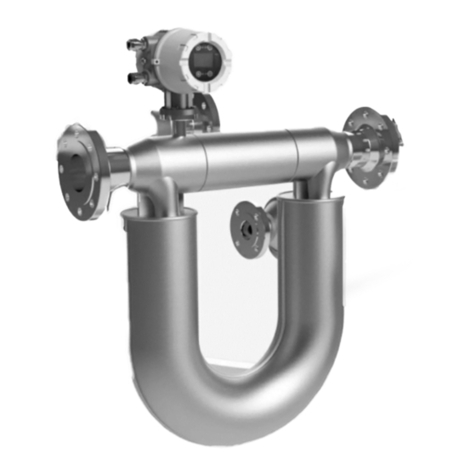
The KATflow 21 is a portable, battery operated ultrasonic flowmeter employing clamp-on sensors for the measurement
of liquids in full, enclosed pipes. Flow measurements can be undertaken without interruption of the process or interfer-
ence with the integrity of the pipeline. The clamp-on sensors are attached to the outside of the pipes. The KATflow 21
uses ultrasonic signals for measurement of the flow, employing the transit-time method.






Picture 1: Clamp-on ultrasonic flowmeter configuration
2.2 Measuring principle
Ultrasonic signals are emitted by a transducer installed on a pipe and received by a second transducer. These signals are
emitted alternately in the direction of flow and against it. Because the medium is flowing, the transit time of the sound sig -
nals propagating in the direction of flow is shorter than the transit time of the signal propagating against the direction of
flow. The transit-time dierence ∆t is measured and allows the determination of the average flow velocity along the path
of acoustic propagation. A profile correction is then performed to obtain the average flow velocity over the cross-sectional
area of the pipe, which is proportional to the volumetric flow rate.
Picture 2: Transit-time measuring principle
6/6 www.katronic.com Operating Instructions KATflow 21

INSTALLATION
3 INSTALLATION
3.1 Unpacking and storage
3.1.1 Unpacking
Care should be taken when opening the box containing the flowmeter, any markings or warnings shown on the packaging
should be observed prior to opening. The following steps should then be taken:
•Unpack the flowmeter in a dry area.
•The flowmeter should be handled with care and not le in an area where it could be subject to physical shocks.
•If using a knife to remove packaging care should be taken not to damage the flowmeter or cables.
•The flowmeter package and contents should be checked against the delivery note supplied and any missing items re-
ported immediately.
•The flowmeter package and contents should be checked for signs of damage during transport and any problems re-
ported immediately.
•The vendor accepts no responsibility for damage or injury caused during the unpacking of the instrumentation sup-
plied.
•Excess packing materials should be either recycled or disposed of in a suitable way.
3.1.2 Storage
If storage is necessary, the flowmeter and sensors should be stored:
•in a secure location,
•away from water and harsh environmental conditions,
•in such a way as to avoid damage,
•small items should be kept together in the bags and small plastic boxes provided to avoid loss.
Operating Instructions KATflow 21 www.katronic.com 7/6

INSTALLATION
3.1.3 Identification of components
The following items are typically supplied (please refer to your delivery note for a detailed description):
•KATflow 21 portable flowmeter,
•Fuse (removed for transport),
•Clamp-on sensors (usually one or two pairs depending on pipe sizes to be measured),
•Sensor extension cable(s) (optional),
•Sensor mounting accessories,
•Coupling component,
•Measuring tape,
•Operating instructions,
•Calibration certificate(s) (optional),
•Temperature measurement probe(s) (optional),
•Wall thickness measurement probe (optional),
•Connector lead for process inputs and outputs (optional).
8/6 www.katronic.com Operating Instructions KATflow 21

INSTALLATION
3.2 Clamp-on sensor installation
The correct selection of the sensor location is crucial for achieving reliable measurements and high accuracy. Measure-
ment must take place on a pipe in which sound can propagate (see Section 3.2.1 Acoustic propagation) and in which a ro-
tationally symmetrical flow profile is fully developed (see Section 3.2.2 Straight pipe lengths).
The correct positioning of the transducers is an essential condition for error-free measurements. It ensures that the sound
signal will be received under optimal conditions and evaluated correctly. Because of the variety of applications and the
dierent factors influencing the measurement, there can be no standard solution for the positioning of the transducers.
The correct position of the transducers will be influenced by the following factors:
•diameter, material, lining, wall thickness and general condition of the pipe,
•the medium flowing in the pipe,
•the presence of gas bubbles and solid particles in the medium.
Aer the sensor location has been selected, make sure that the supplied cable is long enough to reach the flowmeter
mounting location.
Check that the temperature at the selected location is within the operating temperature range of the transducers
(see Chapter 9).
3.2.1 Acoustic propagation
Acoustic propagation is achieved when the flowmeter is able to receive suicient signal from the transmitted ultrasonic
pulses. The signals are attenuated in the pipe material, the medium and at each of the interfaces and reflections. External
and internal pipe corrosion, solid particles and gas content in the medium contribute heavily to signal attenuation.
3.2.2 Straight pipe lengths
Suicient straight lengths of pipe on the inlet and outlet of the measuring location ensure an axi-symmetrical flow profile
in the pipe, which is required for good measurement accuracy. If insuicient straight lengths of pipe are available for your
application measurements are still obtainable, but the certainty of the measurement can be reduced.
Operating Instructions KATflow 21 www.katronic.com 9/6

INSTALLATION
3.3 Installation location
Select an installation location following the recommendations in Table 1 and try to avoid measuring:
•in the vicinity of deformations and defects of the pipe,
•near welding seams,
•where deposits could be building up in the pipe.
For a horizontal pipe:
Select a location where the transducers can be mounted on the side of the pipe, so that the sound waves emitted by the
transducers propagate horizontally in the pipe. In this way, the solid particles deposited on the bottom of the pipe and
the gas pockets developing at the top will not influence the propagation of the signal.
For a free inlet or outlet pipe section:
Select the measuring point at a location where the pipe cannot run empty.
For a vertical pipe:
Select the measuring point at a location where the liquid flows upward to ensure that the pipe is completely filled.
Table 1: Recommendations for sensor mounting location
Look for a sensor installation location with suicient straight pipe to obtain accurate measurements. Please refer
to Table 2 as a guideline for recommended distances from disturbance sources.
1 /6 www.katronic.com Operating Instructions KATflow 21