manuals.online logo
Brands
  1. Home
  2. •
  3. Brands
  4. •
  5. Korg
  6. •
  7. Synthesizer
  8. •
  9. Korg M-500 User manual

Korg M-500 User manual

Other manuals for M-500

2

Other Korg Synthesizer manuals

Korg M-500 User manual

Korg

Korg M-500 User manual

Korg Prophecy User manual

Korg

Korg Prophecy User manual

Korg 800DV User manual

Korg

Korg 800DV User manual

Korg VOLCA FM User manual

Korg

Korg VOLCA FM User manual

Korg Rythm KR-55 User manual

Korg

Korg Rythm KR-55 User manual

Korg microKORG Product information sheet

Korg

Korg microKORG Product information sheet

Korg Poly-800II User manual

Korg

Korg Poly-800II User manual

Korg MICROX X50 User manual

Korg

Korg MICROX X50 User manual

Korg Prophecy User guide

Korg

Korg Prophecy User guide

Korg DSM-1 User manual

Korg

Korg DSM-1 User manual

Korg prologue User manual

Korg

Korg prologue User manual

Korg MS2000 Product information sheet

Korg

Korg MS2000 Product information sheet

Korg EK-50 User manual

Korg

Korg EK-50 User manual

Korg DS-8 User manual

Korg

Korg DS-8 User manual

Korg modvawe User manual

Korg

Korg modvawe User manual

Korg MS-20 Kit User manual

Korg

Korg MS-20 Kit User manual

Korg X5D User manual

Korg

Korg X5D User manual

Korg MONOLOGUE User manual

Korg

Korg MONOLOGUE User manual

Korg Wavedrum mini User manual

Korg

Korg Wavedrum mini User manual

Korg wavestate User manual

Korg

Korg wavestate User manual

Korg Triton Studio User manual

Korg

Korg Triton Studio User manual

Korg MMT microKORG XL+ User manual

Korg

Korg MMT microKORG XL+ User manual

Korg PS60 Instructions for use

Korg

Korg PS60 Instructions for use

Korg Concert-5000 User manual

Korg

Korg Concert-5000 User manual

Popular Synthesizer manuals by other brands

Joranalogue Contour 1 user manual

Joranalogue

Joranalogue Contour 1 user manual

Full Bucket Music Mono/Fury manual

Full Bucket Music

Full Bucket Music Mono/Fury manual

Kawai PH50 owner's manual

Kawai

Kawai PH50 owner's manual

IK Multimedia UNO Synth PRO X user manual

IK Multimedia

IK Multimedia UNO Synth PRO X user manual

Kawai MP7 Software update

Kawai

Kawai MP7 Software update

Behringer DEEPMIND 12 quick start guide

Behringer

Behringer DEEPMIND 12 quick start guide

Roland Gaia SH-01 Quick guidebook

Roland

Roland Gaia SH-01 Quick guidebook

Roland GR-30 manual

Roland

Roland GR-30 manual

Gotharman Gotharman's anAmoNo-box user manual

Gotharman

Gotharman Gotharman's anAmoNo-box user manual

Yamaha DX21 owner's manual

Yamaha

Yamaha DX21 owner's manual

QuStream HDFS-550 Technical manual

QuStream

QuStream HDFS-550 Technical manual

Modal Electronics ARGON8 quick start guide

Modal Electronics

Modal Electronics ARGON8 quick start guide

Roland GS-500 instructions

Roland

Roland GS-500 instructions

Octave Cat SRM Service manual

Octave

Octave Cat SRM Service manual

Dreadbox Murmux Initiate manual

Dreadbox

Dreadbox Murmux Initiate manual

neutral labs ELMYRA 2 Build guide

neutral labs

neutral labs ELMYRA 2 Build guide

Waldorf KYRA user manual

Waldorf

Waldorf KYRA user manual

Tubbutec Juno-66 user manual

Tubbutec

Tubbutec Juno-66 user manual

manuals.online logo
manuals.online logoBrands
  • About & Mission
  • Contact us
  • Privacy Policy
  • Terms and Conditions

Copyright 2025 Manuals.Online. All Rights Reserved.

OWNER’S
MANUAL
m
®
K4
m
m
micro-preset
synthesizer
m-soo
5^t>fUb'nxf-yfiA,ncAT
F*w
ft**4R
icat^*\
emortv^F^Wr-?*«!£.
<\'B
*
a
>
-7
v<n«ft*«tc
«*
A
v
^
tr+t
<
*-C
*
rt
*
ft
*i
•JfltCtt->Tl'«*C3rtUrd
fUjr*.
<}&•#**«£
left**.
<n
a
ic
im
j:
n
r
%»
l
r
\.'*t.
i
->
z
ta.
s
ru&ixnr
♦
.
niHMc.
wt*
y
*r-#
t
TWV£rtc
f
m#j
<
0
*
^
flltt-IIC.t
>CLJ;A.I1.
C<n*s»/mifc<r>*B<oftftnOafc'J.
lun&vta
-
■
f
t
6
M
U
M
*
C
L
VT*
*>fr*>to.<rrC
1
*fc.
—icwM-c
v-i*tc>nff
-*«#*
*
C0)C£ttfffe*flllllC*A£iJ.
/Y<0
mLA'«tU'»,
rt«6*Kirjictilt<*
tt
*
n&t
vv
^
lYiift**
■
■
*<«**cu
>CV.'**.
c/jcl-
.
tkmnmpntmr.
v#.xrt**to£Amru*
«)*.*#,
Wft
:
<
r>tf\t»
*«•;-?*
_
y
<*f-t
v>tr*
f
«f-tDf»ttlAsA\.sA<Li»»A->-*fc'J*i»
.<*/
Krfi
F^t>)
<*fc.
/•
**#>.
A-rU*&*yK
i3-7i»>r>7i
-XJ-79-
CJJl/?2A*-
•
7JI/f
V
15,000).
#>ij
(3Jt?-2*r
V*A¥*.500)&£'fc*l'W|l;:IC
■
On
Synthesizers
Switch
on
the
radio
or
the
TV,
music
by
synthesizers
is
commonplace
not
only
in
music
programs
but
also
as
commercial
background
music
and
drama
theme
music.
You
could
say
that
we
are
surrounded
by
synthesized
sound.
Then,
why
has
the
synthesizer
become
so
popular?
In
a
word,
it
is
because
the
synthesizer
can
imitate
the
sounds
of
the
existing
musical
instruments
and
produce
unique
sounds
which
no
one
else
has
ever
used.
Generally,
the
synthesizer
is
a
monophonic
instrument
for
playing
melodics.
This
means
that
the
synthesizer
has
the
features
that
it
can
freely
change
tones
and
sounds,
and
continuously
change
tunes.
As
a
result
of
technological
progress,
a
polyphonic
synthesizer
capable
of
producing
chords
is
now
available,
through
at
a
very
high
price;
and
an
in¬
creasing
baricty
of
synthesizers
are
on
the
market,
(see
photo)
The
synthesizer
can
produce
sounds
by
connection
to
an
electronic
organ,
stereo
set
or
guitar
amplifier
(preferably
a
keyboard
amplifier).
And
the
effects
can
be
doubled
by
connecting
an
echo
machine,
phase
shifter
(KORG
Mr.Multi).
or
a
volume
pedal
(KORG
2
-
channel)
between
them.
(1)

d^u
try
h
<
v-f
PU
b
•
i/>t*»»
<
•>—tt.
V
*
T
I
v<n*
(
>**(*fr*.
7a«l
-iK—*tU,<
fli-vf)
r
*r-r*.
Y
»f
^A^na'AOfc.
^tnii
z
u^
vt
?a^u
tr
y
t-
u-f
<n
m
n
<*mhv
ft
«
*<ti
.tf
.
i
c
n
t
h
<o#A»c.fc
U*
Gfc
**c
*!,z,u*t
<
♦
/-Cdm^lRfVz';**/
t»'»v
:u,
M«<n
»f#>
*j
c.
ir&ai:
T
fc^
t
n'y7jt)tlf
ttf-6.1.
^t:.a4K'fcU*G*:.
♦
«*>
c
i»
>
t?
♦
#
-f
*f-ic«
<
<,n«»c
t.
jit-^
/<9o;'R->hv>f'i
fR-ic.t
i
c
wut'/v*
Ma
i
<>nufb,
Trt'fcfcit*tj«n^.iii
fctu
rtffj*Tf
fcftttft
i.aA^y-
?<
Vo^'/t'v
hu.
X
”Vil
bw?'i
t?
>v
h
t?
u
■
v
h
AY
-v
f4M
ULffKiU
t'J
-f't
f-y
b
A«n
*
-y
-9
x/ZCtf
*
4
cf>fcahUt*<r>
>0
tz-a
hVVf**
<
f-tU4l'
*f*JU
Ail'J/Mtt
C*4
.
>.*.<*»<
b
9
A
9
-
,tj;j
u-
1
-
3
i*
r
^X.zKA-V
A
>b
>
4
r^ihibic
f
fit
rn
AC
urn*
rtf
-&«nu
g
j"t»h«na'*<
3.MWKO
I
Cftc
l
>
Cd-V.
4»W£-«S
jfefctMC
^«*HIL.
C
A*;,
b*
VU-
l<4«
r«
4.3A/^
?T
?d
A'itr-v
hU.
WAfvflONUm
-wnri--
>yfci»r.
*icii
ut'Aiv
r«i#rtf
*•<
«
f
4
«,#1VV>
*<'!<*»,!.
0414
*c,Ler>in,s.
■
?•)(?»
ha^tx**
*f-iz
x
.
r#*ict»<»;
«*.
Xi
■
Main
Features
ll
K
a
revolutionary,
compact
synthesizer
itui
can
Ik
used
b>
a
wide
range
of
musk
lovers
from
amatcm
electronic
organ
players
lo
professional
Keyboard
ariisiv
li
has
long
been
hclicscd
that
ii
is
difficult
and
complex
to
play
a
synthesizer,
The
new
KORG
Mtcro^preset
synthesizer
is
not
only
simple
loplay
but.
thanks
to
1C
technology,
has
all
the
functions
of
a
synthest/rr
in
compact
form.
With
ihe
belief
that
knobs
on
the
operation
panel
of
a
synthesizer
arc
part
of
the
keyboard,
we
hase
designed
the
operation
panel
to
be
as
compact
as
possible
so
that
the
player
may
be
able
to
operate
all
the
knobs
with
little
need
of
moving
his
hand,
we
are
sure
that
you
will
be
fully
satisfied
with
the
sounds
you
produce
with
this
new
KORG
Micro-preset
svnthcsizcr
Main
Features
I
This
KORG
Micro-preset
Synthesizer
can
mix
preset
sounds
by
means
of
depressing
more
than
two
preset
select
switches
at
the
same
time.
This
means
that
it
can
produce
a
greater
variety
of
sounds
than
the
conventional
preset
type
synthesizer.
2.
Such
effect
knobs
as
TRAVELER.
MODULATION
DEPTH
and
PORAMKNTO
are
located
together
in
the
lower
part
of
the
panel
so
they
out
be
operated
freely
with
the
left
hand
alone.
3.
The
new
KORG
Micro-preset
synthesizer
is
small
in
size
and
light
in
weight
because
its
circuitry'
consists
of
ICs.
This
enables
you
to
play
the
synthesizer
in
a
standing
posture
by
hanging
it
from
your
shoulder
with
a
strap.
4.
Once
the
KORG
Micro-preset
is
tuned
after
a
is
switched
ON.it
is
ready
for
playing
in
tunc
always.
This
is
very
important
for
a
synthesizer
which
is
often
played
with
an
electronic
organ
or
other
musical
instruments,
but
there
have
been
few
synthesizer
which
meet
this
condition.
2
)
■
Operation
Panel
Description
■
Effect
of
Switches
Power
Switch:
tuning
ihe
knob
dockwne
wilt
the
power
oo
and
mercate
volume
pilot
lamp
will
light.
Pilch:
Portamento:
Portamento
Switch:
Traveler:
Adjuti
the
pitch
for
tuning
with
other
inttrumcnii.
One
note
on
the
keyboard
can
be
cotuinuoutly
connected
with
the
next
one
pUvrd
If
It
it
used
long,
art
unrealistic
tone
it
produced;
and
if
it
it
uted
thort.
it
can
effect
r»rty
produce
(he
coundt
of
the
trombone
or
vtohn
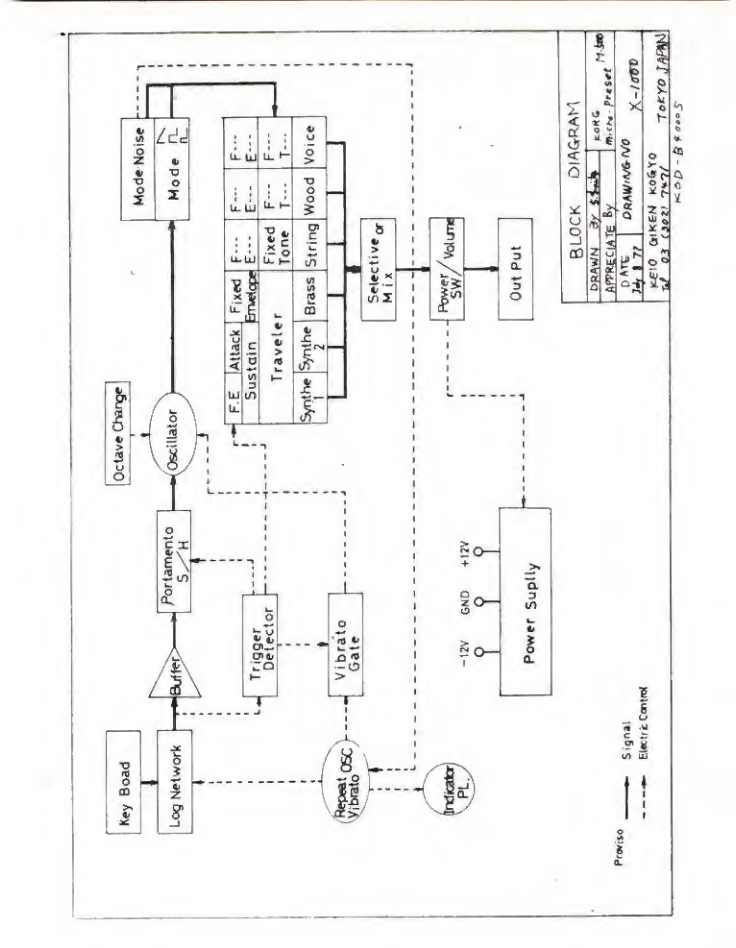
lantlCVTMY
PORTAMENTO
effect
conltmict
at
long
at
thit
twitch
it
an,
bwi
censes
when
n
it
I
relented.
□
PORTAMENTO
doet
not
work
at
ilie
V
center
portion,
Hiarturxm
«t\
PORTAMENTO
effect
ttays
on.
A
wide-range
tone
control
knob
whtch
workt
onl)
with
SYNTHI
».
SYNTME-2
and
BRASS
It
perm.ic
unre
alivtK
tonal
changet
peculiar
to
a
tyniheti/cr.and
fine
bratt
etpretuont.
Standard
tone
at
the
center
potition.
Vibrato
Switch
Modulation
Depth:
raavti-
A
tpecial
vibrato
effect
umiUr
to
the
vbmato
tont
produced
when
the
TRAVELER
knob
it
moved
to
the
right
and
lefe.
Workt
only
wnh
SYNTHE-I,
STNTHt-2.
C
a
nd
BRASS
VIBRATO
doer
not
work
at
the
center
position
v***To.Change
the
tntervaU
periodically
to
make
the
sounds
etpeessive.
Depress
the
key,
and
Vibrato
workt
thonly
Later
Control
knob
for
adjusting
the
DEPTH
of
vibrato
and
travel
vibrato.
Repeat
Switch:
Modulation
Rate
Attack:
Sustain
s
tvtioM-A
non-cycfic
repeal
Is
obtained
at
the
atrEAT
tpeed
elected
with
the
MODULATION
O
R
ATE
knob.
-REPEAT
does
not
work
at
tht
center
poaition
■
MAT
A
tound
it
repeated
periodically.
Control
knob
foe
adjusting
the
speed
of
VIBRATO,
TRAVEL
VlBRATO.RFPEATand
RANDOM
REPEAT
Control
knob
for
adjusting
attack
time.
Works
only
wttb
SYNTHE
2
Control
knob
foe
adjusting
after
sound
duratton.
Works
only
with
SYNTHE-I
and
SYNTHE-2.
■
Preset
Note
•yrithe
I
•ynthe
2
■
PRESET
NOTES
BRASS
Saw-Tootli
IV
wir
rftret
at
TRAVtl
1
R
im*
it
prudiKtO
in
durst
t*«r*Niiun
•o
MHiml
nam
it
tputd
rlkvtl
STRING
Saw-Tonilt
W«k
tilth
itiavr
of
lone.
ihr
dewed
rffctt
n
puvJucrd
h>
ifciivi<v
mack
WOOD
Square
fAjutrd
to
|wuSui.t
ihc
tone
rsvulcu
in
ihr
trvpcvuic
nn—nlv
llUtfln
rflntl
VOICE
|
Saw-Tooth
tmh
lunr
ihr
lo
i«
period,ihr
mar
return*
Iron*
a
hulc
doun
kvrl
Hi
wrmal
IPiicti
Brad
effect
1
(
6
)
■
Before
Use
I.
Avod
using
ihe
Inurnment
new
a
healer
or
a
wove.
and
keep
ii
away
from
exposure
10
direct
sunlight,
much
moisture,
dust
and
vibration.
mmturn
X9-y^-JX>
PAi/X7
A(0**<V«LOW*/jKitUrk'*<
.
+
v-AKn-
\'m*<r>r*-J9-
«.
tf'J
TJd<n*»rP^
^*IC«*L
CT*V'.
2.
Avoid
using
it
new
a
neon
lamp,
fluorescent
light,
transformer,
or
mo*or
because
the
synthesizer
may
pick
up
noise.
■
Connecting
Method
To
use
ihe
Micro-preset,
it
must
be
connected
10
an
electrical
outlet.
Connect
the
power
cord
from
tlic
rear
panel
into
an
electrical
outlet.
Then
connect
that
end
of
the
accessory
shielded
cord
which
has
no
adapter
to
the
rear
panel's
out
jack.
Connect
it
to
the
H
(high)
jack
in
case
of
using
an
electronic
organ
or
stereo
amplifier:
t>r
to
the
L
flow)
jack
in
case
of
using
a
guitar
amplifier
or
a
PA
system
amplifier.
When
connecting
it
to
an
amplifier
hasing
a
pin
connector,
remove
the
adapter
from
the
shielded
cord
end.
and
use
tlic
pin
plug
on
the
cord
end.
When
using
the
volume
pedal,
connect
the
pedal
and
then
connect
it
to
an
amplifier
in
tlic
manner
mentioned
below
.
■
T
>
~7
&
£*
t
■
Examples
of
connection
to
amplifier,
etc.
(
7
)
■
u
-
w
rn
*
:
P
-
C
-12M
-
;
aa
m
k
«
*
■
M
A
IT
a
t>
V
J
-f
A.
Asm
b
»
<
X
XH-V+
'.Mi*
»•
I-
i
*
»-
•It—h
tofts')
t-l*
4iH/V>>»*
t.
>
■
>
*
•
>
4kH-VA>l-
a>f
a—
*
—
I*')
i-Aivi
At
-v
r
t-*n>
m
«u
At
-v
V
J
>1*11-
It,
•Ml
/
>3
>
1
-11
Hi
Lilt
>
•>
At
K
I
>1*11
-
It
41
*1/
V
A
>
I-
I
>
t*
11
Hi
tV
l
li
4
>
»
-V
/A3i-1*0--
Hf
*
*>
«fc
'
\
<
11
•/(*
•'
I—
-
.
i
>
tl
»•
f
:
t
tu
fi
COI-
MM
i
V
I*
•
I*
JftljOt:
V,
mKIIKI
f
•"Vh
Ml**
0.3VP-P
•
:>KUVi
h
i
'4-v
h
«
J*
:
looV
so
iiallf
t
a
—X
:
o.
2
<
23
oVA)
*
A
O
i|l730x
«Hr2iox
■
&
:
4.9
Kg
mm*
««ta-
h
juttftT
t
NEW
SOUNDS
wi«k
KORG
*
h
♦
o
r
:
•
it
■
t
•
n
•
O
•
..*«
■
.
•
»
»
»
m*
«•
-
n.
KEIO
ELECTRONIC
LABORATORY
CORP.
TOKYO.
JAPAN
OWNER
S
MANUAL
am
micro-preset
spumta-M-soosp
IMPORTANT
■
The
wires
in
the
mains
lead
fitted
to
this
equipment
are
coloured
coded
as
follows:
BLUE
-
NEUTRAL
BROWN
-
LIVE
GREEN/YELLOW
-
EARTH
You
are
advised
to
fit
a
3-pin
plug
to
the
lead,
wiring
the
BLUE
wire
to
the
NEUTRAL
terminal
marked
M
N"
in
the
plug,
the
BROWN
wire
to
the
UVE
terminal
marked
“L",
and
the
GREEN/YELLOW
wire
to
the
terminal
marked
by
the
letter
“E”
or
by
the
safety
Earth
symbol
-A-
.
The
plug
must
incorpo¬
rate
a
3amp
fuse.
WARNING
-
This
apparatus
MUST
be
earthed!
■
HOW
TO
USE
THE
MICRO-PRESET
WITH
BUILT-IN
SPEAKER
M-500SP
1)

A
compact
amp
and
speaker
are
built
right
into
the
M-SOOSP
so
you
can
play
it
anytime
by
just
plugging
in
the
power
cord.
Output
is
600mW
so
you
have
plenty
of
volume
for
performance
even
without
an
external
amp
See
figure
I.
2)
To
listen
to
the
M-SOOSP
with
headphones,
plug
the
headphones
into
the
headphone
jack.
When
headphones
are
plugged
in.
the
speaker
is
auto¬
matically
switched
off.
See
figure
2.
For
best
results,
be
sure
to
use
head¬
phones
rated
at
8ft.
3)
Use
the
connecting
cord
supplied
to
attach
external
amplification
equip¬
ment.
as
described
on
page
7.
However,
for
the
model
M-SOOSP.
only
con¬
nect
the
cord
to
the
rear
panel
socket
marked
“High”.
KEIO
ELECTRONIC
LAB..
CORP.
Tokyo.
Japan
ft*
urtM