Model 2221 Portable Scaler Ratemeter
March 2016
page 4
4. OPERATING PROCEDURES
4.1 Initial Preparation
●Unscrew battery door latch.
●Install 4 "D" size batteries in the battery
holder. The correct position of the
batteries is indicated on the bottom of
the battery door.
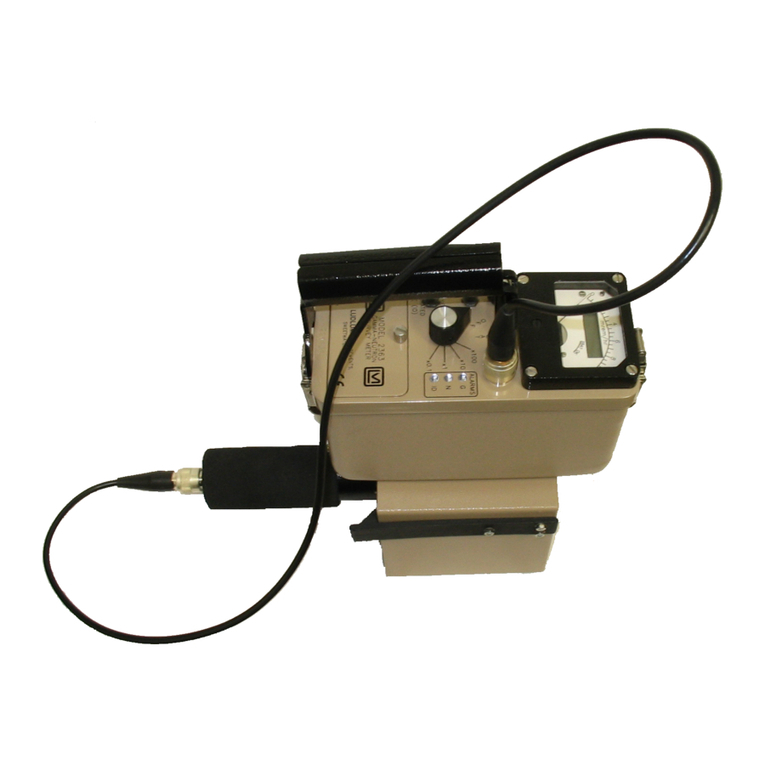
●Switch the POWER ON/OFF switch to
the ON position. A random number
will first be observed in the display,
then 8.8:8.8:8.8. The third displayed
number will be the program version.
(At the time of this printing, program
version is #261010.)
●Press COUNT pushbutton. The display
should zero. Two sets of colons should
appear on the display.
●Press HOLD pushbutton. The colons
should disappear.
●Switch LAMP toggle switch to the ON
position. LCD display backlighting and
two lamps at the bottom of the analog
meter should be illuminated.
NOTE: If the Lamp switch is left in the ON
position for extended periods of time,
battery life will decrease rapidly.
●Check TEST pushbutton functions for
proper operation.
4.2 Operating Point
Instrument and detector operating point is
established by setting the probe voltage
(HV) and instrument sensitivity (THR). For
a given detector system, efficiency,
background and noise are fixed by the
physical makeup of the detector and rarely
vary from unit to unit. However, the
selection of the operating point makes a
marked difference in the apparent
contribution of these three sources of count.
In the singular case of the GM detector, a
minimum operating voltage is required to
establish the GM operating region. (At
lower voltages, the detector operates as a
very insensitive proportional counter.) This
detector is not capable of energy dis-
crimination (pulse-height discrimination).
The threshold (THR) is typically adjusted to
550, with a THR reading of 100 = 10 mV
input pulse for GM detectors.
For gain sensitive detectors (proportional or
scintillation), the most straightforward
method of selecting the operating point is to
develop a graph, relating count rate to
system gain. This relationship is commonly
referred to as a plateau or instrument
plateau curve. System gain may be
changed by adjusting detector high voltage
or THR control. The threshold is typically
adjusted for 100 = 10 mV for scintillation
detectors and 50 (5mV equivalent) on the
THR readout for proportional detectors.
4.3 Limitation of Controls
HV Control provides a linear adjustment of
the detector voltage supply. The range is
approximately 400 to 2400 volts. Changing
the detector voltage will cause the detector
gain to change. It should be remembered
that a linear change in voltage will cause an
exponential change in detector gain. THR
Control sets the basic pulse discrimination
point of the scaler.
WIN Control is calibrated with the THR
control so that the reading of the WIN
control is equivalent to the reading of the
THR control.
As an example, 100 on the THR is equal to
100 on the WIN.