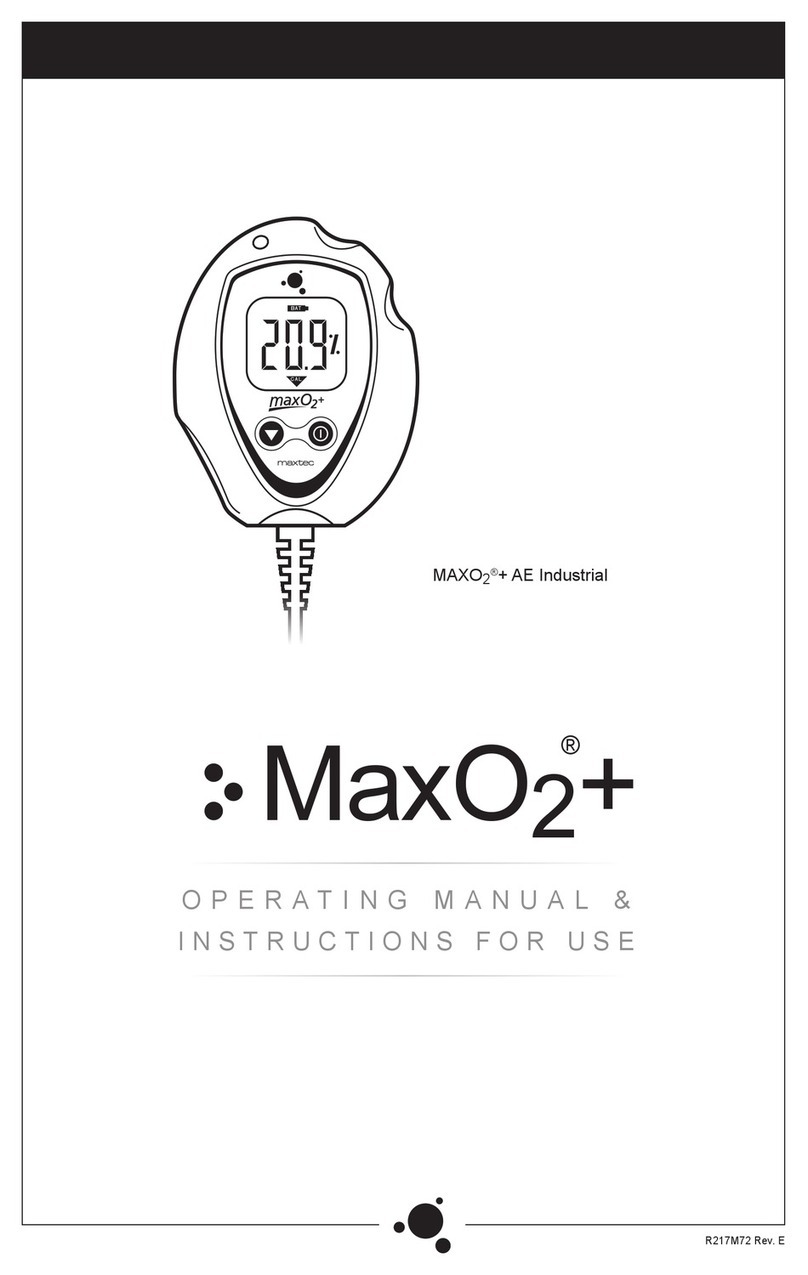
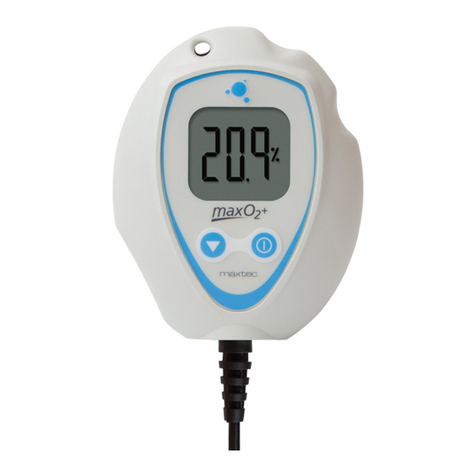
II 866.4.Maxtec www.maxtec.com
WARNINGS
Indicates a potentially hazardous situation, if not avoided, could result in death or serious injury.
»Never install the sensor in a location that will expose the sensor to patient’s
exhaled breath or secretions, unless you intend to dispose of the sensor, flow
diverter and tee adapter.
»
Improper use of this device can cause inaccurate oxygen readings which can lead to
improper treatment, hypoxia or hyperoxia. Follow the procedures outlined in this user manual.
»Not for use in an MRI environment.
»Device specified for dry gas only.
»Never allow an excess length of tubing, lanyard or sensor cable near the patient’s head or
neck, which may result in strangulation.
»Before use, all individuals who will be using the MAXO2+ must become thoroughly
familiar with the information contained in this Operation Manual. Strict adherence to the
operating instructions is necessary for safe, effective product performance.
This product will perform only as designed if installed and operated in accordance with the
manufacturer’s operating instructions.
»Use only genuine Maxtec accessories and replacement parts. Failure to do so may seriously
impair the analyzer’s performance. Repair of this equipment must be performed by a qualified
service technician experienced in repair of portable hand held medical equipment.
»Calibrate the MAXO2+ weekly when in operation, or if environmental conditions change significantly.
(ie, Elevation, Temperature, Pressure, Humidity — refer to Section 3.0 of this manual).
»Use of the MAXO2+ near devices that generate electrical fields may cause erratic readings.
»If the MAXO2+ is ever exposed to liquids (from spills or immersion) or to any other physical
abuse, turn the instrument OFF and then ON. This will allow the unit to go through its self test to
assure everything is operating correctly.
»Never autoclave, immerse or expose the MAXO2+ (including sensor) to high temperatures
(>70°C). Never expose the device to pressure, irradiation vacuum, steam, or chemicals.
»This device does not contain automatic barometric pressure compensation.
»Although the sensor of this device has been tested with various anesthesia gases including nitrous
oxide, Halothane, Isoflurane, Enflurane, Sevoflurane and Desflurane and found to have acceptably
low interference, the device in entirety (including electronics) is not suitable for use in the presence
of a flammable anesthetic mixture with air or with oxygen or nitrous oxide. Only the threaded
sensor face, flow diverter, and “T” adapter may be allowed to contact such a gas mixture.
»NOT for use with inhalation agents. Operating the device in flammable or explosive atmospheres
may result in fire or explosion.
CAUTION: Indicates a potentially hazardous situation, if not avoided, could result in minor or
moderate injury and property damage.
»Federal Law (USA) restricts this device to sale by or on the order of a physician.
»Replace the batteries with recongnized high quality AA Alkaline or Lithium batteries.
DO NOT use rechargeable batteries.
»If the unit is going to be stored (not in use for 1 month), we recommend that you remove the
batteries to protect the unit from potential battery leakage.
»The Maxtec MAX-250 oxygen sensor is a sealed device containing a mild acid electrolyte, lead
(Pb), and lead acetate. Lead and lead acetate are hazardous waste constituents and should be
disposed of properly, or returned to Maxtec for proper disposal or recovery.
DO NOT use ethylene oxide sterilization.
DO NOT immerse the sensor in any cleaning solution, autoclave or expose the sensor to high
temperatures.
» Dropping sensor can adversely affect its performance.
»The device will assume a percent oxygen concentration when calibrating. Be sure to apply
100% oxygen, or ambient air concentration to the device during calibration or the device will not
calibrate correctly.
NOTE: This product is latex free.