8.
For additional clarity, use the left eye diopter adjustment to correct the
differences between the user’s eyes. Set the adjustable left eye
diopter at zero. Then focus with the coaxial focusing knob, using your
right eye only (close your left eye). Now using your left eye only,
adjust the diopter ring until a clear image is seen (close your right
eye). The diopter adjustment is now set to the user’s eyes and will not
need to be adjusted again until a different user uses the microscope.
9.
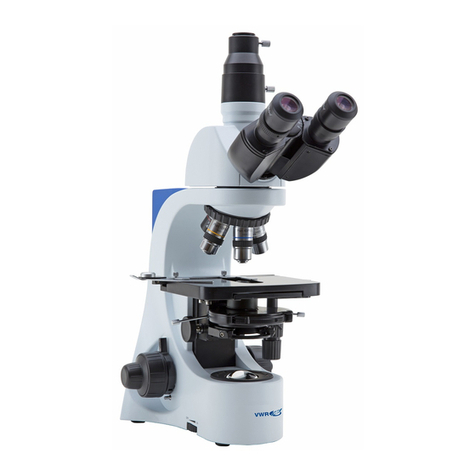
Now you can rotate the nosepiece to higher magnification objectives.
The objectives are parfocaled so that once the lowest objective (4XD)
is focused, only a slight turn of the fine focusing knob is required
when changing to 10XD, 40XRD and 100XRD objectives.
CENTERING THE CONDENSER
1. Fully open the field of view diaphragm and condenser aperture diaphragm.
2. Set the specimen on the stage with the cover glass facing up.
3. Bring the specimen image into focus, using the 10X objective.
4. Close the field of view diaphragm to its minimum setting by means of the
field diaphragm ring.
5. Turn the condenser focus knob to bring the field diaphragm image into
focus on the specimen plane.
6. Adjust the condenser centering screws so that the image of the field
diaphragm appears at the centre of the field of view. At this time, stopping
the field diaphragm image, just short of the maximum field of view, may be
convenient for centering.
7. Adjust and centre the field diaphragm so that it is just outside the field of
view for each magnification change.
USE OF FIELD DIAPHRAGM
1. The field diaphragm determines the illuminated area on the specimen.
Rotating the field diaphragm ring changes the size of the field diaphragm.
For normal observation, the diaphragm is set slightly larger than the field
of view. If a larger than required area is illuminated, extraneous light will
enter the field of view. This will create a flare in the image and lower the
contrast.
2. The thickness of the glass slide must be 1.7mm or less, otherwise the field
diaphragm may not be focused on the specimen plane.
3. The diaphragm does not have any effect when the condenser top lens is
swung out of the optical path in the Swing-out type condenser. Fully open
the field diaphragm, as the N.A. of the illuminating system will be reduced
if the diaphragm is excessively stopped down.