EN
English – 2
and then continue with the installation.
- If the diameter equals 48 mm (optional), apply the adapters (optional) not
supplied (g. 6 and 7) and then continue with the installation.
05. Position the gearmotor in the spring shaft and block it with the aid of the
collar (g. 8).
06. Tighten the central grain (M10) making it pass through the hole made previ-
ously in the spring shaft (point 01), see g. 9.
07. Secure the gearmotor to the spring shaft by screwing the two external
grains (M10); then, lock all three grains with the nuts (g. 9).
08. Make a hole on the spring support shaft, to allow for the cables to pass
through it (g. 10).
for one way versions for reversible versions
09.
Thread the power supply cable
and the manual release cable
through the hole.
09. Thread the power supply cable
through the hole and go straight
to point 13
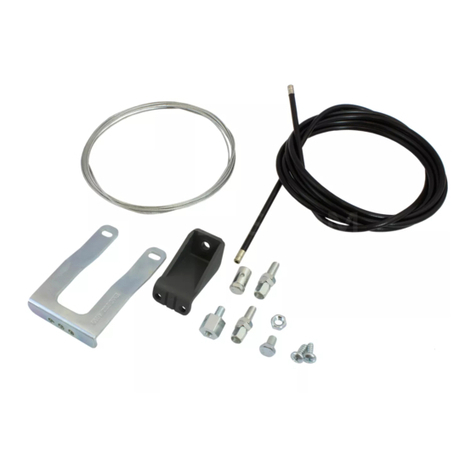
10. Then, insert the steel cable for the
manual release, into the holder
provided, by passing the terminal
through the inside of the spring
(fig. 11); then, remove the ring
andthenreinsertit.Forthever-
sion with two motors, connect the
terminal of the release cable to the
springasindicatedinthegure.
11. Assemble the release knob with all the adjustment knobs tightened (A) g.
12; then, insert the cable and, keeping it powered, lock it with the terminal
(B) g. 12.
12. Perform the manual release manoeuvre: unscrew the lower knob clockwise
(g. 13); manually check that the gearmotor is released. If necessary, act
on the adjustment knobs to eliminate the excess space.
13. Manually check that the gearmotor is released. If necessary, act on the
adjustment knobs to eliminate the excess space.
14. Slightly grease the teeth of the small semi-bush previously disassembled
(point 02) and assemble the two screws (M8), tightening them completely
(g. 14). Assemble any external adapter on the semi-bush, as in point 04.
15. Make the electrical connections as shown in g. 15.
16. On the highest part of the rolling door, make a hole with a diameter of 11
mm and secure this part in the external hole of the gearmotor g. 16.
17. Lock down the canvas of the rolling door to the gearmotor using the screw
(M10) and washer (g. 16).
3.4 - Limit switch adjustment
01. Carry out the manual release manoeuvre by unscrewing the lower knob
clockwise (g. 13) then, manually make an opening and closing manoeu-
vre of the rolling door; check that the latter follows a route with a regular
and silent movement.
02. (only for one way versions) Lock the gearmotor by tightening the lower
knob anti-clockwise (g. 18).
03. Power the gearmotor and make an opening manoeuvre; check that the rolling
doorstopsatthepointdesired.Forgreaterprecision,actontheadjusting
rollers (g. 18). The arrow indicates the direction of the rotation (the +symbol
indicates an increase in the stroke).
04.Continuebymakingvariousattemptstondthedesiredposition.
3.5 - (only for one way versions) Manual lock and release
procedure
Important! - The manual lock and release manoeuvres of the gearmotor must
be carried out only with the gearmotor completely stopped.
Manual operation must be carried out only in case of power failure, system mal-
functions or if expressly requested in the text of the instruction manual.
Releasing the gearmotor:
01. Loosen the lower part of the knob clockwise until you feel a certain resist-
ance (g. 13);
02. Manually open or close the rolling door.
Locking the gearmotor:
01. Tighten the lower part of the knob anti-clockwise until you feel a certain
resistance (g. 17).
Important! - If, after release of the motor, the shutter is moved manually and
the thresholds already set for adjusting the limit switch are exceeded, these will
be updated automatically with the new positions.
3.1 - Preliminary checks for installation
Warning! - The installation of the motor must be carried out by qualied
personnel, in compliance with current legislation, standards, regula-
tions and these instructions.
Beforestartingtheinstallation,makethefollowingchecks:
•Checktheintegrityoftheproductcomponentsassoonastheyaretakenout
of the package.
•Checkthesuitabilityofthemotorselectedbycomparingitsnominaltechnical
characteristics with the technical characteristics of your rolling door; therefore,
DO NOT install the motor if its characteristics (nominal torque, rotation
speed and operation time) are not suitable to drive your rolling door. In
particular, the motor torque MUST NOT EXCEED the one required to
move the rolling door.Additional limitations on use are contained in the sec-
tion “Technical characteristics”.
•Incasesofoutdoorinstallation,makesurethemotorisadequatelyprotected
against atmospheric agents.
•Checkthattherollingdooriswellbalanced:i.e.itmustnotmoveifleftsta-
tionary in any position.
•Checkthattherollingdoordoesnothavepointsofincreasedfriction,during
both the closing and opening movement.
•Checkthattherollingdoorfollowsaroutewitharegularandsilentmovement
during its travel.
•Checkthattheinstallationareaiscompatiblewiththesizeofthemotorg. 1.
•Onthepowerlinetothesystem,installadevicefordisconnectionfromthe
power mains with a gap between contacts that assures complete disconnec-
tion in the conditions of overvoltage category III.
3.2 - Installation preparation works
Fig. 2 shows an example of an automation system set up with Nice components:
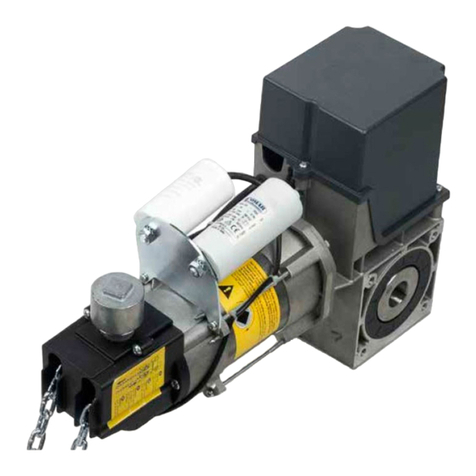
a- Giro gearmotor
b- Junction box
c- Release knob (only for one way versions)
d- Control inverter or electronic control unit
e- Electrical power line
f- Spring box
Thesecomponentsarepositionedaccordingtoatypicalandusuallayout.With
reference to g. 2, establish the approximate position where each component
included in the system will be installed. Important–Beforetheinstallation,
prepare the electrical cables necessary for your system, see g. 2.
3.3 - Installation of the gearmotor
WARNINGS
• An incorrect installation may cause serious injury to the person who
carries out the work and the people who will use the system.
• Before starting to assemble the automation, carry out the preliminary
checks described in paragraphs 3.1 and 3.2.
01. Completely close the rolling door to make the spring shaft accessible; make
a through hole with a 9 mm diameter on it (g. 3).
02. Remove the small semi-bush by unscrewing the two M8 screws (g. 4)
and remove the collar underneath (g. 5).
03. Measure the diameter of the spring boxes:
- if the diameter equals 200 mm, continue with the installation.
- if the diameter equals 220 mm or 240 mm (optional), use the suitable
adapter g. 6.
200 mm
240 mm
220 mm
V 10x30
V 10x20
V 10x40
V 10x30
200 mm 220 mm 240 mm (optional)
V 10x20
04. Measure the diameter of the spring shaft:
- If the diameter equals 76 mm, continue with the installation.
- If the diameter equals 60 mm, apply the adapters supplied (g. 6 and 7)
INSTALLATION
3
to the related instruction manual. KIO, key-operated selector switch with chain
release. Adapters for spring box of 240 mm, spring shaft with diameter of 48 mm.