10
English
Introduction
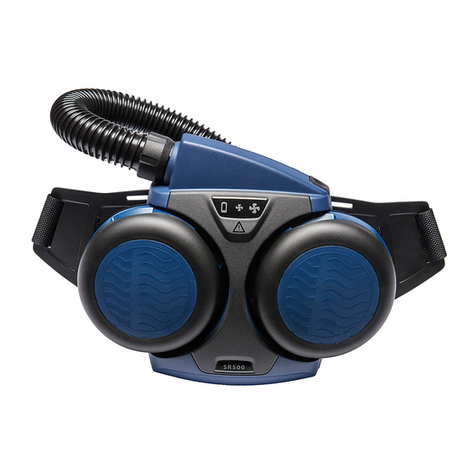
A blower lter unit supplies an approved mask with ltered fresh air. When used
correctly, the user is protected from dust and particles in the air they breathe.
Safety instructions
Please read these operating instructions carefully before using the device. Incorrect
use can endanger life and health and invalidate all warranty and liability claims against
optrel�
Warning notices / protection restrictions and risks
This blower lter unit (PAPR) does not protect against gaseous substances. Before
starting work, assemble the device and turn it on. You may only safely enter a danger
zone after switching on the device. If the fan malfunctions, leave the danger zone
immediately. As soon as the battery alarm (acoustic signal) is activated, you must
leave the danger area immediately and charge or replace the battery. As soon as
the airow alarm is activated (acoustic signal), leave the danger zone immediately
and replace the lter.
The p r otective f u nc t i o n may be imp a ired in strong wind s from the s ide or f r o m behind . In
environments wit h a ver y high level of partic le c o ntamination, a ne gative pressure c an
develop i n the mask w h e n you inhale. This c an i m pair t h e protective eect. In this c a s e,
do not remove the mask switch from the fan until you are out of the hazardous area.
When r emoving t he mas k , take all nec e s s a r y pre c autions to avoid breathing in an y dus t
or c ontami n ated m a terial that m ay ha ve a c cumu l ated o n t he out side of the mask. N ever
immerse the fan or battery in water as this c an damage the device. Prevent water from
entering the device during cleaning. Used lters cannot be cleaned or reprocessed.
Attempts to clean the lter with compressed air or water can damage the lter. Do not
short circuit the battery. This can cause serious damage.
The blower lter unit (PAPR) must not be used:
- in ammable or potentially explosive areas,
- if the oxygen content in the air is too low (Europe: <17%, Australia: <19%) or if the
toxin concentration is so high that a higher protection class than TH3P (Europe and
Australia) is required,
- at temperatures below -5 ° C or above +55 ° C,
- in environments in which there is an immediate danger to health and life.
WARNING
• Your employer (or you, if you do not have an employer) is responsible for ensuring
that this ventilator is suitable for the user's use.
• optrel cannot predict what will happen to this ventilator in any potential environment.
Materials can be chemically attacked when exposed to the wrong environment and
can exhibit excessive corrosion or other forms of damage. Ingress or penetration of
gases, liquids, or par ticles into t he materials c an be excessive. Extreme temper atures
can lead to thermal deterioration. Any of these things or a combination of them could
create conditions where this optrel respirator could not provide adequate protection
and could be dangerous�
• Before entering a hazardous environment with this respirator, you must c onduc t safe
scientic tests to determine if the environment could render the equipment unsafe.
The results of these tests should be well documented. Contact a certied safety
professional or industr ial hygienist. DO NOT use this devic e if the user would be in any
way harmed by environmental degradation of the materials in the device.
• All persons using this optrel breathing apparatus must be informed of its limitations.
We c annot be held responsible for proper ty damage, personal injury or death in which
environmental factors play a role.
• Do not use this ventilator if there is anything between the mask and your face (e.g.
pigtail, headscarf, headgear, etc.). This condition prevents a good seal and can allow
contaminants to leak into the helmet. The product can be used as a beard wearer and
does not require a face adjustment test.
• Do not use this respiratory protective device in environments in which the pollutant
concentration is unknown or in which there is an immediate danger to life or health
(IDLH).
IDLH atmospheres are dened as:
a. Those that the wearer could not breathe for a short time.
b. The ones that the wearer could not escape without the help of a ventilator.
c. Those who have an immediate or delayed adverse health impact.
• NEVER use this respirator without an optrel particle lter.
• Do not use this breathing apparatus if the ambient conditions can cause the breathing
helmet to come o or slip.
• This respirator does not protect against gases or vapors. It is only used to protect
against particle contamination.
• Return to a non-contaminated area immediately if:
on. You taste or smell impurities, or if your eyes, nose, or throat become irritated.
b. Breathing becomes dicult.
c. The air you breathe becomes uncomfortably warm.
d. You feel nauseous or dizzy.
e. You notice a loss or decrease in airow.
f. The mask moves, slips, or leaks.
G� You are tired
• This respirator does not protect any exposed areas of the body. Some contaminants
can be absorbed directly through the skin, while other exposed areas can irritate.
• This respirator does not protect against harmful noises. Always wear suitable hearing
protection�
• This respirator does not provide additional oxygen. Do not use the respirator in
environments with less than 19 vol% oxygen.
• This respirator must not be used underwater, for fumigation, for indoor re-ghting,
for blasting radiation or in areas in which long periods of high heat or ames could
touch the respirator�
• optrel breathing apparatus, accessories, and related devices must not be used in
environments that may contain contaminant concentrations above the lower explosion
level (LEL).
• This respirator reduces the inhalation of contaminants, but does not prevent it. Some
sensitive people can experience health problems from exposure to tiny amounts of
contamination. This respirator does not prevent health problems for these people.
• If you use or modify any components other than those listed in this manual or those
approved by optrel, all warranties and liability of optrel will be void.
• Sensitized persons may be exposed to concentrations that are far below the accepted
health values, such as B. the OSHA permissible exposure limit (PEL), the ACGIH limit
value ( TLV) or the exposure limit values recommended by NIOSH (REL), react strongly
to chemicals. DO NOT use this ventilator if you have been sensitized from previous
exposure or believe you may be sensitive or allergic to chemicals (e.g. isocyanates,
latex, etc.) until you get approval from a doctor.
• Always read and follow the instructions in the safety data sheet for chemicals in the
work area.
• D o not use the product if you already h ave a skin con d i t i o n (such as folli c u litus or vitiligo)
before you have received approval from a doctor.
• This respirator must be worn and used in accordance with optrel's instructions. Do
not leave out any part of the respirator or omit any mandatory step in the instructions.
• No breathing apparatus can provide complete protection from all conditions. Use
extreme caution in an emergency.
• Users should only clean and service this respirator in accordance with optrel's
instructions. Accessories not oered by optrel can aect performance.
• Discontinue use if skin irritation or discoloration occurs.
• This product may not provide adequate protection if improperly used, which could result
in serious injury, serious illness, or death.
• Only for use by trained, qualied personnel.