PHONICCORPORATION Page 7
MQ3600/3400/3300USER
’
SMANUAL
TYPICALGRAPHIC EQUALIZEROPERATION
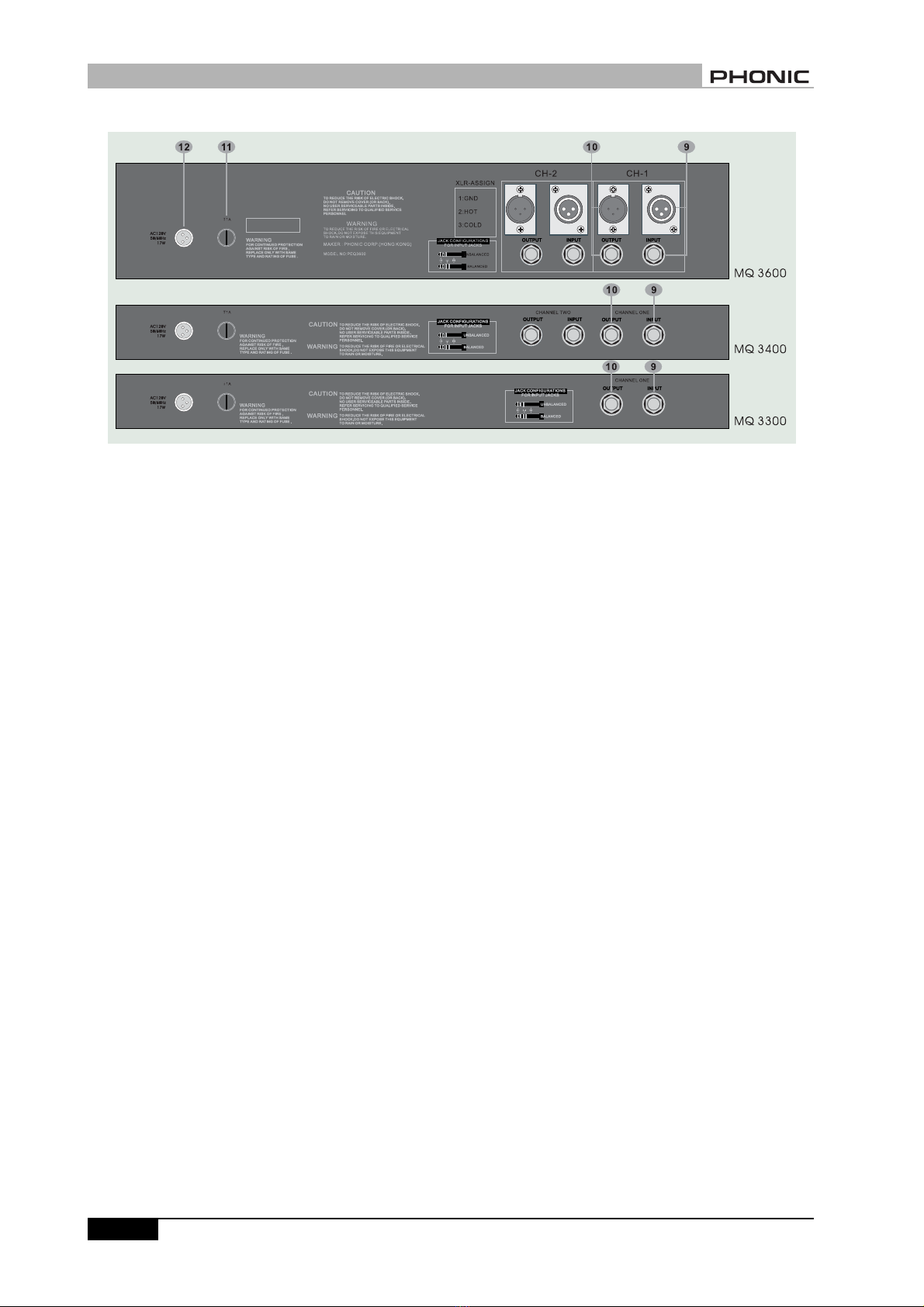
has two balanced 1/4
”
-inch jacks, one for each
channel;whileMQ3600hasanXLRfemalejackand
a balanced 1/4
”
-inch jack for each channel.
11 Fuse holder
Before you attempt to connect and operate this unit,
please make sure that your local voltage matches
the voltage indicated on the unit. Blown fuses may
only be replaced by fuses of the same type and
rating.
12 AC power socket
Connect the enclosed adaptor to this socket.
TYPICAL GRAPHIC EQUALIZER
OPERATION
GENERALTONECONTROL
The graphic equalizer is a very useful device for
general tone shaping because it is simple and easy
to adjust. The visual reference provided by the slide
fader position gives an approximate idea of the
frequencyresponse generated:thehigherfrequency
on the right and lower frequency on the left. To use
the equalizer, you need to know the numerical
frequency range of the tone you want to produce.
Here is a frequency range chart for your reference,
which is useful for starting a new equalized
experience. Use this as a guide, then adjust by ear.
Unfortunately, even a good equalizer can not offer a
complete solution when the room has severe,
inherent acoustic problems. Also, equalization can
not overcome the lack of sound clarity caused by
rooms with unduly long reverberation times.
FEEDBACKCONTROL
Inliveperformanceapplications,graphicequalization
is almost always applied separately to the stage
monitor or foldback system to reduce the level of
those frequencies that would otherwise cause
feedback problems. These problems arise due to
peaks in the frequency response curves of the
monitor speaker system, monitor positioning, and
sound reflected from the stage walls. A graphic
equalizer can be used to provide some control over
moderate feedback problems, but it does not have
enough flexibility or resolution to handle severe
situations. You will get the best results when you
eliminate one or two feedback points by adjusting
one or two slide faders, please cut no more than 6
dB. If you find feedback points covering many
equalizer bands and cutting every band does not
help, then you have to reduce the system gain. The
combined use of a graphic equalizer for tone control
and a parametric equalizer for feedback control is
highly recommended.
MIXERCHANNELEQUALIZATION
Many mixers provide only simple equalization for
individualchannels.Ifyourmixerhaschannelinserts,
you can patch your equalizer into a channel that is
being used for something important and use it to
tailor the sound of this channel exactly the way you
want.
LARGEROOMEQUALIZATION
Large rooms tend to suffer from multiple reflections
with long time delays and long reverberation times;
all of which lead to reduced intelligibility and a
generally muddy sound. As sound travels long