3
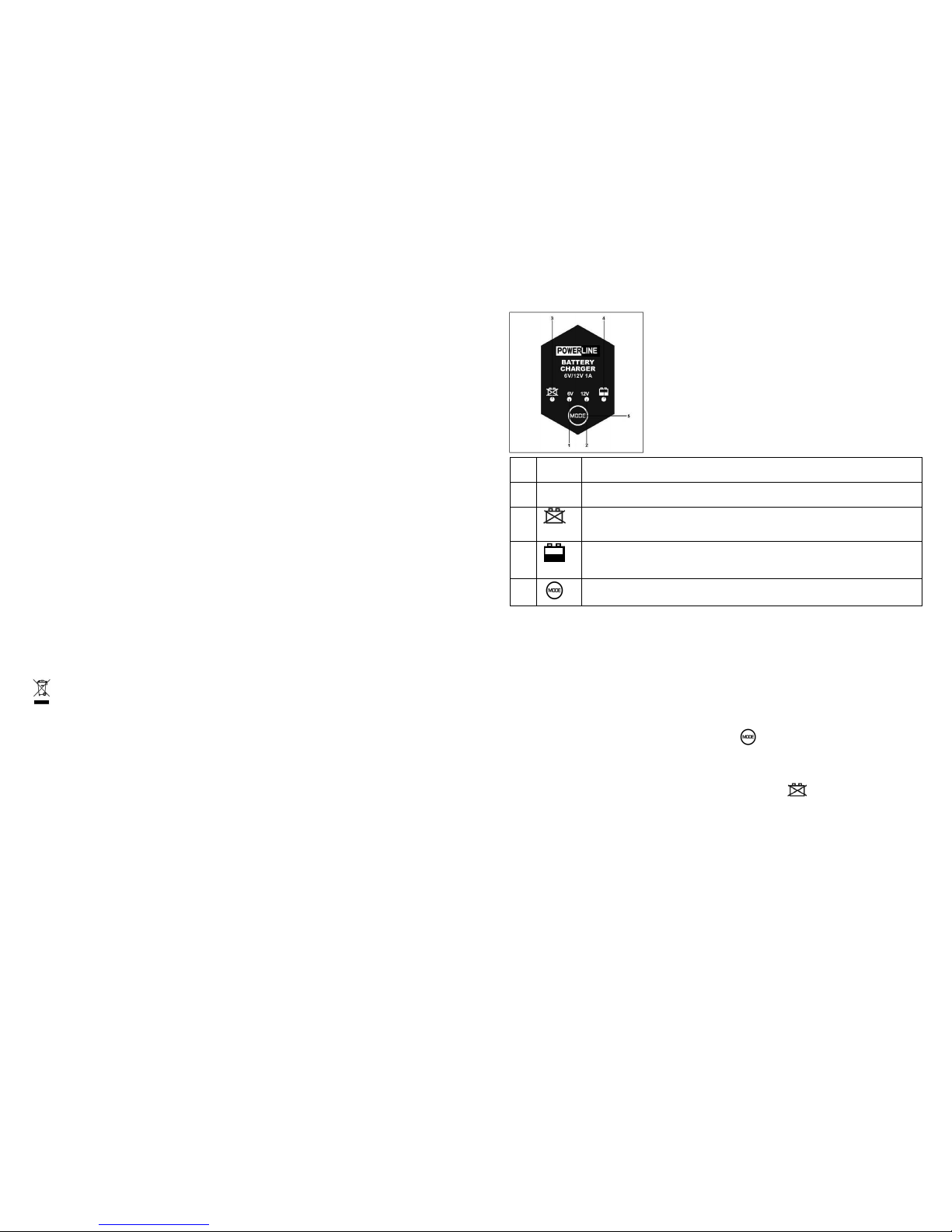
DESCRIPTION OF LEDS/FUNCTIONS
16V Mode 1 - 6V mode
xup to 7.2V, suitable for charging 6V small batteries < 24AH
212V Mode 2 - 12V mode
xup to 14.4 V, suitable for charging 12V small batteries < 24AH
3 LED 3 -
xLit when the charging loop is in short circuit or the cables connected with reverse polarity
or the battery is defective
4 LED 4 -
xFLASHING – Charging in progress
xLit – Fully charged
5MODE button
CHARGING A LEAD-ACID BATTERY
1. First make sure your lead-acid battery is a 6V or 12V battery below 24AH. Do not charge batteries with different
operating voltages!
2. Disconnect all loads from the battery.
If the battery is installed in a vehicle, turn off the ignition and any other loads.
Observe the instructions and safety information of the vehicle to find out how the vehicle battery
should be charged. Modern vehicles are equipped with sensitive electronic parts and controls that
can be damaged if you do not proceed properly!
3. Connect the battery charger to the power supply (100-240 V~/50/60 Hz).
4. Now you can select a function using the mode button (5) . See the next chapter for a description of the
individual operating modes
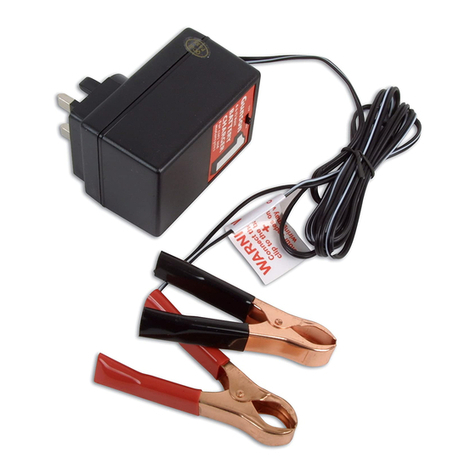
5. Then, connect the red battery clamp (+) to the positive (+) battery pole. Connect the black battery clamp (-) to
the vehicle chassis or the negative (-) battery pole.
6. If the polarity is not correct or the charging loop is in short circuit, LED 3 will be lit.
7. This battery charger is equipped with an automatic memory function, i.e. whenever AC supply is connected, it ʳ ʳ
starts in last selected mode.
8. After the charging process, disconnect the battery charger from the mains supply.
9. First remove the clamp from the vehicle chassis or negative terminal and then from the positive terminal.
2
Operation
xOperation under adverse ambient conditions must be avoided under all circumstances. Adverse ambient
conditions include: ambient temperatures above 40 °C, flammable gases, solvents, vapours, dust, and relative
humidity above 80 %.
xDo not use the battery charger inside a vehicle. The battery charger must not be used in the vicinity of flammable
substances or gases.
xEnsure that there is sufficient ventilation during operation. Never cover the battery charger or the connected
battery.
xNever charge lead-acid batteries in containers or poorly ventilated rooms. Explosive gases can be generated
during the charging process!
xKeep the battery charger as well as the battery away from ignition sources. Do not smoke while handling the
battery charger or the battery! There is danger of explosion!
xNever operate the device immediately after it has been taken from a cold to a warm room. The condensation
generated can cause malfunctions and there is also the risk of a deadly electric shock!
xPersons (including children) who have insufficient knowledge or experience in using the device or who are
physically, sensorially or mentally handicapped may only use the device under the supervision of a person
responsible for their safety. Children must be kept under supervision and may not play with the device.
xCheck the battery voltage before starting the charging process, only 6 and 12 Volt batteries can be recharged.
Notes on rechargeable batteries
xMake sure you observe all safety instructions and charging instructions of the battery manufacturer.
xBefore connecting the battery to the battery charger, disconnect the battery from any loads or cables (turn off the
loads first!).
xAlways disconnect the ground connection from the battery before disconnecting the positive terminal.
xDisconnect the battery from the battery charger before connecting any loads to the battery.
xWhen connecting or disconnecting the battery, sparks might be produced. Therefore, make sure there is sufficient
ventilation!
xObserve the polarity when connecting the battery to the battery charger (red charger terminal = positive/+, black
charger terminal = negative/-).
xLead-acid batteries contain aggressive and corrosive acids. Avoid skin or eye contact with battery fluids! Never
dismantle lead-acid batteries! On skin contact, clean the affected areas thoroughly with water and soap. On eye
contact, rinse the effected eye immediately with clear and cold running water! Then consult a doctor immediately!
xBatteries must not be short-circuited or thrown into fire. Risk of fire and explosion!
DISPOSAL
At the end of its useful life, this product must not be disposed of together with normal household waste, but has to
be dropped off at a collection centre for the recycling of electrical and electronic devices. This is indicated by the symbol
on the product, on the instruction manual or on the packaging.
The materials of which this product is made are recyclable pursuant to their labelling. With the reuse, the recycling of the
materials or other forms of scrap usage you are making an important contribution to the protection of the environment.