3
MEDICAL INFORMATION
WARNINGS
The following are general warnings. Specific warnings appear next to the relevant
instructions in the manual.
!
WARNING • THIS IS NOT A LIFE SUPPORT DEVICE. It may stop operating due to power
interruption or a device fault.
• Explosion hazard—do not use in the vicinity of flammable anaesthetics.
• Special care should be exercised in patients who may be dehydrated, or may
become dehydrated, for example as a result of fluid restriction or diuretic
therapy, including changes or inadvertent changes in therapy.
• If there is any doubt about the likely effect of positive pressure on cardiac
output in a particular patient, the patient’s immediate blood pressure and
heart rate response to therapy should be assessed, at the highest intended
pressure setting for the patient. Symptoms of faintness or dizziness should be
monitored over the first few minutes of therapy.
• If, during therapy, particularly on commencing therapy each night, the patient
feels faint or lightheaded, they should immediately discontinue therapy and
seek medical advice.
• The air flow for breathing produced by this device can be as much as 6oC
(11oF) higher than the temperature of the room. Caution should be exercised
if the room temperature is warmer than 32oC (90oF).
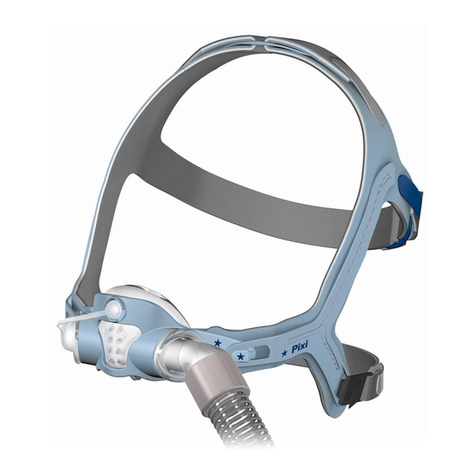
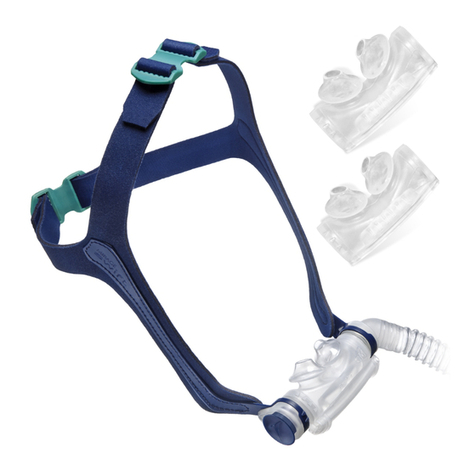
• ResMed CPAP devices have been designed and manufactured to provide
optimum performance using ResMed mask systems. Other mask systems may
be used. However, swings and delivered pressure with non-ResMed masks
may be different from those with ResMed masks. If in doubt, measure
delivered pressure at the mask. Masks with extremely low exhaust vent flow
(less than 15 L/min at 4 cm H2O) may cause somewhat greater temperature
rises in the delivered air than normally expected.
Use of non-ResMed masks may also affect the SmartStart and SmartStop fea-
tures of the CPAP device.
• Inadvertent triggering of SmartStop in high leak situations is more likely
in masks with particularly high exhaust vent flow rates. It is important to
confirm that SmartStart works correctly in these masks when the leak has
reduced somewhat, so that therapy is restarted promptly.
• When the combined flow resistance of the mask and tubing system is too
high, the device may not SmartStop when the mask is off the face and
may continue to log usage hours.
• Do not enable SmartStart when using a mask with an anti-asphyxia valve,
such as the Mirage Full Face Mask.
• A mask should not be worn unless the machine is turned on and operating
properly. The vent holes associated with the mask should never be blocked.