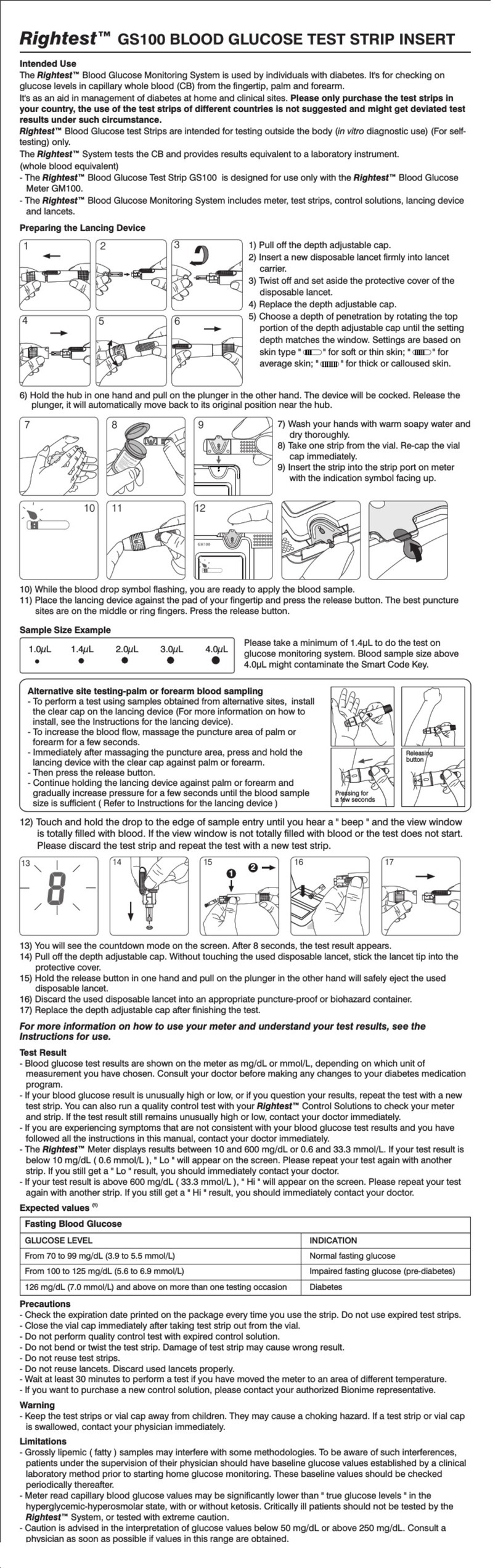
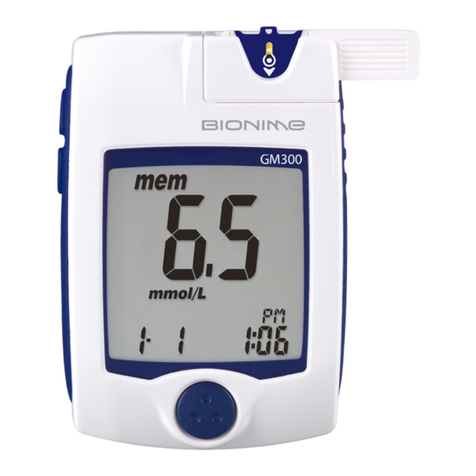
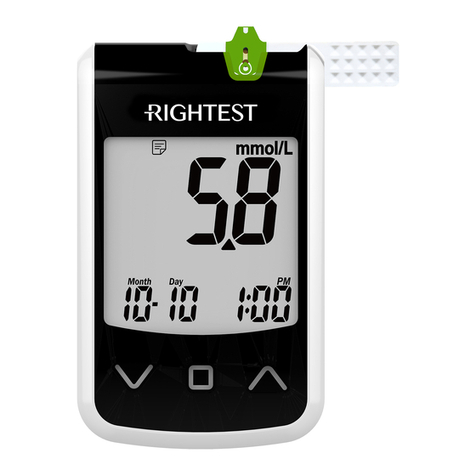
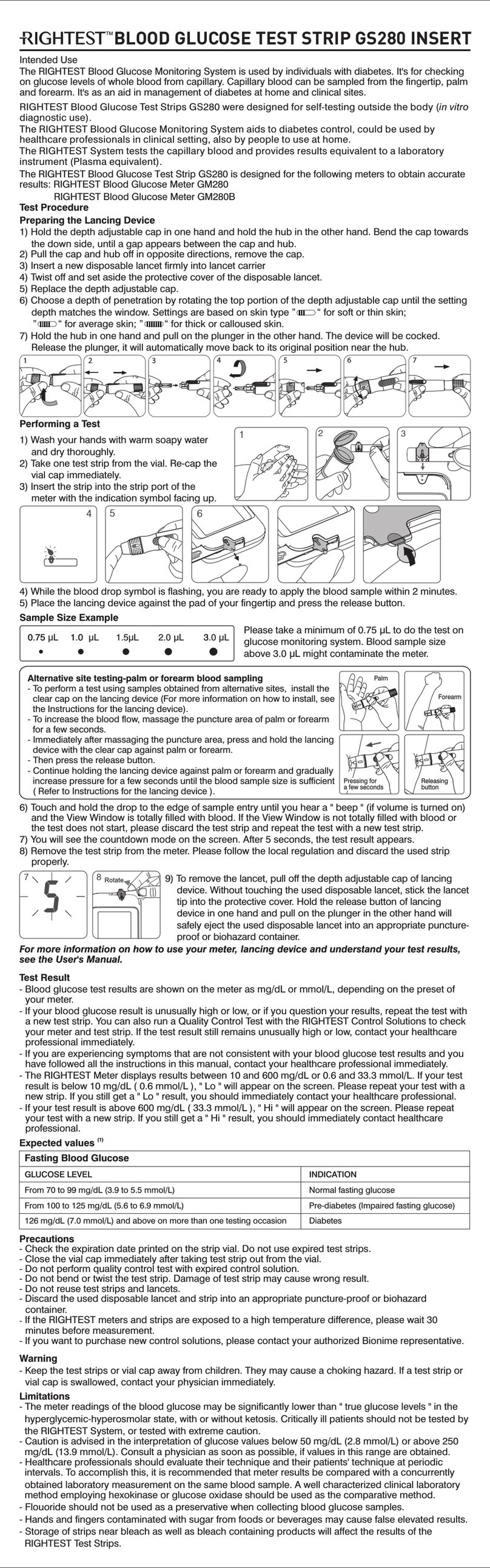
Fingertip
61.0 % (94/154)
84.4 % (130/154)
100 % (154/154)
Palm
61.0 % (94/154)
85.1 % (131/154)
100 % (154/154)
Forearm
59.1 % (91/154)
87.7 % (135/154)
100 % (154/154)
Interferences
The following compounds may interfere with the glucose measurement at the concentrations listed:
Ascorbic Acid ≧ 5 mg/dL ( 0.28 mmol/L ) Dopamine HCl ≧ 2 mg/dL ( 0.11 mmol/L )
L-Dopa ≧ 3 mg/dL ( 0.15 mmol/L ) Tolazamide ≧ 15 mg/dL ( 0.48 mmol/L )
Cholesterol ≧ 500 mg/dL ( 12.93 mmol/L ) Glutathione reduced ≧ 60 mg/dL ( 1.95 mmol/L )
Hemoglobin ≧ 6,000 mg/dL ( 0.94 mmol/L ) Uric acid ≧ 9 mg/dL( 0.54 mmol/L )
Each Blood Glucose Test Strip contains the following reagents:
Glucose Oxidase (GOD) 8.5 %
Potassium Ferricyanide 48.5 %
Non-reactive Ingredients 43.0 %
References
1) Diabetes Information - American Association for Clinical Chemistry (AACC)〔Electronic Version〕
Retrieved Aug 21, 2015 from www.labtestsonline.org/understanding/analytes/glucose/test.html
2) In Vitro Diagnostics in Diabetes : Meeting the Challenge. Clinical Chemistry 45:9, 1596-1601 (1999).
101-3GS100-0J0
EN
BIONIME CORPORATION
No. 100, Sec. 2, Daqing St., South Dist.,
Taichung City 40242, Taiwan
Tel: +886 4 23692388 Fax: +886 4 22617586
Accuracy
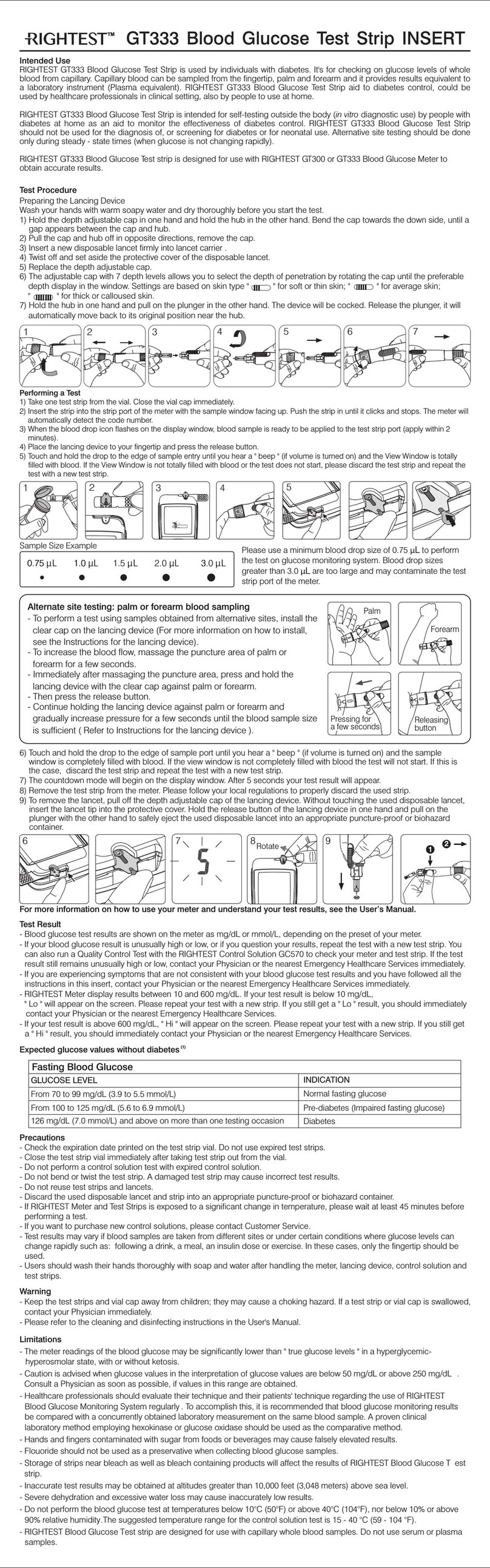
The accuracy of the test study of the Blood Glucose Meter was demonstrated by comparing whole
blood (plasma equivalent) glucose values on the Rightest™ meter with plasma glucose values on a lab
instrument.
A total of 111 patients were enrolled. Each patient collected and tested their own blood samples ( from the
fingertip, palm and forearm) using the Rightest™ System.Then the blood samples were centrifuged immediately
after collection to obtain plasma. Analyze the plasma by the lab instrument - YSI 2300. 100 % of Rightest™
meter values were within ± 15 mg/dL (0.83 mmol/L) of the YSI values at glucose concentrations < 100 mg/dL
(5.55 mmol/L) and within ± 15 % at glucose concentrations ≧ 100 mg/dL (5.55 mmol/L).
The results and differences between the two methods, Rightest™ System and YSI 2300 (as the reference
method) are proved in the tables below.
Rightest™
Additional Information for Healthcare Professionals
(ii) Control solution:
P-01
300
47.1 (2.6)
1.5 (0.08)
3.2 %
P-02
300
104.3 (5.8)
2.9 (0.16)
2.8 %
P-03
300
133.0 (7.4)
2.7 (0.15)
2.1 %
(i) Venous whole blood sample:
Glucose levels
(1) Total test numbers (n)
(2) Mean mg/dL (mmol/L)
(3) SD mg/dL (mmol/L)
(4) CV (%)
Glucose levels
(1) Total test numbers (n)
(2) Mean mg/dL (mmol/L)
(3) SD mg/dL (mmol/L)
(4) CV (%)
- Doctors should evaluate their technique and their patients' technique at periodic intervals. To accomplish this, it
is recommended that meter results be compared with a concurrently obtained laboratory measurement on the
same blood sample. A well characterized clinical laboratory method employing hexokinase or glucose oxidase
should be used as the comparative method.
- Fluoride should not be used as a preservation for venous specimens when using blood glucose monitors.
- Hands and fingers contaminated with sugar from foods or beverages may cause falsely elevated results.
- Differences in whole blood and serum/plasma values may cause variability in results.
- Storage of strips near bleach as well as bleach containing products will affect results of glucose oxidase strips.
- The use of cellular phones and other radio transmitting devices should be prohibited in areas where testing
occurs.
- Rightest™ Blood Glucose Test Strips are designed for use with capillary whole blood samples.
Do not use serum or plasma samples.
- Incorrect test results may be obtained at high altitude more than about 3,048 meters (10,000 feet ) above sea
level.
- Hematocrits should be between 35 % ~ 48 %. If you do not know your hematocrits, ask your healthcare
professional.
- Severe dehydration and excessive water loss may cause inaccurately low results.
- Rightest™ Blood Glucose Monitoring System has not been validated for use on neonates.
Therefore, it should not be used for neonates.
- Do not perform the blood glucose test at temperatures below 10℃ (40 ℉) or above 50 ℃ (104 ℉ ) , below
10 % or above 90 % relative humidity.
(2)
Detection Principle
The glucose oxidase and potassium ferricyanide in the strip react with the glucose in the sample to produce an
electrical current which is proportional to the amount of glucose in the sample. The meter measures the current
and converts it to the corresponding glucose concentration.
Performance Characteristics
Precision
The precision was evaluated including (i) venous whole blood sample (ii) 3 levels glucose control solution in
period of 10 days, by 10 meters and 3 batches of strips.
Storage and Handling
- Store the strips in the original capped vial at temperatures between 4 to 30 (39 to 86 ), and relative
humidity between 10 % to 90 %.
- Replace the vial cap immediately and close tightly after taking test strip out from the vial. Do not leave the cap
of vial opened. If the strip is exposed in the air too long, it will absorb the moisture and cause wrong test result.
- Use test strips within 3 months after first opening.
℃ ℃ ℉ ℉
Troubleshooting and Customer Service
For more information on error messages and trouble shooting, please refer to the Error Messages and Trouble
Shooting section of the Rightest™ Instructions for use.
Y
ou may also contact customer service by calling local distributor or email to
[email protected].
( At all other times, you could contact your healthcare professional for assistance )
Measurement Range
The measurement range of the Rightest™ System is 0.6 to 33.3 mmol/L.
Quality Control Section
Please refer to the Quality Control section of the Instructions for use.
P-04
300
227.5 (12.6)
3.8 (0.21)
1.7 %
P-05
300
349.2 (19.4)
5.1 (0.28)
1.5 %
CS-L
300
59.1 (3.3)
1.8 (0.10)
3.1 %
CS-N
300
109.9 (6.1)
2.4 (0.13)
2.2 %
CS-H
300
299.4 (16.6)
5.3 (0.29)
1.8 %
Bionime GmbH
Tramstrasse 16
9442 Berneck / Switzerland
Difference range in values
between the value and
the Rightest™ meter value
YSI
Within ± 5 mg/dL (0.28 mmol/L)
Within ± 10 mg/dL (0.56 mmol/L)
Within ± 15 mg/dL (0.83 mmol/L)
Bias range in values
between the YSI value and
the Rightest™ meter value
Within ± 5 %
Within ± 10 %
Within ± 15 %
Table 2: represents samples for glucose concentrations ≧ 100 mg/dL (5.55 mmol/L).
Table 1: represents samples for glucose concentrations < 100 mg/dL (5.55 mmol/L).
* Acceptance criteria in ISO15197 : 2013 are that 95 % of all differences in glucose values should be within
± 15 mg/dL (0.83 mmol/L) at glucose concentrations < 100 mg/dL (5.55 mmol/L), and within ± 15 % at
glucose concentrations ≧ 100 mg/dL (5.55 mmol/L).
Note: For glucose concentrations < 100 mg/dL (5.55 mmol/L), difference values are expressed in mg/dL
(mmol/L), and for glucose concentrations ≧ 100 mg/dL (5.55 mmol/L), difference values are compared in
percentage.
The percent ( and number ) of samples of alternative site were
the difference between the Rightest™ and the YSI value
within the range shown in the side row.
The percent ( and number ) of samples of alternative site were the bias
between the Rightest™ and the YSI value within the range shown in the
side row.
Fingertip
58.8 % (40/68)
91.2 % (62/68)
100 % (68/68)
Palm
63.2 % (43/68)
92.6 % (63/68)
100 % (68/68)
Forearm
60.3 % (41/68)
88.2% (60/68)
100 % (68/68)
NOTE
- Suggest not to use this meter close to source of strong electromagnetic radiation, to avoid interference
with proper operation.
- Suggest to keep meter free of dust, water or any liquid.
CE Mark with number of Notified Body
LOT
Use by
Temperature limitations Lot number
IVD For in vitro diagnostic use For single use only
Reference number
Manufacturer
EU Representative
Consult instructions for use
Ve rsion: August 2017
Biological risks