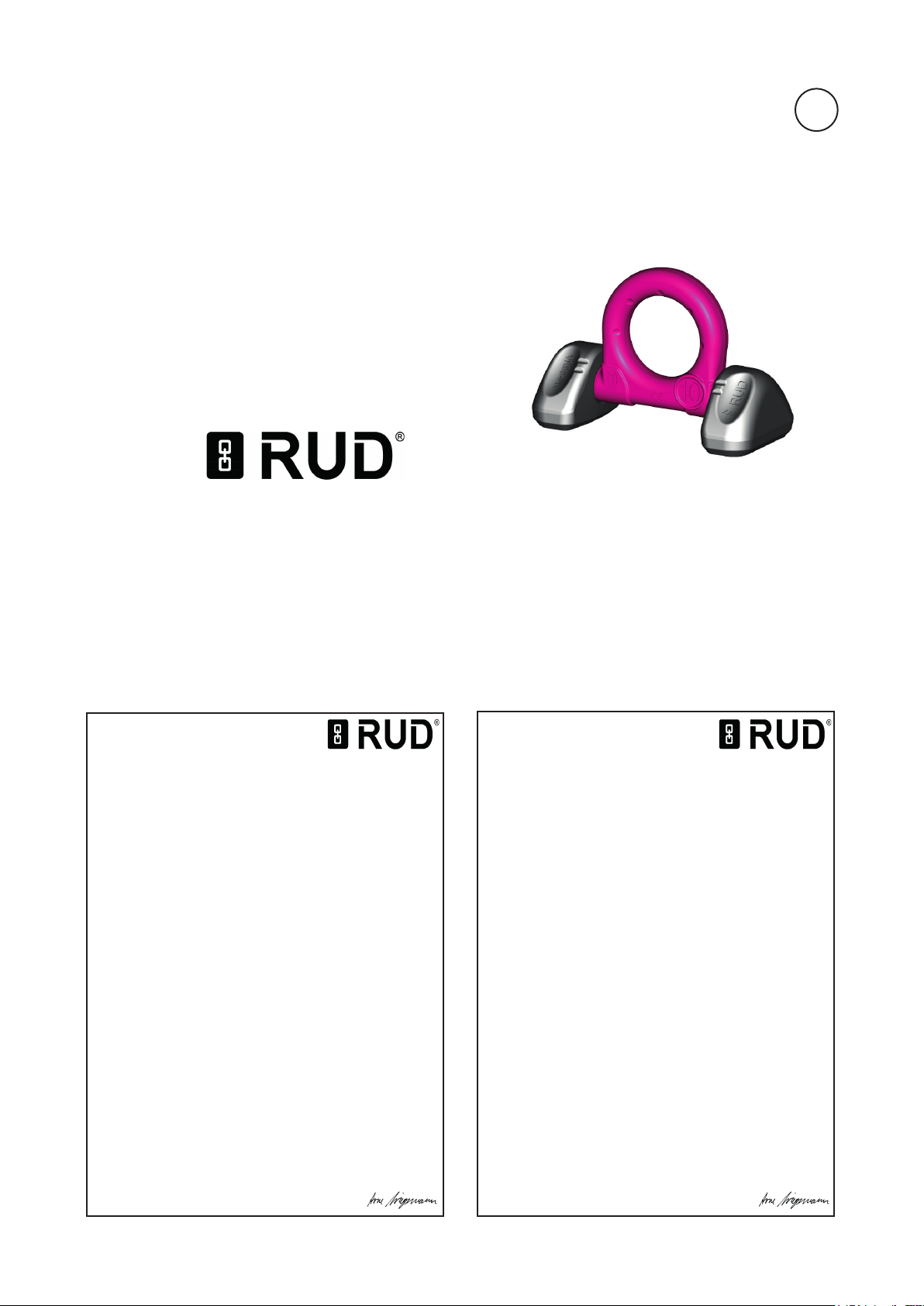
2VRBS-FIX
Before initial usage of the RUD-VRBS-FIX,
please read carefully the safety instruc-
tions. Make sure that you have understood
all subjected matters. Non-observance
can lead to serious personal injuries and
material damage and eliminates warranty.
1 Safety instructions
ATTENTION
Wrong assembled or damaged lifting
points as well as improper use can
lead to injuries of persons and dama-
ge of objects when load drops.
Please inspect all lifting points before each
use.
RUD-Lifting points VRBS-FIX must only be used by
instructed and competent persons considering DGUV
100-500 / BGR 500 and outside Germany noticing the
country specic statutory regulations.
2 Intended use of the VRBS-FIX
RUD-Lifting points VRBS-FIX must only be used for
the assembly at the load or at lifting means.
They are designed and intented to attach lifting
means.
RUD Lifting points can also be used as lashing points
to attach lashing means.
RUD lifting points must only be used for the hereby
described usage and operation purpose.
3 Assembly- and instruction manual
3.1 General information
• Capability of temperature usage:
As of 07/2019: RUD-Lifting points VRBS-FIX are sui-
table for the temperature range from -40°C up to 400°C.
Up to 07/2019: RUD-Lifting points VRBS-FIX are sui-
table for the temperature range from -20°C up to 400°C.
When used at higher temperature the working load
limit (WLL) of the lifting point must be reduced as
follows:
-40°C/-20°C up to 200°C no reduction
200°C up to 300°C minus 10 %
300°C up to 400°C minus 25 %
Temperatures exceeding 400°C are prohibited!
In the unloaded state, VRBS-FIX anchor points
together with the load can be stress relieved by
heat treating (e.g. welded construction) once.
Temperature: < 600°C (one hour maximum). After
stress-relieving heat treatment (< 600°C), however,
the spring force is no longer usable.
• RUD-lifting points VRBS-FIX must not be used
with aggressive chemicals such as acids, alkaline
solutions and their vapours.
• Please mark mounting position of lifting point with
a coloured contrast paint for better visibility.
• VRBS-FIX will be delivered with a pink powder
coated lifting ring.
• VRBS-FIX includes a protected positioned clam-
ping spring, inside the weld-on block. The spring
holds the weld-on blocks together with the ring and
creates at the same time a radial clamping function.
• VRBS-FIX will be delivered as a complete
assembled unit.
3.2 Hints for the assembly
Basically essential:
• The material construction to which the lifting point
will be attached should be of adequate strength to
withstand forces during lifting without deformation.
The weld-on material must be suitable for welding
and the contact areas must be free from dirt, oil,
colour, ect.
The material of the forged welding block is
S355J2+N (1.0577+N (St52-3))
• The position of the lifting points must be carried
out in such a way that unintended movement like
turning or ipping will be avoided.
• For single leg lifts, the lifting point should
be vertically above the centre of gravity
of the load
• For two leg lifts, the lifting points must be
equidistant to/or above the centre of gravity
of the load.
• For three and four leg lifts, the lifting
points should be arranged symmetrical
around the centre of gravity, in the same
plane if possible.
• Load symmetry:
Determine the necessary WLL of each lifting point
for a symmetrical load by using the following phy-
sical calculation formula:
WLL = necessary WLL of lifting point /
single strand (kg)
G = weight of load (kg)
n = number of load bearing strands
ß = inclination angle of single strand
WLL=G
n x cos ß
Number of load bearing strands:
Symmetric Unsymmetric
two leg 2 1
three / four leg 3 1
Chart 1: Load bearing strands (compare to chart
2)
• Check nally the correct assembly (see chapter 4,
test criteria).