4 APT-200 SATEL
and its preset wiring type must be different from “No detector”. You can program any zone
type for the zone. For more information, refer to the ABAX 2 controller manual and the
PERFECTA 64 M control panel manuals.
2.2 System state information
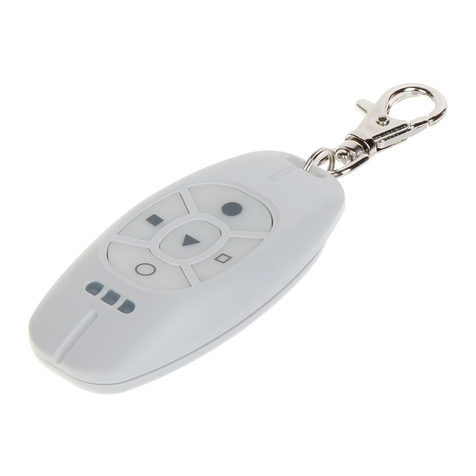
To get the system state information, press any button (it needn't start any function).
The information will be presented by the keyfob LEDs for a few seconds.
ACU-220 controller
The description below does not apply to the ACU-220 controller connected to the
INTEGRA / INTEGRA Plus / VERSA / VERSA Plus / VERSA IP / PERFECTA 64 M
control panel.
Each LED can indicate the state of one zone of the ACU-220 controller. The LED is ON
when:
•the NO type input is shorted,
•the NC type input is open.
For more information, refer to the ACU-220 controller manual.
ABAX 2 / ABAX controller connected to INTEGRA / INTEGRA Plus control panel
Each LED can indicate the state of one output of the alarm system. The LED is ON when:
•output with normal polarity is active,
•output with reversed polarity is inactive.
For more information, refer to the ABAX 2 / ABAX controller manual and the INTEGRA /
INTEGRA Plus control panel manuals.
INTEGRA 128-WRL control panel
Each LED can indicate the state of one output of the alarm system in the same way as in the
case of the ABAX 2 / ABAX controller connected to the INTEGRA / INTEGRA Plus control
panel. For more information, refer to the INTEGRA 128-WRL control panel manuals.
ABAX 2 / ABAX controller connected to VERSA / VERSA Plus / VERSA IP
control panel
For the list of information that can be presented on the keyfob LEDs, refer to the manuals of
VERSA / VERSA Plus / VERSA IP control panels.
ABAX 2 controller connected to PERFECTA 64 M control panel
Each LED can indicate the state of one output of the alarm system (LED ON – output
activated; LED OFF – output deactivated).
3 Battery replacement
There is a danger of battery explosion when using a different battery than
recommended by the manufacturer, or handling the battery improperly. Do not
crush the battery, cut it or expose it to high temperatures (throw it into the fire,
put it in the oven, etc.).
Do not expose the battery to very low pressure due to the risk of battery
explosion or leakage of flammable liquid or gas.