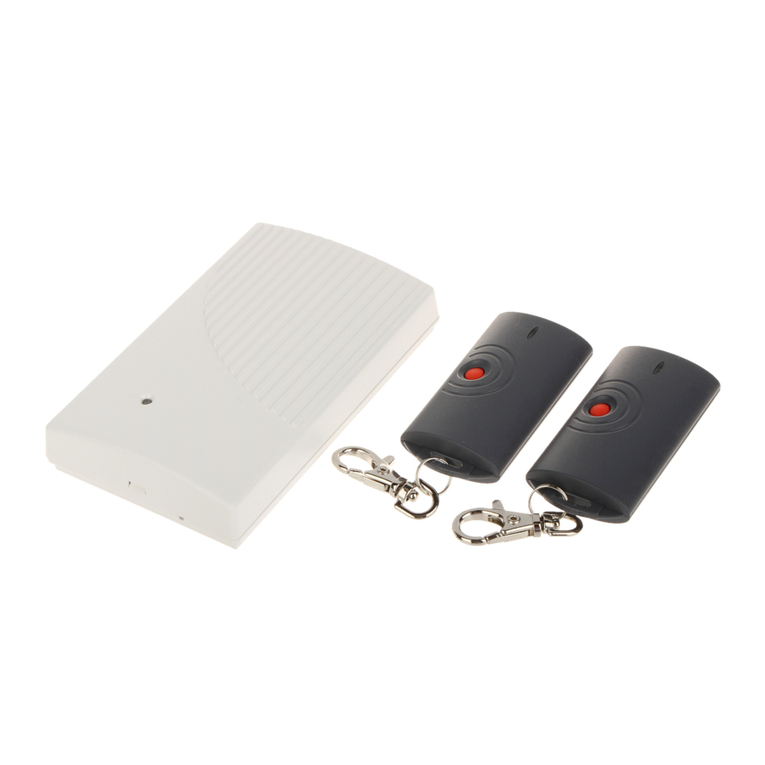
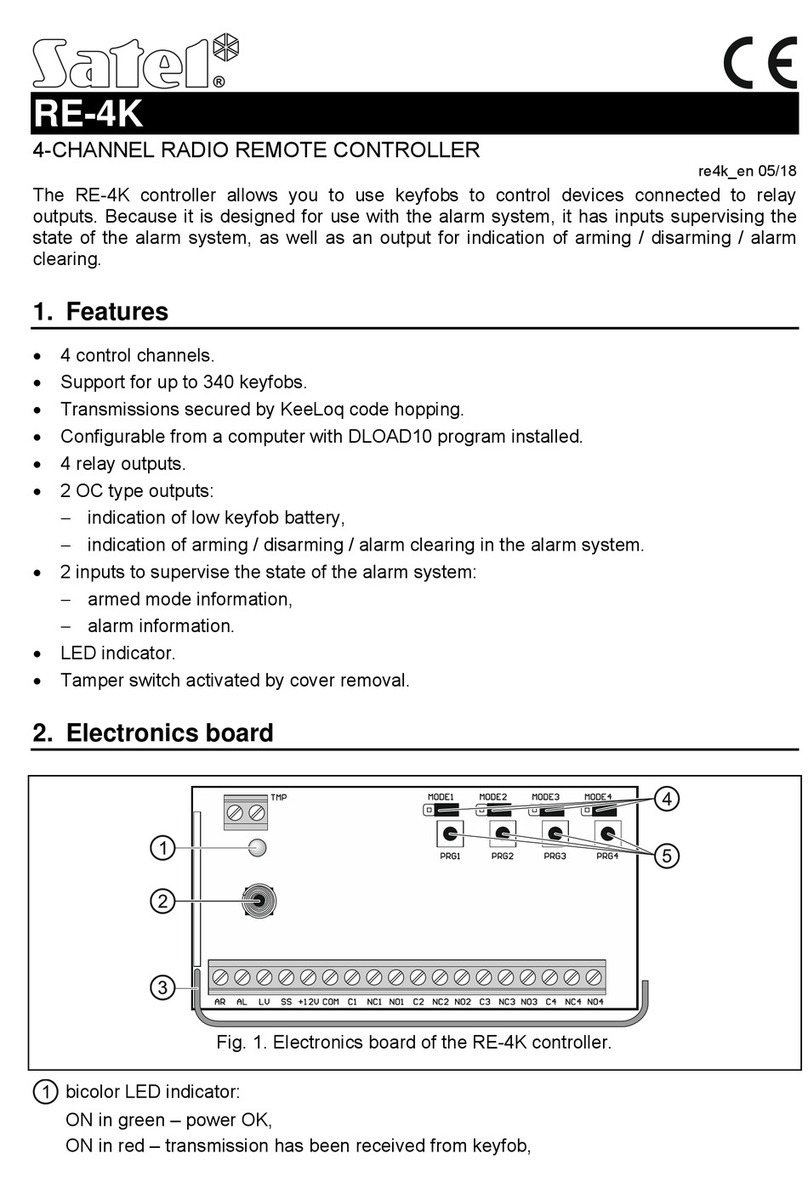
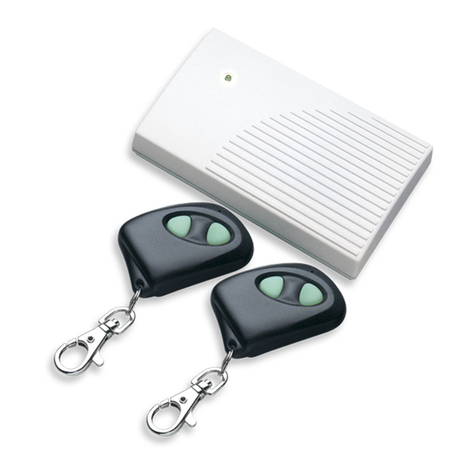
Satel RE-1K User manual

®
REMOTE CONTROL SET
RE-1K / RE-2K
re12k_е10/06
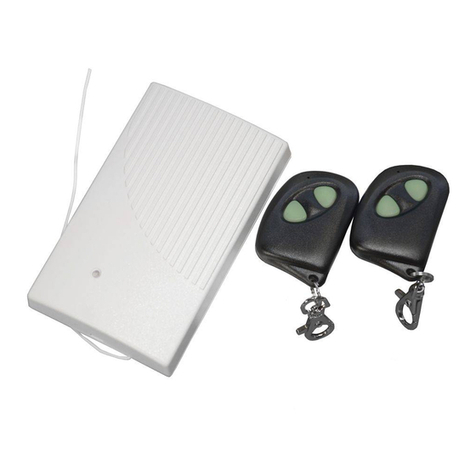
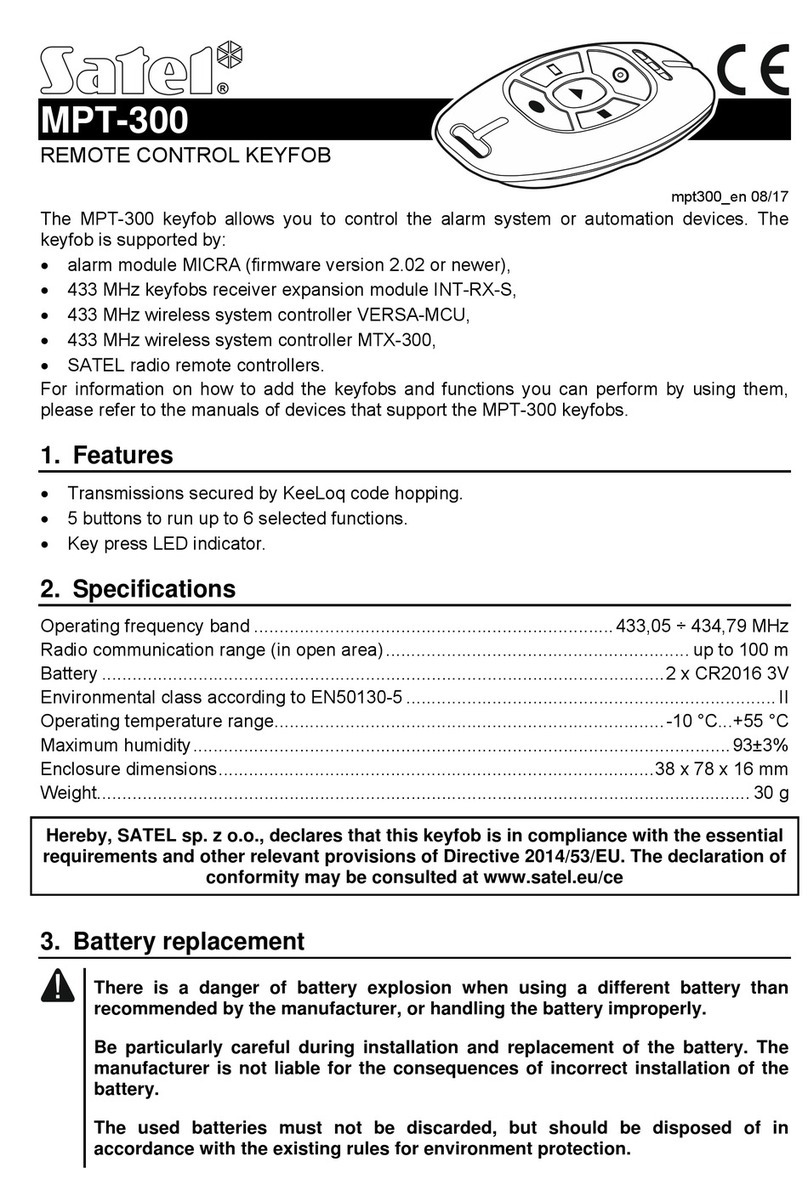
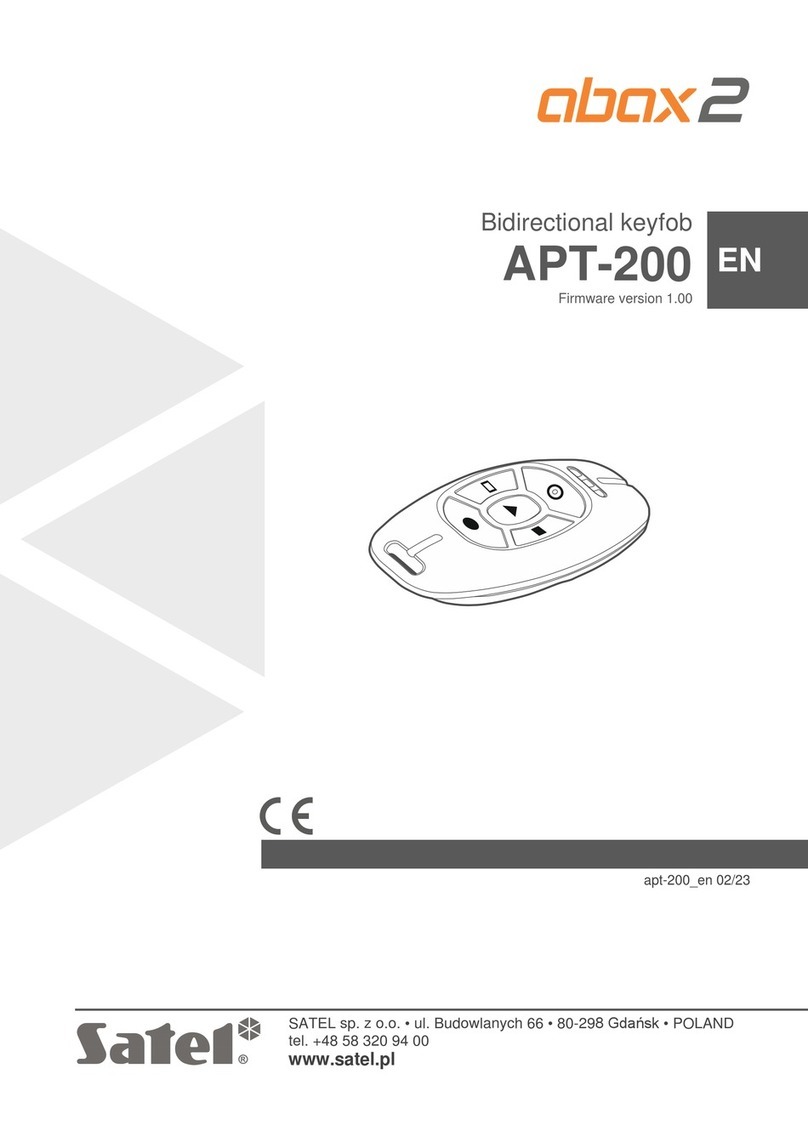
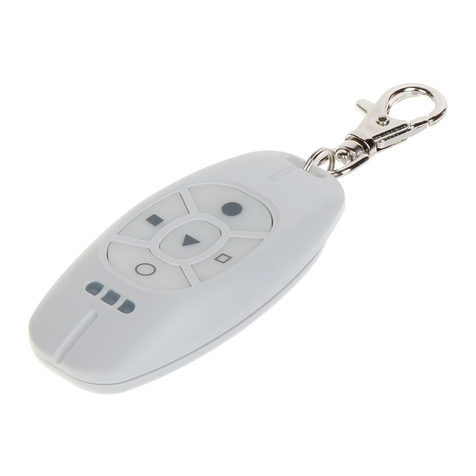
The RE-1K / RE-2K enables electrical equipment to be remotely controlled by
means of radio transmitters (remote keys). The RE-1K is a single-channel controller,
the RE-2K - a double-channel one. Both types of remote control sets can work with up
to 16 remote keys. The RE-1K / RE-2K only support SATEL-manufactured remote
keys.
The design is based on the components of Microchip Technology Inc. which use the
KEELOQ® code-hopping technology for transmission between the transmitter and the
receiver. It ensures both security of use and resistance to spurious control signals
coming from other devices.
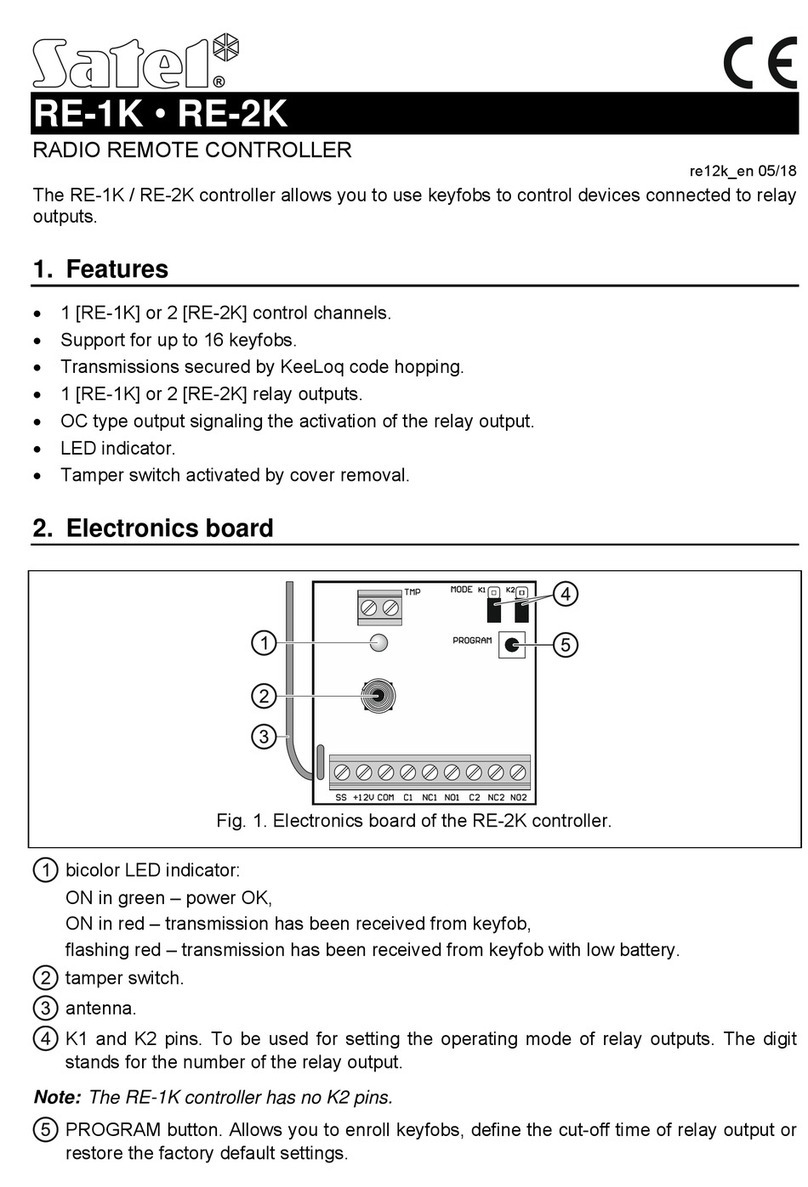
1 Description of electronics board
Figure 1. Schematic view of RE-2K board
As just one relay is installed on the electronics board of the RE-1 controller, the board
has neither the K2 pins or the second relay terminals.
Description of terminals:
SS – siren control output (OC);
+12V – power supply input (direct voltage from 9V to 16V);
COM – common (ground);
C1 – common terminal, channel 1 relay;
NC1 – normally closed terminal, channel 1 relay;
NO1 – normally open terminal, channel 1 relay;
antenna
tamper contact
operating mode
programming pins
programming
button
relays
LED

SATEL RE-1K / RE-2K
2
C2 – common terminal, channel 2 relay (RE-2K only);
NC2 – normally closed terminal, channel 2 relay (RE-2K only);
NO2 – normally open terminal, channel 2 relay (RE-2K only);
TMP – tamper contact terminals.
The two-color LED indicates the module operating status and facilitates programming
of the receiver parameters:
•green light – normal operating mode;
•red light – receiving signal from remote key in normal operating mode;
•green blinking light – waiting for the first press of the remote key button when
entering new remote key into the receiver memory;
•red blinking light
−when entering new remote key into the receiver memory – waiting for the second
press of the remote key button;
−after the programming button is held down for at least 7 seconds – clearing the
receiver memory;
−after pressing the remote key button normal operating mode - the remote key
battery is exhausted;
•alternately blinking red and green – programming the monostable relay ON time.
The programming button allows:
•entering remote keys into the receiver memory;
•programming the monostable relay changeover time;
•clearing the receiver memory.
The J8 pins are used to set the operating mode of the first channel relay (K1). The J7
pins (RE-2K only) are intended for setting the second channel relay (K2) operating
mode.
The SS output is OC type output, i.e. it is shorted to ground when active. The output
will signal operation of the relay in pulse and monostable modes, as well as
changeover of the relay in bistable mode. The signaling is effected in the form of three
pulses with duration of 0.16s each. The SS output can be used e.g. to control a siren.
Permissible current-carrying capacity of the SS output is 500mA.
2 Installation
The RE-1K and RE-2K are mounted in a plastic housing. When closing the housing,
be particularly careful so that the programming button is not pressed in by the cables.
It is recommended that the manufacturer specified batteries be used in the remote
keys. The battery status must be periodically checked (e.g. by noting how the LED on
the receiver board lights when the remote key button is being pressed) and, if
necessary, the used batteries must be replaced by new ones.
Notes:
•Do not discard the used batteries. They should be disposed of as required by the
existing regulations (European Union Directives 91/157/EEC and 93/86/EEC).
•Making any construction changes or unauthorized repairs is prohibited. This
applies, in particular, to modification of assemblies and components.

RE-1K / RE-2K SATEL 3
3 Programming
3.1 Adding remote keys
To enter remote keys into the receiver memory follow the procedure below:
1. Press the programming button – the LED starts blinking green.
2. Press any button on the remote key – the LED starts blinking red.
3. Press the remote key button again – the LED light changes to steady green. The
remote key has been entered into the memory.
Note:If the memory is already full or the remote key is incorrect (from another
manufacturer), the receiver will return to its normal status after the first press of
the remote key button.
The remote key buttons are automatically assigned to the relay which can be
controlled by them.
3.2 Removing remote keys
Removal of the remote key from the receiver memory is only possible by fully clearing
the memory. To do so, press and hold down the programming button for approx.
7 seconds – the LED will start blinking red, thus indicating that the memory has been
cleared (and the factory setting of monostable changeover time restored). When the
LED starts again steadily lighting green, the receiver is ready for programming new
remote keys.
3.3 Programming the relay operating mode
The relay can work in one of the three modes, depending on how the jumpers are set
on pins:
- pins open - bistable mode – each press of the remote key button will change the
relay status to the opposite one.
- the jumper set on the two lower pins - pulse mode – the relay is switched on for
the time when remote key button is pressed.
- the jumper set on the two upper pins - monostable mode – the relay is switched
on for a preset time.
Note:The monostable ON time is running not from the moment when the button is
pressed, but from when it is released.
By default, the monostable ON time is preprogrammed at 5 seconds. This value can
be changed by the user and set within the range from 1 to approx. 250 seconds by
means of the following procedure:
1. Press the programming button twice – the LED will go out.
2. Press the remote key button assigned to the channel and relay the time of which is
being programmed – the LED will start blinking alternately green and red.
3. Having measured off the required time, press the remote key button again - the
LED will start steadily lighting green.

SATEL RE-1K / RE-2K
4
4 Technical data
Range in open area ..........................................................................................up 100m
..............................(an obstacle between the transmitter and the receiver will reduce the device operating range)
Number of controlled outputs .......................................................1 (RE-1K) / 2 (RE-2K)
Supply voltage, rated...........................................................................................12V DC
Current consumption, minimum ................................................................approx. 16mA
Current consumption, maximum ......................approx. 40mA (RE-1K) / 60mA (RE-2K)
Adjustment range of changeover time in monostable mode............................ 1 to 250s
Current-carrying capacity of relay contacts at voltage of 24V DC...............................2A
Current-carrying capacity of SS (OC) output........................................................500mA
Operating frequency range.............................................................433.05 ÷ 434.79MHz
Operating temperature range, receiver..........................................................0 to +55ºC
Operating temperature range, transmitter (remote key)..............................-20 to +55ºC
Housing dimensions.................................................................................72x118x24mm
Type of remote key battery................................................................................ 23A 12V
DECLARATION OF CONFORMITY
Product:
RE-1K – remote control set
RE-2K – remote control set
Manufacturer: SATEL sp. z o.o.
ul. Schuberta 79
80-172 Gdańsk, POLAND
tel. (+48 58) 320-94-00
fax. (+48 58) 320-94-01
Product description:A remote control set with coded transmission, having 1 (2) controlled outputs, operating
in frequency band 433.05MHz – 434.79MHz. The set includes a +12V DC supplied receiver and battery
supplied remote key (transmitters), type T-2. The device enables low-voltage equipment to be controlled,
including alarm control panels.
This product conforms to the following EU Directives:
R&TTE 1999/5/EC
This product meets the requirements of harmonized standards:
R&TTE: EN 300 220-1: v.1.3.1; EN 300 220-3: v.1.1.1;
EMC: EN 301 489-1: v.1.4.; EN 301 489-3: v.1.4.1
LVD: EN60950-1:2001
Notified body taking part in conformity evaluation: Identification No.: 1471
Gdańsk, Poland
2005-08-12 Head of Test Laboratory:
MichałKonarski
This manual suits for next models
1
Table of contents
Other Satel Remote Control manuals