Issue Preliminary 1, April 2022 Model 342 User Guide
Page 6 Studio Technologies, Inc.
Model 342
INTERCOM STATION
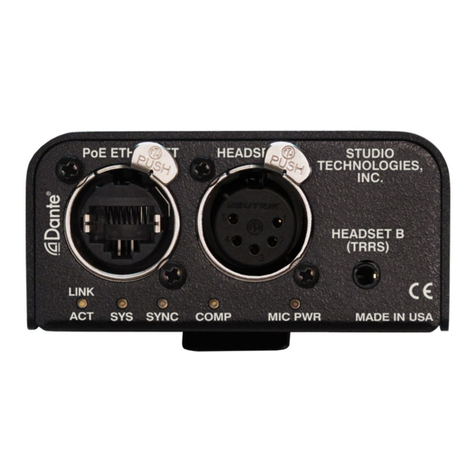
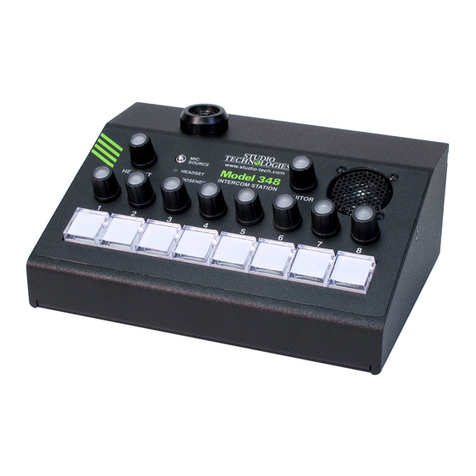
Dual-color LEDs provide status indications of the Dante
interface. The Dante Identify command can take on a
unique role with the Model 342. Not only can it cause the
two talk pushbutton switches to light orange in a highly
visible sequence, it can be congured to turn o (“kill”) the
talk functions if either or both are active.
Audio Quality
The Model 342 oers “pro” audio performance that is not
found in typical party-line (PL) intercom devices. A low-
noise, wide dynamic-range microphone preamplier and
associated voltage-controlled-amplier (VCA) dynamics
controller (compressor) ensures that microphone audio
quality is preserved while minimizing the chance of signal
overload. DC power to support electret microphones can be
enabled as required. The output of the microphone preamp
and compressor is routed to an analog-to-digital converter
(ADC) section that supports a sampling rate of 48 kHz with
a bit depth of up to 24. The audio signal, now in the digital
domain, travels through the processor and on to the Dante
interface section where it is packetized and prepared for
transport over Ethernet.
Audio input signals arrive via two Dante receiver (input)
channels. The supported sampling rate is 48 kHz with a bit
depth of up to 24. The audio signals pass into the Model
342’s processor where channel routing, headphone level
control, and sidetone creation are performed within the
digital domain. This provides exibility, allowing precise
control of the audio signals and eliminating the need for
the two rotary level controls from having to directly han-
dle analog audio signals. The audio signals destined for
the 2-channel headphone output are sent to a high-
performance digital-to-analog converter and then on to
robust driver circuitry. High signal levels can be provided
to a variety of headsets.
Call Receive Function
A call receive function allows Model 342 users to be pro-
vided with a visual indication that a call signal is active on a
Dante receiver (input) channels. The cadence of the visual
indication can be congured to meet an application’s needs.
Using 20 kHz tones, the call signals are sent within the
Dante audio channels (“in band”) allowing interoperability
between multiple Studio Technologies’ beltpack units, as
well as being compatible with legacy party-line intercom
systems. Call signals can be useful to indicate to users
that they are needed “on headset” or should be actively
listening to an intercom channel. The call function can also
be used to provide real-time cues to production personnel
during the running of live events.
Conguration Flexibility
A highlight of the Model 342 is its ability to be easily cong-
ured to meet the needs of specic users and applications.
All conguration choices are made using the STcontroller
software application that communicates with the Model 342
by way of an Ethernet network connection. Congurable
parameters include microphone power and preamplier
gain, headphone monitoring, sidetone operation, call
receive cadence, and talk button operation.
The microphone input can be selected for compatibility
with dynamic or electret (DC-powered) microphones. The
gain of the microphone preamplier can be selected from
among five choices. These choices allow compatibility
with the variety of microphones that are part of broadcast,
intercom, and computer gaming headsets.
To support optimum user performance, the Model 342’s two
talk pushbutton switches can be independently congured
from among four choices: Push to Talk, Latching, Push to
Talk/Tap to Latch, or Disabled. Two audio channels arrive
via Dante receiver (input) channels and are destined for
the 2-channel headphone output. Each input source can
be independently routed to the left headphone channel,
right headphone channel, or both the left and right head-
phone channels. This exibility allows a variety of listening
environments to be created, including stereo, dual-channel
monaural, and single-channel monaural.
Ethernet Data and PoE
The Model 342 connects to an Ethernet data network
using a standard 100 Mb/s twisted-pair Ethernet interface.
The physical interconnection is made by way of a Neutrik®
etherCON RJ45 receptacle. While compatible with standard
RJ45 plugs, etherCON allows a ruggedized and locking
interconnection for harsh or high-reliability environments.
An LED, located on the unit’s back panel, displays the
status of the network connection.
The Model 342’s operating power is provided by way of the
Ethernet interface using the 802.3af Power-over-Ethernet
(PoE) standard. This allows fast and ecient interconnec-
tion with an associated data network. To support PoE power
management, the Model 342’s PoE interface reports to the
power sourcing equipment (PSE) that it’s a class 1 (very
low power) device.
Future Capabilities and Firmware
Updating
The Model 342 was designed such that its capabilities
and performance can be enhanced in the future. A USB
connector, located on the unit’s main circuit board (un-
derneath the unit’s cover), allows the application rmware
(embedded software) to be updated using a standard USB
ash drive. The Model 342 uses the UltimoX2™ integrated
circuit from Audinate to implement its Dante interface. The
rmware in this integrated circuit can be updated via the
Ethernet connection, helping to ensure that its capabilities
remain up to date.