ENGLISH
UPS EVO RT 6User’s manual
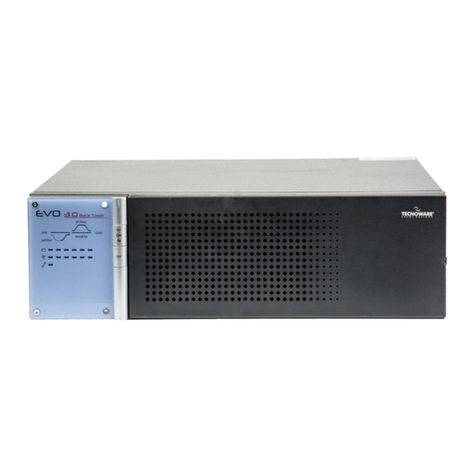
LOAD LEVEL led bar
The led bar has 6 leds (5 leds are blue and one led is red). This bar indicates the output power
percentage (LOAD LEVEL), proportional to the number of switched on leds. The greater the load
the more LED indicators will light on.
There are the following LOAD LEVEL percentages:
•0~20%: only one led is on (LED13)
•21~40%: two leds are on (LED13 and LED12)
•41~60%: three leds are on (LED13, LED12 and LED11)
•61~80%: four leds are on (LED13, LED12, LED11 and LED10)
•81~100%: five leds are on (LED13, LED12, LED11, LED10 and LED9)
The OVERLOAD red led (LED8), is on to warn of an OVERLOAD condition.
BAT. LEVEL led bar
The led bar has 6 leds (5 leds are blue and one led is yellow). This bar indicates the battery
capacity percentage (BAT. LEVEL), proportional to the number of switched on leds. The higher
the battery capacity the more LED indicators will light on.
There are the following battery capacity percentages:
•100~81%: five leds are on (LED15, LED16, LED17, LED18 and LED19)
•80~61%: four leds are on (LED15, LED16, LED17 and LED18)
•60~41%: three leds are on (LED15, LED16 and LED17)
•40~21%: two leds are on (LED15 and LED16)
•20~0%: only one led is on (LED15)
The LOW BAT yellow led (LED14), is on to warn of a LOW BATTERY condition during BATTERY
mode.
REAR SIDE
The following are located on the rear side (see figure 3):
1) Grounded AC Input power socket: to connect the UPS to AC utility line by the supplied
input cord.
2) Input Circuit Breaker: it goes off in overload or short-circuit condition; push the external
3) Grounded output socket: for connecting equipments to be protected.
4) (Only EVO 2.0 RT and EVO 3.0 RT) Grounded power output socket: for connecting
an output power line to supply all the equipments to be protected.
5) RS-232 Computer Interface (female connector 9 poles DB9): it is the interface port
(RS-232) to communicate with a computer.
6) RJ11/RJ45 IN/OUT plugs: to protect and filter a phone line, an ADSL or a LAN.
7) External batteries connector: to connect the UPS to an external Box Battery (optional).
8) Slot for Dry Contact Board (optional)/SNMP adapter (optional)
9) Manual BYPASS switch: to force the UPS into BYPASS mode (see chapter “Running
Operations”).
10) Remote ON/OFF connector.
11)EPO (Emergency Power OFF) connector.