Tempco PCM10001 User manual

Part Number Input Voltage Max. Heater Maximum hermocouple
(50/60 Hz) Amperage Fusing Wattage Sensor Input
PCM10001 120VAC 16 20amps 1920 Type J
PCM10002 240VAC 16 20amps 3840 Type J
PCM10003 120VAC 16 20amps 1920 Type K
PCM10004 240VAC 16 20amps 3840 Type K
Page 1 of 10
TEMPCO Electric Heater Corporation
607 N. Central Avenue ◆Wood Dale, IL 60191-1452 USA ◆630.350.2252 ◆Fax: 630.350.0232
Visionary Solutions for Industry ®Since 1972 — ISO 9001 Certified
Temperature Controllers & Sensors ◆Heating Elements ◆Process Heating Systems
®
®
Instructions for Tempco Control Enclosure PCM10001 through PCM10004
© 2016 Tempco Electric Heater Corporation (Revision 6/15/2016)
1: TEC-9100 Controller
2: On-Off Switch
3: 1 Amp Control Fuse
4: 20 Amp Main Fuse (240V model has 2)
5: 120V or 240V Power Cord (20A)
6: 120V or 240V Heater Receptacle (20A)
7: Type J or K Thermocouple Jack
WARNINGS
1. Dangerous voltage capable of causing injury or death is present within this enclosure. Power to all
equipment must be disconnected before installation or beginning any troubleshooting procedures.
All wiring and component replacement must be made by qualified personnel only.
2. To minimize the possibility of fire or shock, do not expose this console to rain or excessive moisture.
3. Do not use this enclosure in areas where hazardous conditions exist such as excessive shock, vibration,
dirt, corrosive gases, oil or where explosive gases or vapors are present.
emperature Controller: Model TEC-9100, 1/16 DIN, Dual Display with PID Auto-tuning
Main Power Switch: ocated on Front Panel
4.00"
6.75"
1
4
5
2
3
7
6
20A-FAST
1A-FAST

Page 2 of 10
WIRING (for safety, unplug unit prior to making any heater or sensor connections)
1. Attach the leads from your thermocouple to the provided standard thermocouple jack of the
same thermocouple type. Note the correct polarity: For type “J” and “K thermocouples, the
RED lead is (-) negative.
2. The heater output current is sourced directly thru the line cord. The bottom console output re-
ceptacle provides live controlled power for direct connection to your heater(s).
OPERA ION
1. Verify the power switch is in the off position. Plug your heater into the straight-blade enclosure
connector. Plug the provided line cord from the console into a standard outlet. Switch on the
enclosure.
2. Using the up & down pushbuttons on the TEC-9100 controller, start out with the temperature
set low to test your system. If the setpoint temperature is being maintained, set your desired
temperature setpoint.
Note: he signal of the output circuit is wired through output 2 of the EC-9100 which can
be used as a cut-out in the event of an over-setpoint temperature condition. his is
a deviation contact set to 30º F above the setpoint.
In the event of an over-setpoint temperature condition, output 2 will open, cutting
the control signal to the output relay.
his deviation setpoint can be changed by accessing “SP2” in the EC-9100 (note
page 3 for user menu selection). his is not meant to be a redundant safety controller.
Refer to our EC-910 for a safety controller.
3. Auto-tuning is recommended for initial set-up. Refer to page 7 of the attached manual for auto-
tuning procedures.
SPARE/REPLACEMEN PAR S
Part Number Description
EHD-124-245 (1 or 2) Main fuse(s) rated 20 amps, 250V, Class CC, fast acting,
ittelFuse K KR020 or equivalent.
EHD-124-276 Control fuse (1) rated 1 amp, 250V, 1/4 x 1¼", fast acting,
Bussmann ABC-1-R or equivalent.
EHD-102-218 Output plug — 20A 125V, 2-pole, 3-wire grounding,
NEMA 5-20R (PCM10001, PCM10003)
EHD-102-187 Output plug — 20A 250V, 2-pole, 3-wire grounding,
NEMA 6-20P (PCM10002, PCM10004)
TCA-101-101 Thermocouple plug, Type “J” (if PCM10001, PCM10002)
TCA-101-102 Thermocouple plug, Type “K” (if PCM10003, PCM10004)

Page 3 of 10
1–5 Menu Overview

Page 4 of 10
Parameter Descriptions (TEC-9100 Temperature Controller)
Controller Parameter Descriptions that are not applicable are not shown in the above table.

Page 5 of 10
The ON-OFF control may introduce excessive process oscillation
even if hysteresis is minimized. If ON-OFF control is set (i.e.,
PB=0), TI, TD, CYC1, OFST, CYC2, CPB, and DB will be hidden
and have no function in the system. The auto-tuning and bumpless
transfer functions will be disabled as well.
Heat only P (or PD) control: Select REVR for OUT1, set TI to
0. OFST is used to adjust the control offset (manual reset).
O1HY is hi en if PB is not equal to 0.
Control Outputs
Heat only ON-OFF control: Select REVR for OUT1. Set PB
(proportional band) to 0. O1HY is used to adjust dead band for
ON-OFF control. The output 1 hysteresis (O1HY) is enabled
in case PB=0. The heat only on-off control function is shown
in the following diagram:
OFST function: OFST is measured by % with a range of 0–
100.0%. In the steady state (i.e., process has been stabilized), if
the process value is lower than the set point by a definite value,
say 5°C, while 20°C is used for PB, that is lower by 25%, then
increase OFST 25%, and vice-versa. After adjusting OFST
value, the process value will be varied and eventually coincide
with set point.
Refer to section 3-12 “manual tuning” for the adjustment of PB
and TD. Manual reset (adjust OFST) is not practical because the
load may change from time to time and OFST may need to be
adjusted repeatedly. PID control can avoid this situation.
Heat only PID control: If REVR is selected for OUT1, PB and
TI should not be zero. Perform auto-tuning for the new process,
or set PB, TI, and TD with historical values. See section 3-11
for auto-tuning operation. If the control result is still unsatisfac-
tory, then use manual tuning to improve control. See section 3-
12 for manual tuning. The unit contains a very advanced PID
and Fuzzy Logic algorithm to create a very small overshoot and
very quick response to the process if it is properly tuned.
Cool only control: ON-OFF control, P (PD) control, and PID
control can be used for cool control. Set OUT1 to DIRT (direct
action). The other functions for cool only ON-OFF control, cool
only P (PD) control, and cool only PID control are the same as
for heat only control except that the output variable (and action)
for cool control is inverse to heat control.
NOTE: ON-OFF control may result in excessive overshoot and
undershoot problems in the process. P (or PD) control will result
in a deviation of process value from the set point. It is recom-
mended to use PID control for heat-cool control to produce a stable
and zero offset process value.
Note: When the ramp function is used, the lower display will show
the current ramping value. The ramping value is an artificially de-
termined setpoint created and updated by the control to match the
ramp rate set by the user. However, it will revert to show the set
point value as soon as the up or down key is touched for adjust-
ment. The ramping value is initiated to process value either on
power-up or when RR and/or the set point are changed. Setting
RR to zero means no ramp function.
Ramp
The ramping function is performed during power up as well as any
time the set point is changed. If MINR or HRR is chosen for
RAMP, the unit will perform the ramping function. The ramp rate
is programmed by adjusting RR. The ramping function is disabled
as soon as failure mode, manual control mode, auto-tuning mode
or calibration mode is entered.
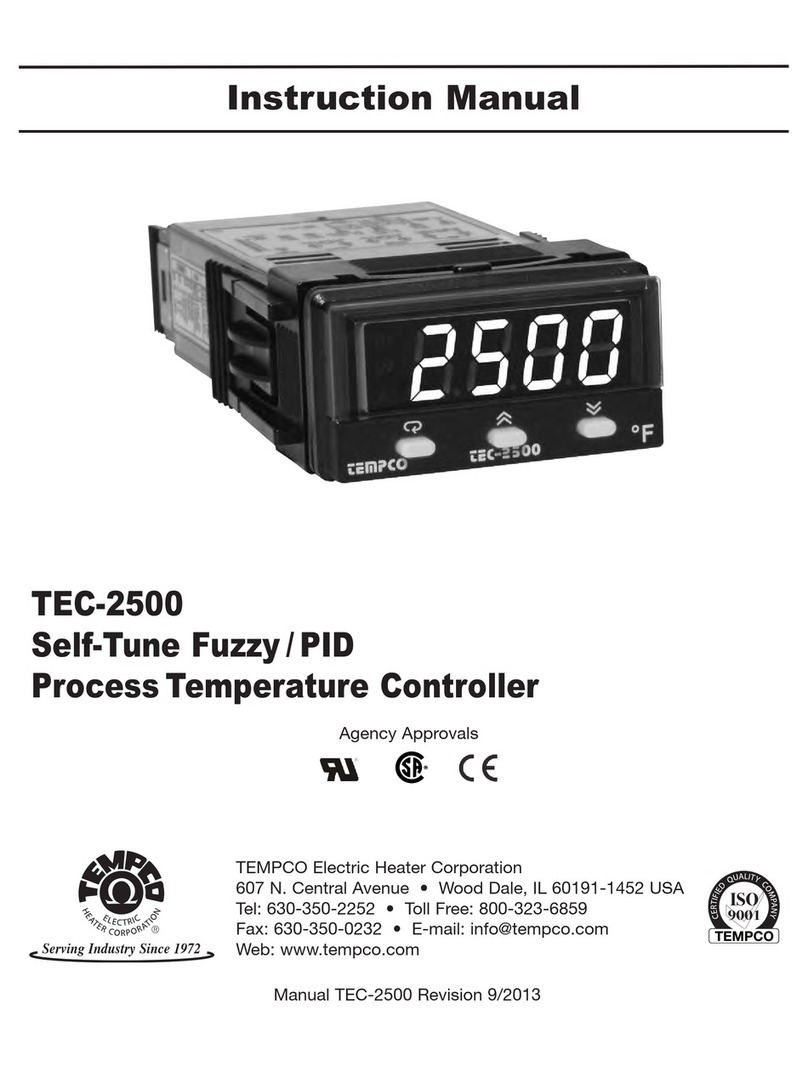
Example without well timer
Select MINR for RAMP, select °C for UNIT, select 1-DP for DP,
set RR=10.0. SV is set to 200°C initially, and changed to 100°C
30 minutes after power-up. The starting temperature is 30°C. After
power-up, the process runs like the curve shown below:
Figure 3.5 RAMP Function

Page 6 of 10
PV Shift
In certain applications it is desirable to shift the con-
troller display value (PV) from its actual value. This
can easily be accomplished by using the PV shift
function.
The SHIF function will alter PV only.
Example: A process is equipped with a heater, a sen-
sor, and a subject to be warmed up. Due to the design
and position of the components in the system, the sen-
sor could not be placed any closer to the part. Thermal
gradient (differing temperatures) is common and nec-
essary to an extent in any thermal system for heat to
be transferred from one point to another. If the differ-
ence between the sensor and the subject is 35°C, and
the desired temperature at the subject to be heated is
200°C, the temperature at the sensor should be 235°C.
You should enter -35°C to subtract 35°C from the ac-
tual process display. This in turn will cause the con-
troller to energize the load and bring the process
display up to the set point value.
The controller will enter failure mode if one
of the following conditions occurs:
1. SBER occurs due to input sensor break
or input current below 1mA if 4–20 mA
is selected or input voltage below 0.25V
if 1–5V is selected.
2. ADER occurs due to the A-D converter
of the controller failing.
Output 1 and output 2 will perform the fail-
ure transfer function as the controller enters
failure mode.
Output 1 failure transfer, if activated, will
perform:
1. If output 1 is configured as proportional
control (PB≠ 0), and BPLS is selected
for O1FT, then output 1 will perform
bumpless transfer. Thereafter, the previ-
ous averaging value of MV1 will be
used for controlling output 1.
2. If output 1 is configured as proportional
control (PB≠ 0), and a value of 0 to
100.0% is set for O1FT, then output 1
will perform failure transfer. Thereafter,
the value of O1FT will be used for con-
trolling output 1.
3. If output 1 is configured as ON-OFF
control (PB=0), then output 1 will be
driven OFF if OFF is set for O1FT and
will be driven ON if ON is set for O1FT.
Failure Transfer
Figure 3.7 PV Shift Application
Manual Control
Operation
To enable manual control, the LOC parameter should be set
to NONE, then press for 6.2 seconds;
(hand control) will appear on the display. Press for 5 sec-
onds, then the MAN indicator will begin to flash and the lower
display will show . The controller is now in manual
control mode. indicates output control variable for out-
put 1, and indicates control variable for output 2. Now
you can use the up and down keys to adjust the percentage
values for the heating or cooling output.
The controller performs open loop control as long as it stays
in manual control mode.
Exit Manual Control
Pressing the key will cause the controller to revert to its
normal display mode.
R

Page 7 of 10
Auto-tuning
The auto-tuning process is performed near the set point.
The process will oscillate around the set point during
the tuning process. Set the set point at a lower value if over-
shooting beyond the normal process value is likely to cause
damage.
Auto-tuning is applied in cases of:
• Initial setup for a new process
• The set point is changed substantially from the previous
auto-tuning value
• The control result is unsatisfactory
Operation:
1. The system has been installed normally.
2. Set the correct values for the setup menu of the unit, but
don’t set a zero value for PB and TI, or the auto-tuning pro-
gram will be disabled. The LOC parameter should be set
at NONE.
3. Set the set point to a normal operating value, or a lower value
if overshooting beyond the normal process value is likely to
cause damage.
4. Press and hold until appears on the display.
5. Then press again for at least 5 seconds. The AT indicator
will begin to flash and the auto-tuning procedure begins.
NOTE: The ramping function, if used, will be disabled when
auto-tuning is taking place.
Auto-tuning mode is disabled as soon as either failure mode or
manual control mode is entered.
Proce ures:
Auto-tuning can be applied either as the process is warming
up (cold start), or when the process has been in a steady state
(warm start). After the auto-tuning procedures are completed,
the AT indicator will cease to flash and the unit will revert to
PID control using its new PID values. The PID values ob-
tained are stored in the nonvolatile memory.
Auto- uning Error
If auto-tuning fails an ATER message will appear on the upper
display in the following cases:
• If PB exceeds 9000 (9000 PU, 900.0°F or 500.0°C),
• if TI exceeds 1000 seconds,
• if the set point is changed during the auto-tuning procedure.
Solutions to
1. Try auto-tuning once again.
2. Don’t change the set point value during the auto-tuning pro-
cedure.
3. Don’t set a zero value for PB and TI.
4. Use manual tuning instead of auto-tuning (see section 3-12).
5. Touch RESET key to reset message.
Manual Tuning
In certain applications auto-tuning may be inadequate for the
control requirements. You can try manual tuning for these ap-
plications.
If the control performance using auto-tuning is still unsatis-
factory, the following rules can be applied for further adjust-
ment of PID values:
Figure 3.9 shows the effects of PID
adjustment on process response.
Figure 3.9 Effects of PID Adjustment
able 3.2 PID Adjustment Guide

Page 8 of 10
Table A.1 Error Co es an Corrective Actions

Page 9 of 10
WARRANTY
Tempco Electric Heater Corporation is pleased to offer sugges-
tions on the use of its products. However, Tempco makes no war-
ranties or representations of any sort regarding the fitness for use,
or the application of its products by the Purchaser. The selection,
application, or use of Tempco products is the Purchaser's respon-
sibility. No claims will be allowed for any damages or losses,
whether direct, indirect, incidental, special, or consequential.
Specifications are subject to change without notice. In addition,
Tempco reserves the right to make changes–without notification
to the Purchaser–to materials or processing that do not affect com-
pliance with any applicable specification. TEC Temperature Con-
trollers are warranted to be free from defects in material and
workmanship for two (2) years after delivery to the first purchaser
for use. Tempco's sole responsibility under this warranty, at Tem-
pco's option, is limited to replacement or repair, free of charge, or
refund of purchase price within the warranty period specified.
This warranty does not apply to damage resulting from transporta-
tion, alteration, misuse, or abuse.
RETURNS
No product returns can be accepted without a completed Return
Material Authorization (RMA) form.
TECHNICAL SUPPORT
Technical questions and troubleshooting help is available from
Tempco. When calling or writing please give as much background
information on the application or process as possible.
E-mail: techsupport@tempco.com
Phone: 630-350-2252
800-323-6859
Incorrect parameters entered in menu (most common)
Excessive electrical interference
Line wires are improperly connected
No voltage between line terminals
Incorrect voltage between line terminals
Connections to terminals are open, missing or loose
Thermocouple (or RTD) is open at tip
Thermocouple (or RTD) is broken
Shorted thermocouple (or RTD) leads
Short across terminals
Open or shorted heater circuit
Open coil in external contactor
Burned out line fuses
Defective solid-state relays
Defective line switches
Burned out contactor
Defective circuit breakers
Common Causes of Failures
If the points listed above have been checked and the controller does not function, it is suggested
that the instrument be returned for inspection.
Please request an RMA (Return Material Authorization) number for return instructions.

Page 10 of 10
Complete Your Thermal Loop System
With Over 100,000 Various Items
Available from Stock
The Electric Heating Element, Temperature Controls and
Temperature Sensors Hand ook
REQUEST YOUR FREE 960 PAGE COPY TODAY!
Call (800-323-6859) or E-mail ([email protected])
Specify Print Edition, CD-ROM or Both
EMPCO’s Visionary Solutions™
Experience the Advantages of our Diverse and Innovative Products
© Copyright 2015. All Rights Reserved.
• Electric Heating Elements
• Thermocouples an RTD Assemblies
• SCR Power Controls
• Soli State Relays
• Mechanical Relays
• Vi eographic Data Recor ers
• Temperature Measurement
• Current In icators
• Thermocouple an Power Lea Wire
• Wiring Accessories
Serving Industry Since 1972
TEMPCO Electric Heater Corporation
607 N. Central Avenue • Wood Dale, I 60191-1452 USA
Tel: 630-350-2252 • Toll Free: 800-323-6859
Fax: 630-350-0232 • E-mail: [email protected]
Web: www.tempco.com
This manual suits for next models
3
Table of contents
Other Tempco Temperature Controllers manuals
Popular Temperature Controllers manuals by other brands

Monnit
Monnit PoE-X Duct Temperature Sensor user guide

SmartSense
SmartSense Temp/Humidity Booklet

Sure Electronics
Sure Electronics XMTS quick start guide

Sub-Zero
Sub-Zero SZ-7081 operating instructions

Automationdirect.com
Automationdirect.com SOLO SL4896 Series Quick start guid

Eurotronic
Eurotronic 700087 Installation & operation guide