manuals.online logo
Brands
  1. Home
  2. •
  3. Brands
  4. •
  5. TP-Link
  6. •
  7. Network Router
  8. •
  9. TP-Link TL-WR841HP User manual

TP-Link TL-WR841HP User manual

Other manuals for TL-WR841HP

9

Other TP-Link Network Router manuals

TP-Link Archer A9 User manual

TP-Link

TP-Link Archer A9 User manual

TP-Link Archer BE805 User manual

TP-Link

TP-Link Archer BE805 User manual

TP-Link PG1200 KIT User manual

TP-Link

TP-Link PG1200 KIT User manual

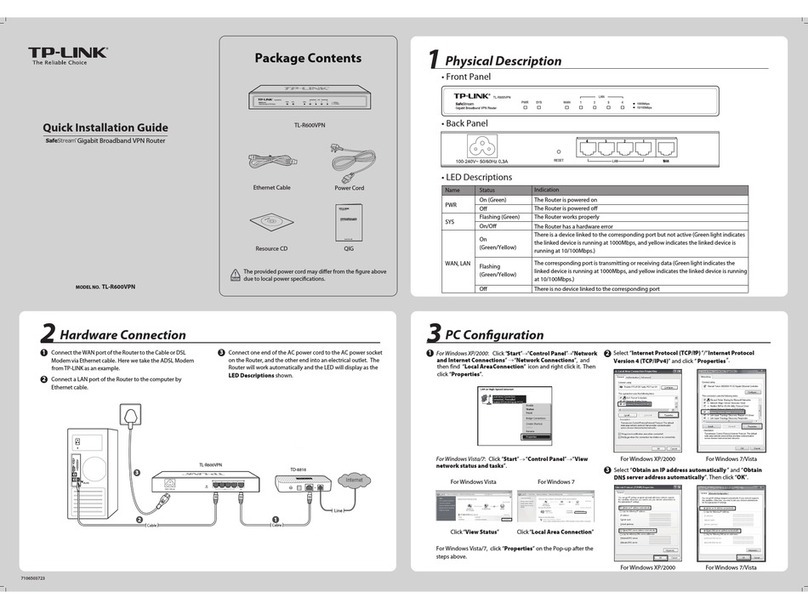
TP-Link SafeStream TL-R600VPN User manual

TP-Link

TP-Link SafeStream TL-R600VPN User manual

TP-Link ER8411 User manual

TP-Link

TP-Link ER8411 User manual

TP-Link TL-WR841N User manual

TP-Link

TP-Link TL-WR841N User manual

TP-Link TD-8841 User manual

TP-Link

TP-Link TD-8841 User manual

TP-Link Archer AX53 User manual

TP-Link

TP-Link Archer AX53 User manual

TP-Link Archer MR400 User manual

TP-Link

TP-Link Archer MR400 User manual

TP-Link ARCHER C3150 Instruction Manual

TP-Link

TP-Link ARCHER C3150 Instruction Manual

TP-Link Archer AXE200 Omni V1 User manual

TP-Link

TP-Link Archer AXE200 Omni V1 User manual

TP-Link AC1600 User manual

TP-Link

TP-Link AC1600 User manual

TP-Link AC600 User manual

TP-Link

TP-Link AC600 User manual

TP-Link TL-PA7020P User manual

TP-Link

TP-Link TL-PA7020P User manual

TP-Link TD-W9977 User manual

TP-Link

TP-Link TD-W9977 User manual

TP-Link TL-WR1043ND - Ultimate Wireless N Gigabit... User manual

TP-Link

TP-Link TL-WR1043ND - Ultimate Wireless N Gigabit... User manual

TP-Link Archer C50 User manual

TP-Link

TP-Link Archer C50 User manual

TP-Link EC120-F5 User manual

TP-Link

TP-Link EC120-F5 User manual

TP-Link Archer A9 User manual

TP-Link

TP-Link Archer A9 User manual

TP-Link TL-WR802N User manual

TP-Link

TP-Link TL-WR802N User manual

TP-Link SafeStream TL-R600VPN User manual

TP-Link

TP-Link SafeStream TL-R600VPN User manual

TP-Link Arher C3200 User manual

TP-Link

TP-Link Arher C3200 User manual

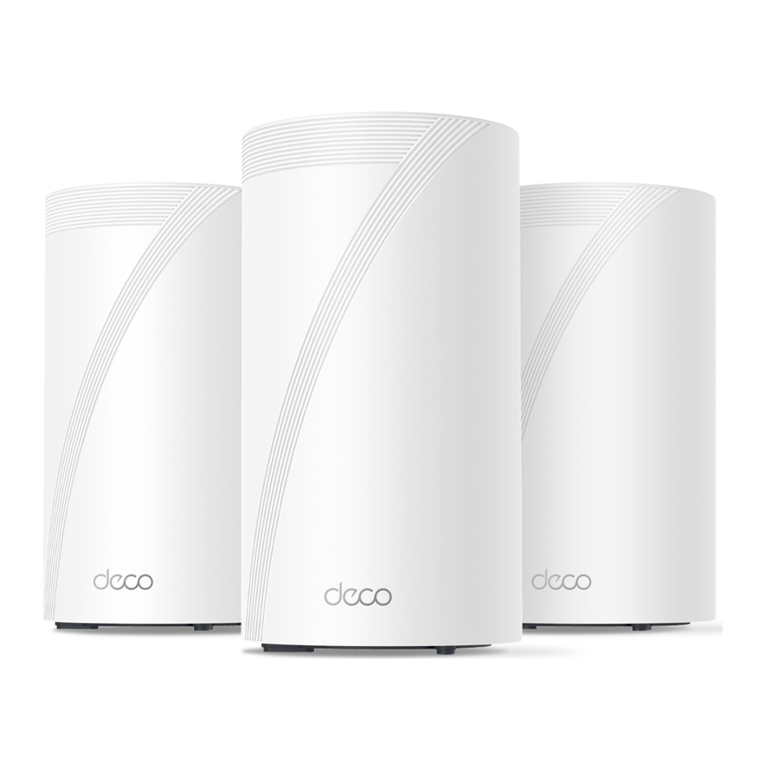
TP-Link Deco BE16000 User manual

TP-Link

TP-Link Deco BE16000 User manual

TP-Link Aginet MX515v User manual

TP-Link

TP-Link Aginet MX515v User manual

Popular Network Router manuals by other brands

TRENDnet TEW-435BRM - 54MBPS 802.11G Adsl Firewall M Quick installation guide

TRENDnet

TRENDnet TEW-435BRM - 54MBPS 802.11G Adsl Firewall M Quick installation guide

Siemens SIMOTICS CONNECT 400 manual

Siemens

Siemens SIMOTICS CONNECT 400 manual

Alfa Network ADS-R02 Specifications

Alfa Network

Alfa Network ADS-R02 Specifications

Barracuda Networks Link Balancer quick start guide

Barracuda Networks

Barracuda Networks Link Balancer quick start guide

ZyXEL Communications ES-2024PWR Support notes

ZyXEL Communications

ZyXEL Communications ES-2024PWR Support notes

HPE FlexNetwork 5510 HI Series Openflow configuration guide

HPE

HPE FlexNetwork 5510 HI Series Openflow configuration guide

Allied Telesis AT-AR236E quick start guide

Allied Telesis

Allied Telesis AT-AR236E quick start guide

ADTRAN NetVanta 3458-PoE quick start

ADTRAN

ADTRAN NetVanta 3458-PoE quick start

C&H Technologies EM405-8 manual

C&H Technologies

C&H Technologies EM405-8 manual

Huawei WiFi Mesh 3 Product description

Huawei

Huawei WiFi Mesh 3 Product description

Addonics Technologies ISC8P2G-S Quick install guide

Addonics Technologies

Addonics Technologies ISC8P2G-S Quick install guide

Atel W02 Arch+ Faqs

Atel

Atel W02 Arch+ Faqs

Allnet ALL0333AU user guide

Allnet

Allnet ALL0333AU user guide

Sercomm Genesis OC3505D Quick installation guide

Sercomm

Sercomm Genesis OC3505D Quick installation guide

Billion BIPAC 5102 Series user manual

Billion

Billion BIPAC 5102 Series user manual

Motorola MR1900 user guide

Motorola

Motorola MR1900 user guide

Cisco SOHO Series Regulatory compliance and safety information

Cisco

Cisco SOHO Series Regulatory compliance and safety information

NETGEAR WGE101 Reference manual

NETGEAR

NETGEAR WGE101 Reference manual

manuals.online logo
manuals.online logoBrands
  • About & Mission
  • Contact us
  • Privacy Policy
  • Terms and Conditions

Copyright 2025 Manuals.Online. All Rights Reserved.

Access Point Mode
[This mode transforms your existing wired network to a wireless network. ][This mode boosts your home wireless coverage.]
1. Connect the router to your wired host router’s Ethernet port via
an Ethernet cable as shown above.
2. Connect a computer to the router via an Ethernet cable or
wirelessly by using the SSID (wireless name) and password
printed on the bottom label of the router.
3. Launch a web browser and enter http://tplinkwifi.net or
http://192.168.0.1. Use admin for both the username and
password to log in.
4. Click on the top-right corner of the Web Management
Page and choose Access Point and then click Save. The router
will reboot automatically.
Mode
Quick Installation Guide
Start Here >>
Connect to the wireless network by using the SSID (wireless name)
and password of the router.
©2016 TP-LINK 7106506186 REV1.0.1
FASTER
AND
STRONGER
1
Configure
1. Connect a computer to the router via an Ethernet cable or
wirelessly by using the SSID (wireless name) and password
printed on the bottom label of the router.
2. Launch a web browser and enter http://tplinkwifi.net. Use
admin for both the username and password to log in.
3. Follow Quick Setup to configure.
Make sure to choose
Range Extender
and click
Survey
to choose
your host network and fill in its wireless password.
Option Two: Using Web Browser
Option One: Using RE Button
1. Press the WPS button on the host router.
2. Within 1 minute, press and hold the (RE)button on the
top panel of router for about 3 seconds. The router will start
to reboot.
3. After rebooted, the RE LED should change from blinking to a
solid state, indicating a successful connection.
If not, please refer to the Option Two.
Using the RE button is an easy way to extend your host network.
We recommend you to use this way if your host router has the
WPS button. The button might look like these: WPS
The extended network shares the same SSID (wireless name) and
password as your host network.
Place the router between your host router and the Wi-Fi “dead”
zone. The location you choose must be within the range of
your existing host network.
2
Relocate
Extended NetworkHost Network
Client
Host Router High Power Router
ClientHigh Power RouterWired Host Router
Ethernet4Ethernet3Ethernet1 Ethernet2Internet
Tether App
TP-LINK Tether provides the easiest way
to manage your router. Search for
TP-LINK Tether in the Apple App Store or
Google Play, or simply scan the QR code
to download Tether App.
Range Extender Mode
Router Mode Troubleshooting
Connect your device to the router and check the LED lights. Configure the router.
Launch a web browser and enter http://tplinkwifi.net or http://192.168.0.1.
Use admin for both username and password to log in, then follow Quick
Setup to complete the configuration.
6
5
If you have customized the SSID (wireless name) and password during the
configuration, you will have to reconnect your wireless devices to the new
wireless network.
[This mode enables multiple users to share Internet connection via an ADSL/Cable Modem. If your Internet connection is through an Ethernet cable from the
wall instead of through a modem, connect the Ethernet cable directly to the router’s Internet port, and skip Step 1, 2, 4.]
Wired:
Connect your computer to the
router’s Ethernet port via an
Ethernet cable.
Wireless:
Connect wirelessly by using the SSID
(wireless name) and password printed
on the bottom label of the router.
ON ON ON ON ON ON ON
Note: Restoring the router to its factory defaults will clear all previous conguration.
1. What can I do if I cannot log into the router’s Web Management Page?
If the computer is set to a static or fixed IP address, change the setting to obtain an
IP address automatically.
Verify if http://tplinkwifi.net or http://192.168.0.1 is correctly entered in the web
browser.
Use another web browser and try again.
Reboot your router and try again.
Disable and enable the network adapter in use again.
Clear browsing data and cookies of the browser.
2. What can I do if I cannot access the Internet?
Check if the Internet is working properly by connecting a computer directly to the
modem via an Ethernet cable. If not, contact your Internet Service Provider.
Log into the Web Management Page, and run the Quick Setup again.
Reboot your router and try again.
For cable modem users, reboot the modem. If the problem still exists, log into the
Web Management Page of the router, and go to Advanced > Network > MAC
Clone, click Clone MAC Address and then click Save.
3. What can I do if I forgot my wireless network password?
If you have not changed the default Wireless Password, it can be found on the
product label at the bottom of the router.
Log into the Web Management Page, go to Basic (or Setting)> Wireless to retrieve
or reset your wireless password.
4. How do I restore the router to its factory default settings?
While the router is powered on, press and hold the Reset button on the back panel
of the router until all the LEDs turn back on momentarily.
Log into the Web Management Page of the router, and go to Advanced (or
Setting)> System Tools > Factory Defaults, and click Restore. The router will
restore and reboot automatically.
5. What can I do if I forgot my password of the router’s Web Management
Page ?
Refer to Troubleshooting > 4 to reset the router, and then use the default admin
(all lowercase) for both username and password to log in.
For more information about the configuration, refer to User Guide which can be
downloaded in Support page at http://www.tp-link.com.
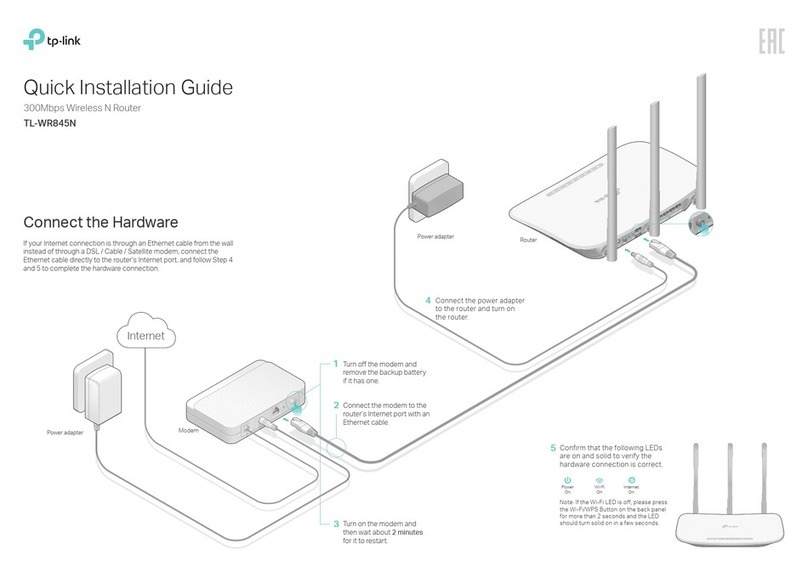
Turn off the modem, and
remove the backup battery if it
has one.
Replace the battery, turn on the
modem and wait about 2
minutes for it to restart.
Connect the modem to the
Internet port on the router
via an Ethernet cable.
Turn on the router.
Modem
1
4
23
Install antenna
Please note: The Router provides three working modes: Router,
Range Extender and Access Point. You can choose the mode to
better suit your network needs and follow the guide to
complete the configuration.
Remove the cap from
the router.
1
2
3
4
Slide the cap onto the
antenna until it xes into
place.
Position the antenna
vertically for best Wi-Fi
performance.
B. Make sure that the
adjustable elbow is facing
up when attached.
A. Insert and screw the
antenna into the antenna
socket.