EN 6
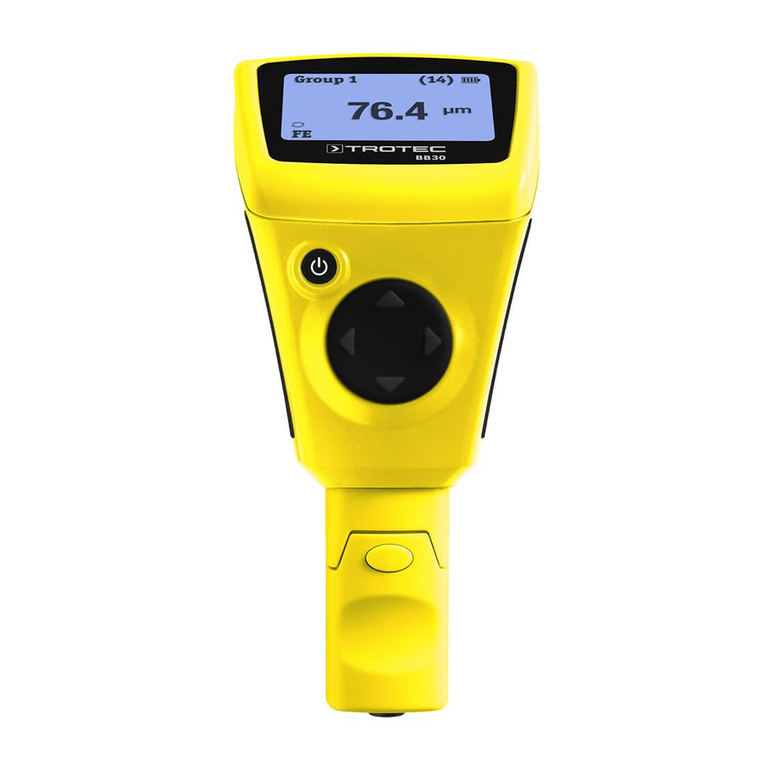
Operating manual – layer thickness measuring device BB30
Device calibration
Carry out a zero point calibration before each measuring
operation.
You can perform the calibration e.g. at an untreated or uncoated
spot of the object to be tested or use the set included in the
scope of delivery.
Info
Please bear in mind that the device at hand is a
precision measuring device that can determine coating
thicknesses of no more than a few micrometres (1µm
is equivalent to one thousandth of a millimetre).
The surface condition of most measuring objects is
hardly ever perfectly even and homogeneous, even
though it might appear differently to the naked eye.
Observed under the microscope, even the smoothest
surface looks much like a mountain and valley
landscape. The teensiest of scratches, cavities or
contaminations can therefore already have a negative
effect on the expected measurement result, seeing as
they will also be a part of the measurement to a
greater or lesser extent. It does, however, not affect
the accuracy of the device. Even after the calibration
unexpected measurement deviations of a few
micrometres always have to be regarded in this
context.
Hence it is important to handle the supplied calibration
accessories with care to avoid scratches and dirt on
their respective surface as far as possible.
Zero point calibration
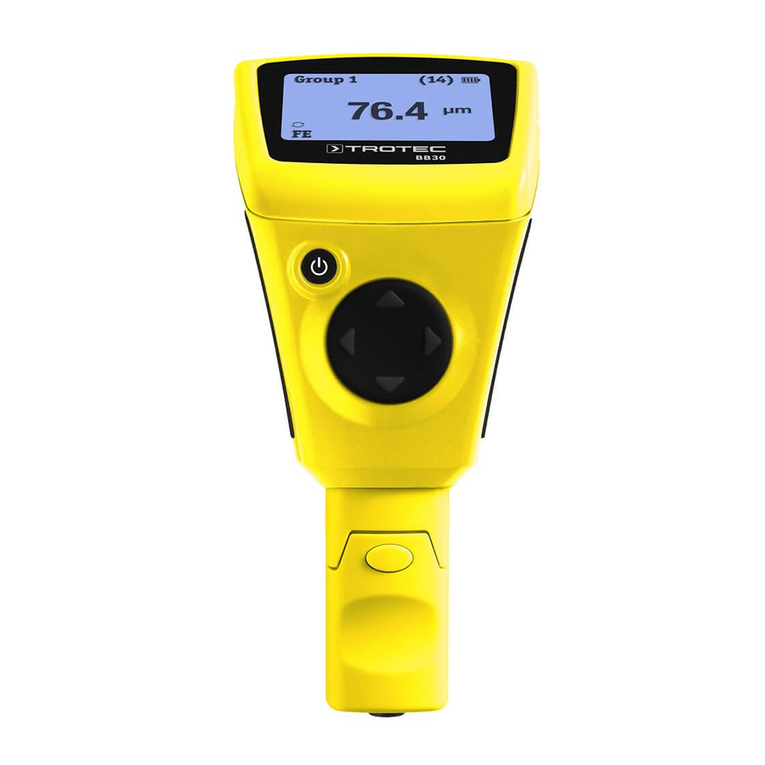
1. Press the Left button(2).
ðThe main menu will be called up.
2. Use the Up or Down button(2) to select the menu item
Calibration.
3. Confirm your selection by pressing the Left button(2).
ðThe Calibration submenu will be opened.
4. Select CAL Zero of FE for sensorF or CAL Zero of NFE for
sensorN.
5. Confirm your selection by pressing the Left button(2).
ðThe device switches to measuring mode.
ðCAL FE or CAL NFE will be indicated at the bottom of the
display.
6. Position the sensor(4) on an uncoated spot of the material
to be measured. The measured medium is to be identical
to the coated material to be measured thereafter in terms
of material composition, shape and surface condition.
ðThe measurement will be acknowledged with an
acoustic signal.
ðThe measured value will be indicated on the display.
ðIf the calibration was successful, the result should be
0.0.
ðOK and CANCEL will be indicated at the bottom of the
display.
7. Use the Left button(2) to confirm and complete the
calibration or cancel this process by use of the Right
button(2).
You can perform several measurements before confirming
or aborting.
ðThe main menu will be displayed.
ðIf cancelled, the calibration will not be saved!
ðIf confirmed, a zero point calibration will be carried out.
Designation Meaning
(sensor F = magnetic induction)
(sensor N = turbulent flow)
CAL Zero of FE Performing calibration for sensor F
CAL Zero of NFE Performing calibration for sensor N
DEL Zero of FE Deleting calibration for sensor F
DEL Zero of NFE Deleting calibration for sensor N
Quick access to the zero point calibration
1. Press the Up button(2) for approx. 3s.
ðThe following message will be displayed:
Zero Reference
Place Probe
2. Position the sensor(4) on an uncoated spot of the material
to be measured. The measured medium is to be identical
to the coated material to be measured thereafter in terms
of material composition, shape and surface condition.
ðThe measurement will be acknowledged with an
acoustic signal.
ðThe measured value will be indicated on the display.
ðThe following message will be displayed:
Zero Reference
Lift off Probe
ðAnother acoustic signal will be emitted, then the
calibration is completed.
Carrying out a measurement
Carry out a zero point calibration before each measuring
operation.
1. If you want to save your measured values, use the Up and
Down buttons(2) to select a group (Group(1) to
Group(50)) or else to perform individual measurements
select Group(0).
2. Select the desired measuring mode (see Setting the
measuring mode).
3. Position the sensor(4) on the material to be measured and
perform group measurements or individual measurements.
ðThe measured value will be indicated on the display(1).
ðThe measurement will be acknowledged with an
acoustic signal.