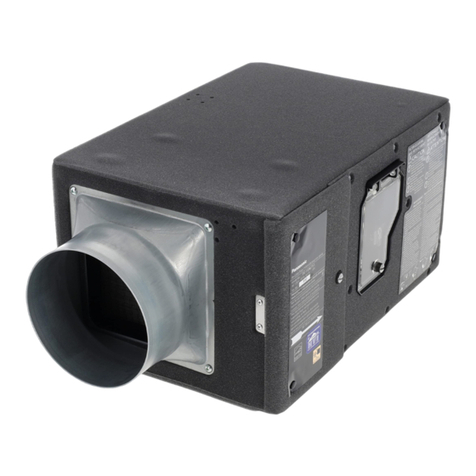
Vents KSB User manual

KSB
SOUNDINSULATED FAN
User’s Manual

2KSB
CONTENTS
Safety Requirements 3
Introduction 5
Use 5
Delivery set 5
Designation key 6
Technical Specications 6
Design and operating logic 8
Mounting and set-up 9
Power Mains Connection 10
Control 12
Technical Maintenance 14
Troubleshooting 15
Storage and transportation rules 15
Manufacturer's Warranty 16
Acceptance Certicate 17
Seller information 17
Installation Certicate 18
Warranty Card 19

3
www.ventilation-system.com
• Read this User’s Manual carefully prior to the operation and installation of the duct fan (hereinafter
«Fan»).
• Installation and operation of the fan shall be performed in accordance with the present User’s
Operation Manual as well as the provisions of all the applicable local and national construction,
electrical and technical codes and standards.
• The warnings contained in the present User’s Manual must be considered most seriously since they
contain vital personal safety information.
• Failure to follow the safety regulations may result in an injury or fan damage.
• Upon familiarization keep the User’s Manual for the entire service life of the fan.
• While transferring equipment control the User’s Manual must be turned over to the receiving
operator.
The symbols used in the present User’s Manual have the following meaning:
FAN INSTALLATION SAFETY PRECAUTIONS
ATTENTION!
RESTRICTED!
The fan must be disconnected
from the power mains prior
to every installation or repair
operation.
The fan must be grounded!
The fan must not be operated
outside the temperature
envelope stated in the User's
Manual or in aggressive or
explosive environments.
Do not use damaged equipment
or conductors to connect the fan
to the power mains.
While installing the fan follow the
safety regulations specic to the
use of power tools.
Unpack the fan with care.
Do not change the power cord
length at you own discretion. Do
not bend the power cord. Avoid
damaging the power cord.
Do not position any heating
devices or other equipment in
close proximity to the fan power
cord.
SAFETY REQUIREMENTS;

4KSB
FAN OPERATION SAFETY PRECAUTIONS
Do not touch the regulator
or the control panel with wet
hands. Do not carry out fan
maintenance with wet hands.
Do not wash the fan with
water. Avoid penetration of
water onto the electric parts
of the fan.
Use the fan only as intended
by the manufacturer. Do not
connect any drying machines
or other similar equipment
to the fan or the ventilation
circuit.
Do not put any water
containers (e.g. vases etc.)
on top of the fan.
Do not sit on the fan or put
any foreign objects on top of
the fan. OFF
ON
Disconnect the fan from the
power mains prior to any
technical maintenance.
Do not let children operate
the Fan.
Keep the power cord intact
while operating the fan. Do
not put any foreign objects
on top of the power cord.
Do not store any ammable
gases or highly ammable
substances in close proximity
to the fan.
Do not open the fan during
its operation.
Should the fan generate any
unusual sounds, smells or
smoke disconnect it from the
power mains and contact the
service centre.
Check the fan for secure
installation from time to
time in case of prolonged
operation.
Do not block the air duct while
the fan is working.
Do not direct the air ow
generated by the fan onto
combustion equipment or
burning candles.

5
www.ventilation-system.com
The present User’s Manual contains the technical details, operating instructions, technical specication
as well as the installation and mounting instructions specic to VENTS KSB Sound-Insulated Fan (hereinafter
«Fan»).
INTRODUCTION
USE
DELIVERY SET
The fan is intended for supply and exhaust ventilation of household, public and industrial spaces with
stringent noise emissions restrictions and conned installation space. The fan is designed for round air duct
systems.
The units allow continuous operation without disconnection from the power mains.
The fan is a component unit and is not designed for autonomous operation.
The air being handled must not contain any combustible or explosive mixtures, chemical fumes, coarse
dust, soot, fat or any environment prolic for the formation of harmful substances (toxic substances, dust and
pathogens) as well as sticky substances and brous materials.
Fan - 1 piece;
User’s Manual - 1 piece;
Shipping Box - 1 piece.
THE FAN IS NOT INTENDED FOR OPERATION BY CHILDREN OR ANY PERSONSWITH LIMITED
SENSORY OR MENTAL CAPACITY AS WELL PERSONS LACKING THE REQUIRED TRAINING.
THE FAN MUST BE HANDLED ONLY BY PROPERLY QUALIFIED PERSONNEL AFTER THE
APPROPRIATE SAFETY BRIEFING. THE CHOICE OF FAN INSTALLATION LOCATION MUST
PREVENT UNAUTHORIZED ACCESS BY UNATTENDED CHILDREN.

6KSB
TECHNICAL SPECIFICATIONS
Power Cord
_ - equipped with a junction box;
R- equipped with a power cord with IEC С14 plug;
R1 - equipped with a power cord with a wall socket plug
(depending on the country of intended use)
Motor on vibration mounts
M
Unit Designation
KSB
KSB ХХХ Х Х ХХХ Х
Temperature and speed controller availability
U- electronic temperature-controlled module, temperature
sensor in the fan duct;
Un - electronic temperature-controlled module, remote-position
temperature sensor;
U1 - electronic time-controlled module, temperature sensor in
the fan duct;
U1n - electronic time-controlled module, remote-position
temperature sensor.
High-performance motor
S
Fitting Diameter
100, 125, 150, 160, 200, 250, 315
The fan is designed for operation in an enclosed area at ambient temperatures from -25 ºС to + 55 ºС at
relative humidity of up to 80% (at +25 ºС).
The unit meets the requirements of IPX4 hazardous parts access and water ingress protection standard.
The main outside and connecting dimensions as well as the appearance and technical parameters of the
unit are given on Figure 1 and in Tables 1 and 2.
The fan undergoes continuous improvement - therefore, some models may slightly dier from the ones
described herein.
DESIGNATION KEY

7
www.ventilation-system.com
Type Dimensions [mm] Масса, кг
ØD B В1 H L L1 L2
KSB 100 99 322 280 192 447 380 350 5,4
KSB 125 124 322 280 192 447 380 350 5,4
KSB 150 149 352 310 212 477 410 380 6,4
KSB 160 159 352 310 212 477 410 380 6,4
KSB 200 199 432 368 287 588 506 480 10,0
KSB 200S 199 432 368 287 588 506 480 12,0
KSB 250 249 432 368 287 588 506 480 12,5
KSB 315 314 502 438 397 648 566 540 15,5
Table 1
Type
Supply Voltage,
50 Hz [V]
Power
Consumption [W]
Current [А]
Max. Air Flow
[m3/h]
Rotation speed
[min-1]
Sound Pressure
Level at 3m. [dB(A)]
Max. transported air
temperature [°C]
Protection rate
KSB 100
230
73 0,32 240 2560 33 -22 +55
IP X4
KSB 125 73 0,32 330 2590 35 -22 +55
KSB 150 72 0,32 420 2600 36 -22 +55
KSB 160 75 0,33 420 2690 36 -22 +55
KSB 200 103 0,45 730 2550 38 -22 +55
KSB 200S 195 0,85 950 2570 41 -22 +45
KSB 250 198 0,87 1300 2420 41 -22 +55
KSB 315 322 1,40 2150 2670 43 -22 +45
Table 2
Fig. 1

8KSB
The fan casing is made of galvanized steel sheets with additional thermal and sound-insulation layers. The
round ttings are equipped with rubber gaskets (see Fig. 2).
The fan is equipped with a bipolar asynchronous motor with an external rotor and a centrifugal impeller
with backward-curved blades. The motor is equipped with built-in thermal protection enabling its automatic
restarting. The motor utilizes ball bearings with a specially selected lubricant which drastically reduce the fan
noise and ensure maintenance-free operation. To further reduce the noise resulting from the fan vibration the
motor can be mounted on rubber vibration mounts (KSB...M).
There is also a higher performance motor option (KSB…S) available for select standard sizes.
DESIGN AND OPERATING LOGIC
Fig. 2
Sound Insulation Material
Impeller
Terminal Block
Electronic Module
(optional)
Casing
Sealed Lead-In
Mounting Bracket

9
www.ventilation-system.com
INSTALLATION AND SETUP
Duct fans are intended for installation into round air ducts. The fans are installed into air duct splits.
The casing has mounting brackets to ensure optimum placement of the fan.
In case the fan is mounted on exible joints attach the fan to the structural unit by means of supports,
suspension links or brackets.
The fan may be installed in any position in consideration of the air ow direction (as indicated by the arrow
on the fan casing).
To reduce the aerodynamic drag resulting from the air ow turbulence provide for a straight section equal
to 1 air duct diameter on the fan intake side and one equal to 3 air duct diameters on the fan exhaust side. The
said sections must be free of any lters or other devices.
Make sure to arrange unimpeded access for the fan maintenance.
Having unpacked the fan and prior to installation:
Carefully read the instructions specic to the fan installation, operation and maintenance;
Check the fan for integrity and signs of transit damage.
Follow the safety regulations during the make-ready procedures and fan operation.
The fan installation procedure is as follows:
Make sure that the motor is de-energized (see Fig. 3.1);
Apply the markings for mounting the brackets onto the structural surface (unit) (see Fig. 3.2);
Drill the holes and fasten the fan on the brackets by using appropriate fasteners (e.g. expansion
bolts) (see Fig. 3.3);
Connect the ducts to the fan (see Fig. 3.4).
Fig. 3
1. 2.
3. 4.
S1

10 KSB
CONNECTION TO POWER MAINS
THE FAN MUST BE CONNECTED TO THE POWER MAINS ONLY BY QUALIFIED PERSONS
HAVING BEEN MADE FAMILIAR WITH THE PRESENT OPERATION MANUAL. THE UNIT IS
INTENDED FOR CONNECTION TO AC MAINS SUPPLYING THE VOLTAGE COMPLIANT WITH
THE TECHNICAL SPECIFICATION CHART. CHECK THE ENTIRE POWER CORD LENGTH FOR
CHOKING. DO NOT SWITCH ON THE UNIT IF THE POWER CORD IS DAMAGED. DISCONNECT
THE FAN FROM THE POWER SUPPLY PRIOR TO ANY WORK ON THE UNIT! THE NOMINAL
ELECTRICAL PARAMETERS OF THE UNIT ARE GIVEN ON THE MANUFACTURER’S LABEL.
ANY TAMPERING WITH THE INTERNAL CONNECTIONS IS PROHIBITED AND WILL VOID THE
WARRANTY.
The fan is intended for connection to a single-phase 230 V/50 Hz AC mains.
Depending on the conguration there are two possible options for fan connection to the power mains:
via the plugged power cord;
via the junction box.
The fan connections (cables and wires) must be durable, insulated and heat-resistant. The external lead-in
must be equipped with an automatic cutout switch built into the stationary wiring to disconnect all the power
mains phases. The external switch position must ensure free access for quick power-o of the unit.
The recommended automatic switch nominal current is 2 A for for KSB 315 and 1 A for all other modications.
The recommended minimum conductor section is 0.75 mm2. The conductor selection shall be based on the
maximum permissible wire heating depending on the wire type, its insulation, length and installation method
(i.e. overhead, in pipes or inside the walls).
The power mains connection steps are as follows:
1. Internal fan connections:
Undo the screws securing the upper casing panel (see Fig. 4.1);
Remove the upper panel (see Fig. 4.2);
Run the power supply cable through the sealed lead in the side wall; Strip the wire tips to 7 - 8 mm;
Connect the wires to the terminal block in accordance with the electrical connections diagram and
the terminal markings (see Fig. 5). To do this insert the wires into the respective terminals until the insulation
stops against the metal part and secure the wires with clamping screws;
Assemble the fan.
2. Connection via the junction box.
In case of the fan connection to the power mains via the junction box the connection diagram and the
terminal markings also apply (see Fig. 5).

11
www.ventilation-system.com
Fig. 5
X1
L
PE
N
L
PE
N
~230 В
50 Гц
QF
~230 В
50 Гц
QF
Автоматический
выключатель
QF
Автоматический
выключатель
~230 В
50 Гц
Распределительная
коробка
1 - Terminal Block;
QF - is an automatic switch (not
included in the delivery package).
Fig. 4
1. 2.

12 KSB
CONTROL
Fig. 6
min max
21
22
23
24 25 26
27
28
29
t C
30° C20° C
Speed Adjustment Knob
Thermostat Adjustment Knob
Thermostat Threshold LED
Depending on the conguration the fan may be equipped with an electronic temperature and speed
control module (see Fig. 6).
KSB fan is a perfect solution for ventilation systems for premises which require air temperature control
(i.e. greenhouses). The fan equipped with the electronic temperature and speed control module automatically
changes the impeller speed (air ow rate) relative to the temperature in the ventilation duct or on the premises.
The front panel of the electronic module has the
following controls and indicators:
Impeller speed pre-set knob;
Electronic thermostat operating threshold knob;
Thermostat operation indicator.
The fan is available in two variants:
with a temperature sensor built into the fan duct
(«U»/»U1» option);
with a remote-position temperature sensor
attached to a 4 m long cable («Un»/U1n» option).
The operation algorithm of KSB fans equipped with the electronic temperature and speed control
module is as follows:
Set the desired air temperature (thermostat operating threshold) by turning the thermostat adjustment
knob and the minimum rotation speed (air ow rate) by turning the speed adjustment knob. If the temperature
increases above the pre-set thermostat operating threshold the automatic circuit will switch the fan to
maximum rotation speed (maximum air ow rate). If the temperature decreases below the pre-set thermostat
operating threshold the automatic circuit will switch the fan to the previously set rotation speed.
The operation algorithm includes a speed switching delay preventing frequent switching of the motor
speed in case the duct temperature remains at the threshold value. Depending on the case the following two
delay algorithms are applied:
1. Temperature sensor feedback delay («U» option):
Upon the air temperature increasing by 2 °C above the pre-set thermostat operating threshold the fan will
switch to a higher speed.The fan will switch to the pre-set (low) speed upon the temperature decreasing below
the pre-set temperature threshold. This algorithm is used to maintain the air temperature with a 2 °C accuracy.
The fan speed is switched at reasonably frequent intervals.
2. Timer feedback delay (KSB…U1).
Upon the air temperature increasing above the pre-set thermostat operating threshold the fan will switch
to a higher speed with simultaneous activation of the 5 minute delay timer. The fan will then switch to the
pre-set (lower) speed upon the temperature decreasing below the pre-set temperature threshold only upon
elapsing of the 5 minute timer providing for the delay.
The above algorithm is used to precisely maintain the air temperature as desired. Compared to the U option

13
www.ventilation-system.com
algorithm the U1 fan speed is switched more frequently with a 5 minute minimum period for maintaining each
speed.
Example of Temperature Sensor Feedback Delay.
Initial Conditions:
Rotation speed = 60 % of the maximum;
Operation threshold = +25 °C;
Air duct temperature = +20 °C.
Fan impeller rotation speed = 60 %
Air duct temperature increases
Fan impeller rotation speed = 60 %
Air duct temperature reaches +27 °C
Fan switches to impeller rotation speed = 100 %
Air duct temperature starts falling
Fan impeller rotation speed = 100 %
Air duct temperature reaches 25 °C
The fan switches to the previously selected rotation speed (= 60 %).
Timer Feedback Delay Example.
Initial Conditions:
Rotation speed = 60 % of the maximum;
Operation threshold = +25 °C;
Air duct temperature = +20 °C.
Fan impeller rotation speed = 60 %
Air duct temperature increases, reaches +25°C and continues to grow;
The fan switches to impeller rotation speed = 100 % with simultaneous activation of the 5 minute timer;
Air duct temperature starts falling;
Fan operates at impeller rotation speed = 100 %
Air duct temperature reaches +25 °C and continues to drop;
Fan runs until the timer elapses and then switches to the previously selected rotation speed (= 60 %). After
switching to the previously selected speed (= 60 %) the 5 minute timer will activate again;
Air duct temperature increases, reaches +25°C and continues to grow;
Fan runs until the timer elapses and then switches to impeller rotation speed =100% (with simultaneous
activation of the 5 minute timer).
In other words while following the timed delay algorithm the delay timer will activate on each switching
of the fan speed.

14 KSB
TECHNICAL MAINTENANCE
The technical maintenance and repair of the fan may commence only after its disconnection from the
power mains and all the rotating parts coming to a complete halt.
The technical maintenance includes periodic cleaning of the surfaces from accumulated dust and dirt.
The impeller blades require thorough cleaning every 6 months.
To clean the blades:
Disconnect the fan from the power mains;
Wipe the exterior surfaces of the fan casing (see Fig. 7.1);
Undo the screws and remove the upper fan panel (see Fig. 7.2 and 7.3);
Clean the impeller blades using a soft brush or compressed air (see Fig. 7.4).
Avoid penetration of liquid onto the electric motor and inside the electronic equipment bay. Blade
cleaning must be approached with caution so as not to displace the balancing weights of the impeller wheel.
Upon cleaning perform all the above operations in the reverse order.
Fig. 7
1. 2.
3. 4.

15
www.ventilation-system.com
TROUBLESHOOTING
Possible Malfunctions and Their Elimination
Problem Possible Reasons Fault handling
Fan will not start
The unit is not connected to the power
mains.
Make sure that the unit is properly
connected to the power mains and make
any corrections, if necessary.
Motor seizure.
Switch o the fan. Eliminate the reason
that has caused the motor seizure. Switch
on the fan again.
The automatic
breaker activates
upon the unit power-
up
Excessive electric current consumption
caused by a short circuit.
Switch o the fan. Contact the service
centre.
Noise and vibration
Fan impeller clogging. Clean the fan impeller.
Loose screw connections. Check the fastening screws and tighten,
if necessary.
Table 3
STORAGE AND TRANSPORTATION RULES
The fan must be stored in the original packing in a ventilated area at the temperature from +10 °C ai +40 °C.
The air must not contain any vapors or admixtures which may lead to corrosion or compromise the
connection integrity.
Use only suitable lifting equipment for handling operations to prevent fan damage. Follow the applicable
moving regulations specic to the cargo type.
The fans can be carried by any transport provided their adequate protection from atmospheric precipitation
and mechanical damage. Avoid jolts and collisions while loading and unloading.

16 KSB
MANUFACTURER’S WARRANTY
The manufacturer hereby warrants normal fan operation over the period of 24 months from the retail sale date provided
observance of the transportation, storage, installation and operation regulations. Should any malfunctions occur in the course
of the fan operation through the manufacturer’s fault during the warranty period the user is entitled to elimination of faults by
means of warranty service performed by the manufacturer. The warranty service includes work specic to elimination of faults
in the fan operation to ensure its intended use by the user within the warranty period. The faults are eliminated by means of
replacement or repair of the complete fan or the faulty part of such a fan.
The warranty repair does not include:
• Routine maintenance;
• Fan installation/dismounting;
• Fan setup.
To benet from warranty repair the user must provide the fan, the User’s Manual with stamped sale date and the payment
document certifying the purchase. The fan model must comply with the one stated in the User’s Manual.
Contact your Seller for warranty service.
The manufacturer’s warranty does not apply to the following cases:
• User’s failure to provide the fan with the entire delivery package as stated in the User’s Manual or with missing
component parts previously dismounted by the user;
• Mismatch of the fan model and manufacturer with the respective details stated on the fan packing and in the User’s
Manual;
• User’s failure to ensure timely technical maintenance of the fan;
• Exterior damage to the fan casing (with the exception of exterior modications of the fan
• as required for its installation) or damaged internal components;
• Alteration of the fan design or engineering changes of the fan;
• Replacement and use of fan assemblies, parts and components not approved by the manufacturer;
• Fan misuse;
• User’s violation of the fan installation regulations;
• User’s violation of the fan control regulations;
• Fan connection to the power pains with a voltage dierent from the one stated in the User’s Manual;
• Fan breakdown due to voltage surges in the power mains;
• User’s discretionary repair of the fan;
• Fan repair performed by any persons without the manufacturer’s authorization;
• Elapsing of the fan warranty period;
• User’s violation of the established regulations specic to the fan transportation;
• User’s violation of the fan storage regulations;
• Wrongful acts against the fan committed by third persons;
• Fan breakdown due to circumstances of insuperable force (re, ood, earthquake, war, hostilities of any kind,
blockade);
• Missing seals if provided by the User’s Manual;
• Failure to provide the User’s Manual with the sale date stamp;
• Missing payment document certifying the fan purchase.
FOLLOWING THE REGULATIONS STIPULATED HEREIN WILL ENSURE A LONG AND TROUBLEFREE
OPERATION OF THE FAN.
USERS’ CLAIMS SHALL BE SUBJECT TO REVIEW ONLY UPON PRESENTATION OF THE FAN, THE
PAYMENT DOCUMENT AND THE USER’S MANUAL WITH THE SALE DATE STAMP.

17
www.ventilation-system.com
ACCEPTANCE CERTIFICATE
SELLER INFORMATION
Shop name
Address
Phone Number
E-mail
Sale date
This is to certify delivery of the complete fan with the User’s Manual. The warranty terms and service centre
list are acknowledged and accepted.
Customer signature
Seller stamp here
Product Type Sound-Insulated Fan
Model VENTS KSB______________
Serial Number
Manufacturing Date
The fan is recognized as serviceable.
Quality Inspector's
Stamp

18 KSB
MOUNTING CERTIFICATE
VENTS KSB ______________ Sound-Insulated fan
has been installed and connected to the power mains in accordance with
the provisions stated herein.
Company Name
Address
Phone Number
Installation
Technician’s Full Name
Mounting date
Signature:
Installer stamp here
This is to certify that the work specic to the fan installation has been performed in accordance with all the
applicable provisions of local and national construction, electrical and technical codes and standards. The
fan operates normally as intended by the manufacturer.
Signature:

19
www.ventilation-system.com
WARRANTY CARD
Product Type Sound-Insulated Fan
Model VENTS KSB________________
Serial Number
Manufacturing
Date
Sale date
Warranty Period
Selling Company
Seller Stamp here

2013
V51EN-02
Table of contents
Other Vents Fan manuals

Vents
Vents CBF LP 200 User manual

Vents
Vents Centro-MZ 100 User manual

Vents
Vents PA 01 W User manual

Vents
Vents VV 180 User manual

Vents
Vents Quiet User manual

Vents
Vents M1 Series User manual

Vents
Vents TwinFresh Comfo RA-25 User manual

Vents
Vents VDK Series User manual

Vents
Vents TT EC User manual

Vents
Vents TT Silent-M Series User manual

Vents
Vents TwinFresh Expert RW1-50 User manual

Vents
Vents VKV User manual

Vents
Vents VKV Series User manual

Vents
Vents Quiet-dMEV 100 DC User manual

Vents
Vents VCU(z) Series User manual

Vents
Vents VK Series User manual

Vents
Vents TT PRO EC User manual

Vents
Vents KSA Series User manual

Vents
Vents VKDV-K2 Series User manual

Vents
Vents TT User manual