6
Cordless Li-Ion handy saw EN
a) Do not force the power tool. Use the correct
power tool for your application. The correct
power tool will do the job better and safer at
the rate for which it was designed.
b) Do not use the power tool if the switch
does not turn it on and off. Any power tool
that cannot be controlled with the switch is
dangerous and must be repaired.
c) Disconnect the plug from the power
source and/or remove the battery pack,
if detachable, from the power tool before
making any adjustments, changing
accessories, or storing power tools. Such
preventive safety measures reduce the risk of
starting the power tool accidentally.
d) Store idle power tools out of the reach of
children and do not allow persons unfamiliar
with the power tool or these instructions
to operate the power tool. Power tools are
dangerous in the hands of untrained users.
e) Maintain power tools and accessories. Check
for misalignment or binding of moving parts,
breakage of parts and any other condition
that may affect the power tool’s operation. If
damaged, have the power tool repaired before
use. Many accidents are caused by poorly
maintained power tools.
f) Keep cutting tools sharp and clean. Properly
maintained cutting tools with sharp cutting
edges are less likely to bind and are easier to
control.
g) Use the power tool, accessories and tool bits
etc. in accordance with these instructions,
taking into account the working conditions
and the work to be performed. Use of the
power tool for operations different from those
intended could result in a hazardous situation.
h) Keep handles and grasping surfaces dry,
clean and free from oil and grease. Slippery
handles and grasping surfaces do not allow
for safe handling and control of the tool in
unexpected situations.
5) Battery tool use and care
a) Recharge only with the charger specied by
the manufacturer. A charger that is suitable
for one type of battery pack may create a risk
b) Use power tools only with specically
designated battery packs. Use of any other
battery packs may create a risk of injury and
c) When battery pack is not in use, keep it away
from other metal objects, like paper clips,
coins, keys, nails, screws or other small
metal objects, that can make a connection
from one terminal to another. Shorting the
battery terminals together may cause burns
d) Under abusive conditions, liquid may be
ejected from the battery; avoid contact. If
If liquid contacts eyes, additionally seek
medical help. Liquid ejected from the battery
may cause irritation or burns.
e) Do not use a battery pack or tool that is
damaged or modied.
batteries may exhibit unpredictable behaviour
f) Do not expose a battery pack or tool to re
or excessive temperature.
or temperature above 130 °C may cause
explosion.
g) Follow all charging instructions and do not
charge the battery pack or tool outside
the temperature range specied in the
instructions. Charging improperly or at
damage the battery and increase the risk of
6) Service
a) Have your power tool serviced by a
qualied repair person using only identical
replacement parts. This will ensure that the
safety of the power tool is maintained.
b) Never service damaged battery packs.
Service of battery packs should only be
performed by the manufacturer or authorized
service providers.
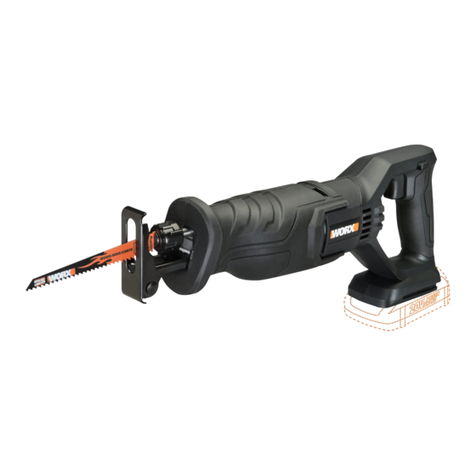
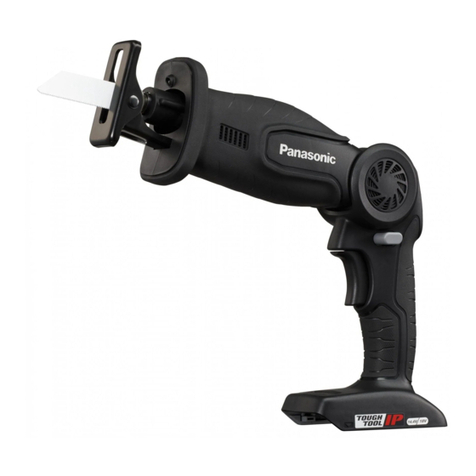
RECIPROCATING SAW
SAFETY WARNINGS
1. Hold reciprocating saw by insulated gripping
surfaces, when performing an operation
where the cutting accessory may contact
hidden wiring. Cutting accessory contacting
a “live” wire may make exposed metal parts
of the power tool “live” and could give the
operator an electric shock.