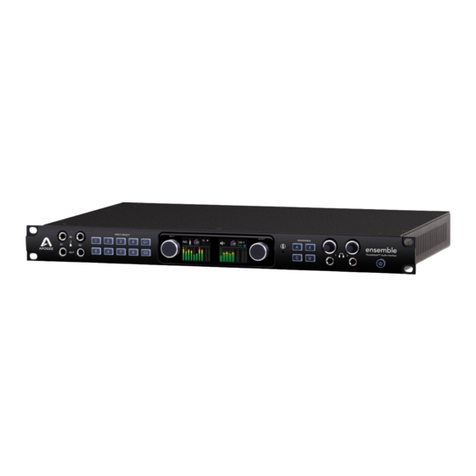
Apogee ensemble User manual

Multi–Channel,
24bit/192kHz Audio Interface
for the Macintosh
User’s Guide
v1.1 – October 2006


............................................................................................................. 2
................................................................................................................... 3
.......................................................................................... 4–7
............................................................................................ 4
....................................................................................... 4
............................................................................................ 5
................................................................................................. 5
............................................................................................ 6
.......................................................................................................... 7
................................................................................................... 8–11
...................................................... 8
............................... 8
.............................................................................................. 9
................................................................... 9
............................................................................................. 9
............................................................................................................. 9
.................................................................................................. 9
........................................................................................ 10
...................................................................................... 11
............................................ 12–13
................................................................................................ 13
................................................................. 14–15
............................................................................. 16–17
............................................................................ 16–17
.................................................................................... 18
............................................................................ 19
.................................................................................... 20–21
................................................................................... 20
.................................................................................. 21
.................................................................. 22–23
.......................................................................................... 22
.............................................................................................. 22
...................................................................................... 23
................................................................................................ 23
.................................................................................................... 24–25
............................................................................................ 26
..................................................................................... 27
........................................................... 28
User’s Guide
Table of Contents
Owners Record
Introduction
Getting Started Quickly
1. Installing software
2. Hardware connections
3. OS X configuration
4. iTunes playback
5. DAW configuration
6. Recording
General Operation
Making Settings with Software Control Panels
Making Settings with Ensemble’s Front Panel Encoder Knobs
Setting Sample Rate
Using 176.4–192 kHz Sampling Rates
Setting Clock Source
Digital I/O
Ensemble Routing
Input Routing Diagram
Output Routing Diagram
Connecting and Configuring Multiple Ensembles
Advanced Clocking
Maestro – Settings – Control Panel
Maestro – Settings – Output
Maestro – Settings – Mic Pre
Navigating the Front Panel
Connections on the Rear Panel
Connecting Your Studio
Basic studio configuration
5.1 surround configuration
Configuring Audio Software Apps
Apple Soundtrack Pro
Apple Final Cut Pro
MOTU Digital Performer
Steinberg Nuendo
Troubleshooting
Warnings & Copyrights
Declarations of Conformity
Registration and Warranty Information

APOGEE ELECTRONICS
2
Ensemble – User’s Guide
The serial number is located on the rear panel of the unit. We suggest you record the serial number
in the space provided below. Refer to it whenever you call an authorized Apogee Electronics repair
facility or the manufacturer. Please be sure to return your completed warranty card immediately!
Ensemble Serial No._________________________________________________
Purchase Date__________________________________________________________
Dealer_________________________________________________________________
Phone_________________________________________________________________
Address________________________________________________________________
CAUTION:
Any changes or modifications not expressly approved by APOGEE ELECTRONICS
CORPORATION could void your authority to operate this equipment under the FCC rules.
Please register this unit by filling in the included registration card, or registering online at
http://www.apogeedigital.com/support/register.php Please read this manual – if you call for
technical support, we’ll assume that you have. There will be a quiz.
OWNER’S RECORD

APOGEE ELECTRONICS
Ensemble – User’s Guide
3
Introduction
Ensemble is a digitally–controlled Firewire audio interface specifically designed for Apple Macintosh
computers. From mic preamps to Mac CoreAudio connectivity to headphone outputs, Ensemble includes all
that’s necessary for a high–quality Mac–based recording system.
Ensemble includes several of Apogee’s Core technologies, including:
SoftLimit
Soft Limit is an analog peak limiting circuit that instantaneously and gracefully controls transient peaks,
thereby allowing an additional 4 dB of headroom. Soft Limit may be engaged on all 8 Ensemble analog
inputs.
UV22HR
UV22HR is Apogee’s industry standard dither algorithm for reducing the word–length of a digital audio signal
from 24 to 16 bits. UV22HR is also being employed to produce dramatically improved internet and computer
audio content without increased file sizes or data rates.
Apogee Sample Rate Conversion (SRC)
Ensemble’s hardware sample rate conversion provides a high quality, flexible solution for working with digital
audio hardware and software running at different sample rates. Ensemble’s sample rate conversion may
be applied to a digital input (to convert an input stream to Ensemble’s sample rate) or to a digital output (to
provide an output stream at a user selected sample rate different than Ensemble’s rate).
Ensemble Requirements
1. Apple PowerMac 1.5GHz or higher, 512MB of RAM required, 1GB recommended
2. OS X 10.4.6
3. Apple Logic Pro 7.2.1
4. One Firewire 400 cable (per Ensemble)

APOGEE ELECTRONICS
4
Ensemble – User’s Guide
Getting Started Quickly
1. Installing software
VERY IMPORTANT!
BEFORE CONNECTING ENSEMBLE...
Insert the CD that is attached to this document
into your Mac and double click on the “Apogee
Software Installer”. Follow the on screen instruc-
tions to install the necessary software (figure 1).
2. Hardware connections
Using the enclosed FireWire cable, connect one
of Ensemble’s FireWire ports to a FireWire 400
port on your Mac (figure 2).
Connect Ensemble’s AC input to an AC outlet
of 90 to 250 volts; Ensemble’s power switch will
illuminate to indicate the presence of AC. Press
the power switch to turn the unit on (figure 3).
Connect a pair of headphones to Ensemble’s
1 output (figure 4).
figure 1
figure 2
figure 3
figure 4

APOGEE ELECTRONICS
Ensemble – User’s Guide
5
3. OS X configuration
From your Mac’s Apple menu bar, open the
System Preferences window, then click on the
sound icon (figure 5).
In the Sound Preferences window click on the
Output tab and select Ensemble (figure 6).
figure 5
figure 6
4. iTunes playback
Open iTunes, select an audio file and initiate
playback (figure 7).
Press the OUTPUT encoder knob until the 1
LED is lit and adjust the level in your head-
phones (figure 8).
figure 7
figure 8
Getting Started Quickly

APOGEE ELECTRONICS
6
Ensemble – User’s Guide
Getting Started Quickly
5. DAW configuration
Configure your CoreAudio compatible software
to communicate with Ensemble hardware I/O.
For example, in Logic Pro:
Open Audio > Audio Hardware and Drivers >
Drivers > CoreAudio and check the Enabled
box (figure 9). Click “OK” when prompted by
Logic.
Select Ensemble in the Driver field (figure 10),
and click Try (Re)–Launch when prompted by
Logic.
To “customize” the I/O routing labels in Logic to
match Ensemble hardware I/O, open Audio >
Audio Configuration; under the View menu,
select I/O Labels; under the Drivers’ I/O Label
column, Option–click the first radio button of
each group of I/O labels (figure 11).
To control Ensemble directly from your Logic
session, open Audio > Apogee Control Panel
(figure 12).
If you’re using another CoreAudio compatible
audio software app, use Apogee’s Maestro
software (installed in your Applications folder in
Step 1) to control Ensemble.
figure 9
figure 10
figure 11
figure 12

APOGEE ELECTRONICS
Ensemble – User’s Guide
7
6. Recording
Connect a mic to the MIC 1 rear panel connnec-
tion (figure 13).
or an instrument to the HI–Z 1 front panel con-
nection (figure 14).
In Logic, set a track’s input to Analog 1 and
its output to Analog 1/2 and record enable the
track (figure 15).
Press the front panel INPUT encoder knob until
the Pre 1 LED is lit, and turn encoder to obtain
a proper recording level on the record–enabled
track (figure 16).
You’re now ready to record!
figure 13
figure 15
Getting Started Quickly
figure 16
figure 14

APOGEE ELECTRONICS
8
Ensemble – User’s Guide
Making Settings with Software Control Panels
All Ensemble settings are made from Apogee’s Maestro Settings panel or Logic Pro’s Apogee Control Panel.
Certain settings can be also be made from OS X audio control panels. It’s possible to open multiple control panels
simultaneously, as settings made on one control panel are mirrored on all others. Additionally, Mic Pre gain and
Ouput level may be controlled from Ensemble’s front panel encoders, as described on the lower half of this page.
Apogee Maestro provides the most complete control of Ensemble, including control of all Ensemble
parameters, store/recall of configurations, expanded routing and 2 low–latency mixers. Maestro may
be used with any Core Audio compatible audio application. Please see the complete explanation of
Maestro’s
Settings panel beginning on p. 14
The Logic Pro Apogee Control Panel, found in Logic Pro under the Audio menu, provides control of all
Ensemble parameters and store/recall of configurations.
Audio Midi Setup (AMS) – This OS X utility (found in the rootdrive/Applications/Utilities folder) provides con-
trol of Ensemble’s clock source, sample rate and output level.
To set Ensemble’s output level using the Mac’s menu bar audio fader, set Default Output (in AMS) to En-
semble; OSX audio faders (including the menu bar fader) will then control the output selected on Ensem-
ble’s front panel. For example, if the front panel 1 LED is lit, OSX audio faders control the 1 output
level.
Making Settings with Ensemble’s Front Panel Encoder Knobs
Ensemble’s front panel encoders provide simple and immediate access to Mic Pre gain settings and Output levels.
To use the left encoder to control mic pre gain:
Select the mic pre gain to set by clicking the left encoder knob until the desired PRE LED is lit.
Turn the encoder clockwise to increase gain or counter–clockwise to decrease gain.
The LEDs encircling the encoder indicate its “position”, providing a quick visual indication of level in the
same fashion as a traditional knob.
To use the right encoder to control output levels:
Select the output to set by clicking the left encoder knob until the desired LED is lit, and turn the knob as
described above; by selecting MAIN, rear panel analog output levels may be set; by selecting either 1 or
2, the corresponding front panel headphone output level may be set.
By pressing and holding the right encoder button for a few seconds, all analog outputs are muted. The
selected output LED flashes to indicate muting.
Please see p. 16 to configure the MAIN and headphone outputs
General Operation
Other manuals for ensemble
9
Table of contents
Other Apogee Accessories manuals

Apogee
Apogee Element 24 User manual
Apogee
Apogee SQ-422 User manual
Apogee
Apogee SQ-421X User manual

Apogee
Apogee SQ-222 User manual

Apogee
Apogee TS-100 User manual
Apogee
Apogee duet3 User manual

Apogee
Apogee SQ-500 Series User manual
Apogee
Apogee ONE User manual

Apogee
Apogee SO-110 User manual
Apogee
Apogee Apogee Duet User manual
Apogee
Apogee AD-16X User manual
Apogee
Apogee SQ-100 Series User manual

Apogee
Apogee SQ-614 User manual
Apogee
Apogee SQ-212 User manual

Apogee
Apogee SU-221 User manual

Apogee
Apogee S2-131-SS User manual
Apogee
Apogee ONE User manual
Apogee
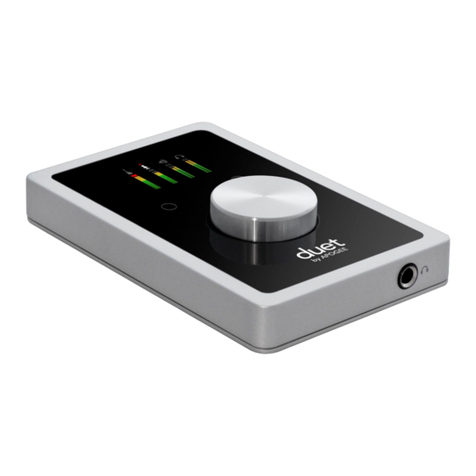
Apogee Apogee Duet User manual
Apogee
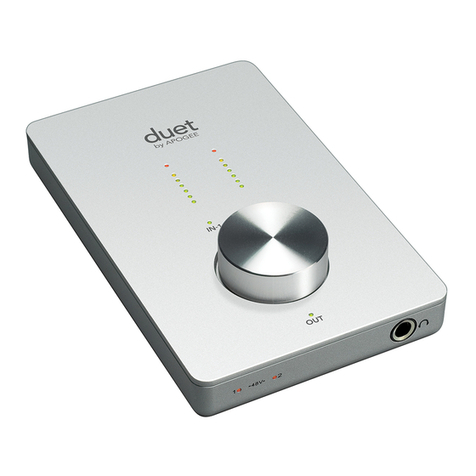
Apogee Apogee Duet User manual
Apogee
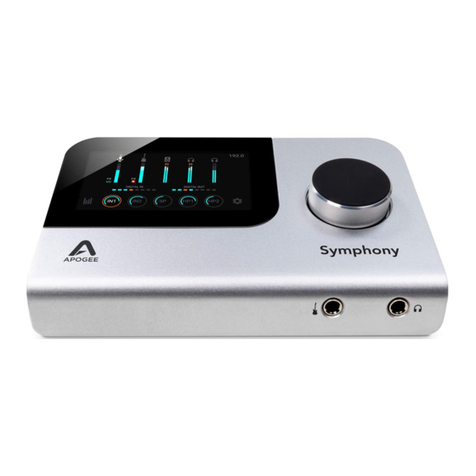
Apogee Symphony Mobile User manual