INTRODUCTION
Radiation that drives photosynthesis is called photosynthetically active radiation (PAR) and is typically defined as
total radiation across a range of 400 to 700 nm. PAR is almost universally quantified as photosynthetic photon flux
density (PPFD), the sum of photons from 400 to 700 nm in units of micromoles per square meter per second (µmol
m-2 s-1, equal to microEinsteins m-2 s-1). While microEinsteins and micromoles are equal (one Einstein = one mole of
photons), the Einstein is not an SI unit, so expressing PPFD as µmol m-2 s-1 is preferred. Daily total PPFD is typically
reported in units of moles of photons per square meter per day (mol m-2 d-1) and is often called daily light integral
(DLI).
The acronym PPF is also used and refers to the photosynthetic photon flux. The acronyms PPF and PPFD refer to
the same variable. Both terms are used because there is not a universal definition of the term flux. Flux is
sometimes defined as per unit area per unit time and sometimes defined as per unit time only. PPFD is used in this
manual.
Sensors that measure PPFD are often called quantum sensors due to the quantized nature of radiation. A quantum
refers to the minimum quantity of radiation, one photon, involved in physical interactions (e.g., absorption by
photosynthetic pigments). In other words, one photon is a single quantum of radiation.
Typical applications of quantum sensors include measurement of incident PPFD on plant canopies in outdoor
environments or in greenhouses and growth chambers, and reflected or under-canopy (transmitted) PPFD
measurement in the same environments.
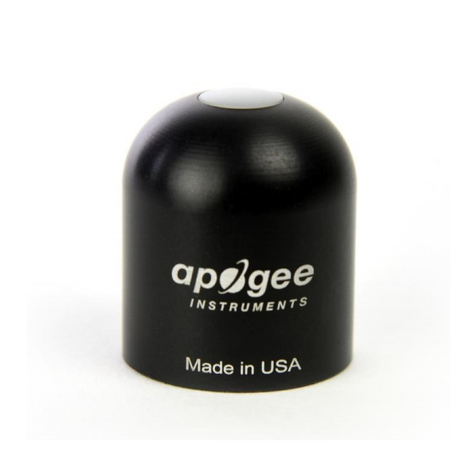
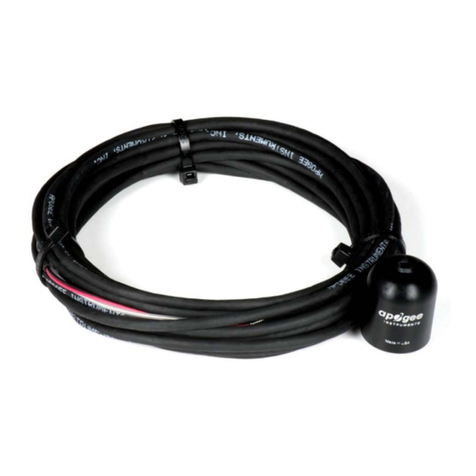
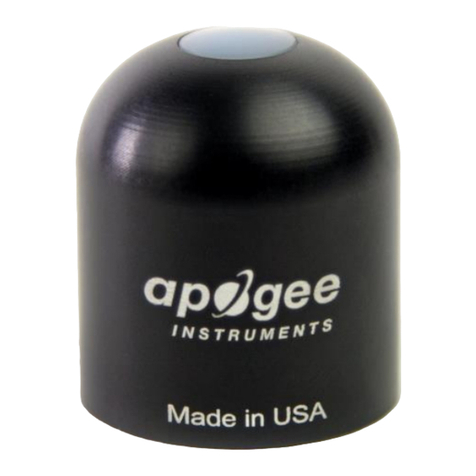
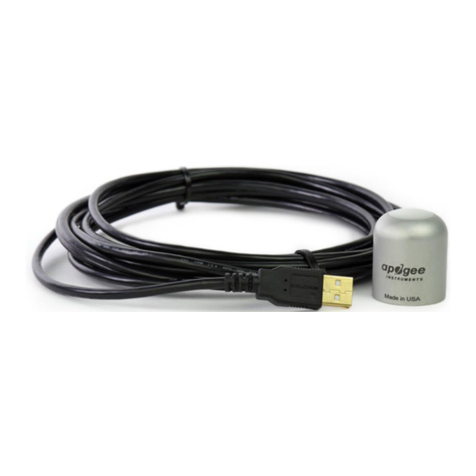
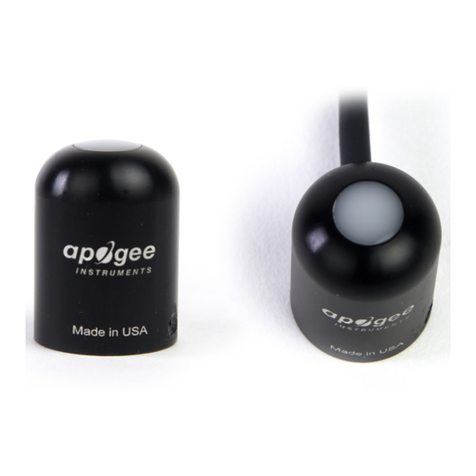
Apogee Instruments SQ series quantum sensors consist of a cast acrylic diffuser (filter), photodiode, and signal
processing circuitry mounted in an anodized aluminum housing, and a cable to connect the sensor to a
measurement device. Sensors are potted solid with no internal air space, and are designed for continuous PPFD
measurement in indoor or outdoor environments. SQ series sensors output an analog voltage that is directly
proportional to PPFD under sunlight (e.g., model SQ-215) or electric lights (e.g., model SQ-225). The voltage signal
from the sensor is directly proportional to radiation incident on a planar surface (does not have to be horizontal),
where the radiation emanates from all angles of a hemisphere.