Installation Recommendations
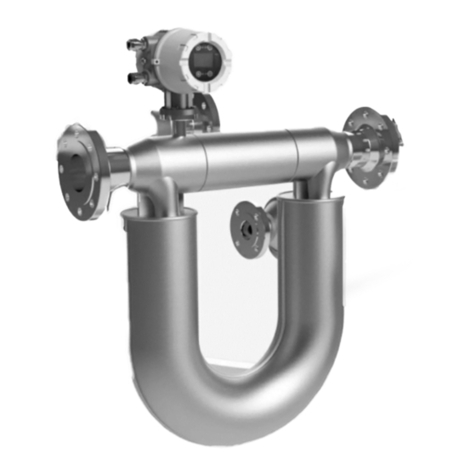
The inline flow meter is a simple device to install. However, the following measures are recommended for reliable, trouble-
free operation:
1. Piping should be accurately aligned and of correct length. The high pressure body of the ow meter can withstand
shock and ow/pressure pulsation. However, the piping should be rmly supported by external mounting brackets, both
upstream and downstream of the meter, to avoid any pipe exing actions that could reduce meter life.
2. If the ow meter inlet or outlet are to be rigidly mounted, and the opposing port is to be connected to a exible hose, the
end connected with the exible hose must be rigidly mounted.
3. Use Teon® tape for sealing NPT tting.
4. Install a union near the inlet or outlet of the meter for quick, easy meter removal and inspection during periodic
maintenance procedures.
5. Mount the meter either horizontally or vertically (ow arrow pointing to either side or straight up). If the meter must be
mounted inverted, special inverted scales are available.
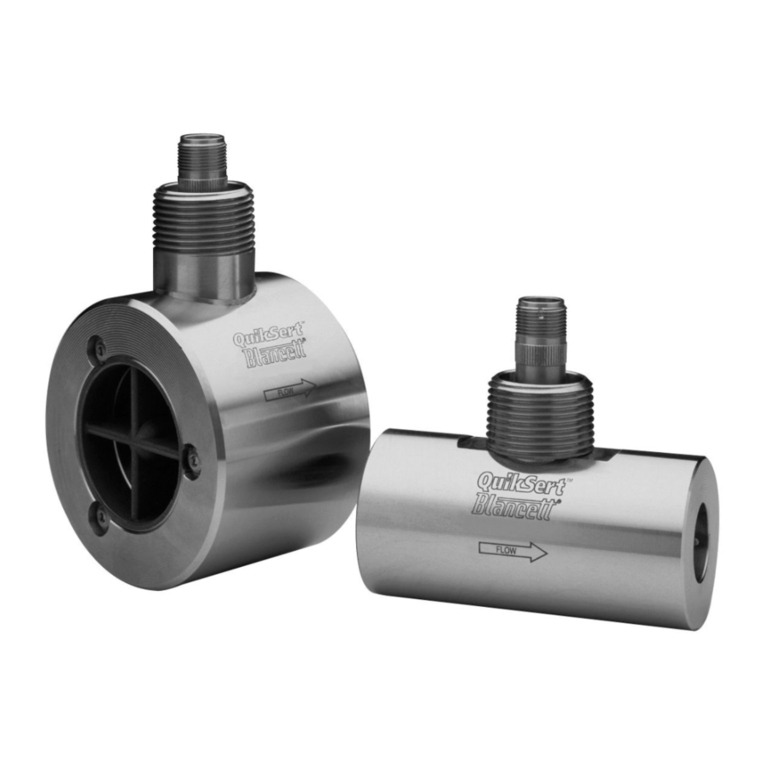
6. Ensure the uid is traveling in the direction of the ow arrow (see Figure 2).
7. Systems that do not have ltration should be equipped with at least a 200 mesh (74 micron) lter. Most systems already
have much ner ltration. The meter will allow particulate to pass that would jam most valves and ow controls. Dirt,
ferrous metal or sealing agents, such as Teflon® tape may lodge and cause malfunction. If the meter is jammed at a fixed
position, see "Removal of Dust Guard" on page 11.
8. Don not use thread locking compounds as thread sealant.
9. Do not install the ow meter near turbulence producing ttings such as elbows, reducers and close coupled valves for
maximum reliability. The inline ow meter does not require ow straighteners or special lengths of straight inlet/outlet
piping to stabilize turbulent ow patterns.
10. Do not install the meter near fast-acting valves. Fast-acting valves have the potential to create high magnitude hydraulic
pressure spikes. These spikes can damage the internal components of the meter, resulting in inaccuracies or malfunction.
11. Do not allow unidirectional meters to be operated against the direction of the ow arrow. The standard ow meter is an
unidirectional ow meter. The piston acts as a check valve to block ow in the reverse direction. This causes an excessive
pressure dierential, which can result in damage to internal meter components.
Installing the Flow Meter
1. Mount the meter so uid is traveling in the direction of the ow arrow. See Figure 1 on page 4.
Flow Direction
Arrow
AIR
Figure 2: Flow direction arrow
2. Select a mounting location that is suitable for viewing and product service. To connect the ow meter into the piping
system, place an open-ended wrench onto the ow meter wrench ats adjacent to the pipe connection being installed.
DO NOT wrench on the opposite end of the ow meter or leakage may result. See Figure 3 on page 7.
Installation
Page 6 August 2014VAM-UM-00593-EN-02
www.GlobalTestSupply.com
Find Quality Products Online at: sales@GlobalTestSupply.com