20 | English
2 609 140 996 | (23.9.13) Bosch Power Tools
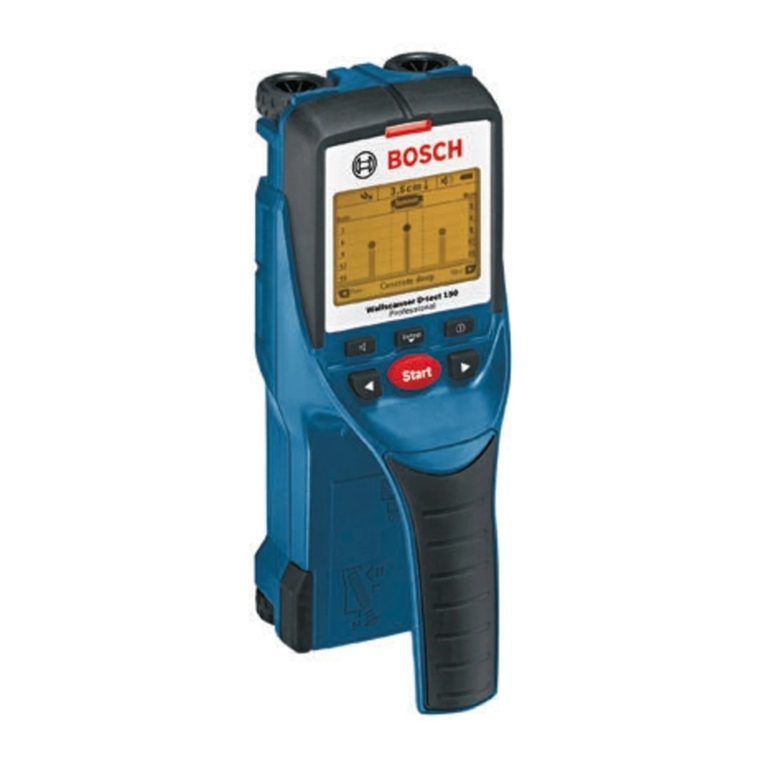
Scanning for “Live” Wires
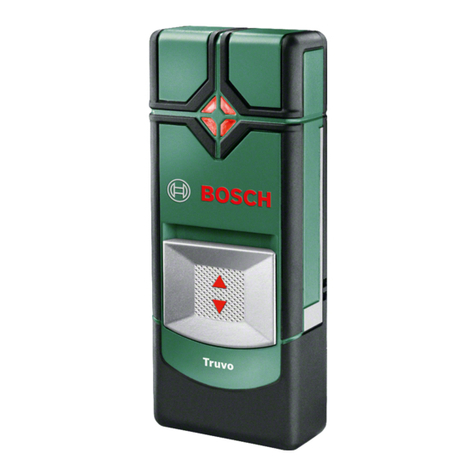
The measuring tool indicates wires, which carry voltage between 110 V
and 240 V and a frequency corresponding to the widely used standard
(AC with 50 or 60 Hz). Other wires (carrying DC, higher/lower frequency
or voltage) as well as non-“live” wires/conductors cannot be found relia-
bly, but are possibly indicated as metal objects.
The detection for “live” wires/conductors takes place automatically with
every measurement. When a “live” wire/conductor is detected, the signal
LED 2flashes red and an intermittent signal tone sounds with rapid tone
sequence. Move the measuring tool repeatedly over the surface to locate
the “live” wire/conductor more precisely. After moving over the surface
several times, the position of the “live” wire/conductor can be indicated
very accurately.
“Live” wires/conductors can be detected more easily when power con-
sumers (e.g. lamps, appliances) are connected to the wire being sought
and switched on.
Note: Always ensure that you hold the measuring tool firmly without
gloves to enable a good grounding. Also ensure that ladders/scaffolding
must be grounded. Avoid ladders/scaffolding whose supports have plas-
tic caps underneath them. Do not wear insulating footwear.
Under certain conditions (e.g. below metal surfaces or behind surfaces
with high water content), “live” wires/conductors cannot be securely de-
tected. When the signal LED 2illuminates yellow or red over a larger area,
then the material is screening-off electrically and the detection for “live”
wires/conductors is not reliable.
Working Advice
Measuring values can be impaired through certain ambient condi-
tions. These include, e.g., the proximity of other equipment that
produce strong magnetic or electromagnetic fields, moisture, me-
tallic building materials, foil-laminated insulation materials or
conductive wallpaper or tiles. Therefore, please also observe other
information sources (e.g. construction plans) before drilling, sawing
or routing into walls, ceilings or floors.
Note: Do not hold the device in the area of the sensor, so as not to affect
the measurement. This achieves more accurate measurement results.
OBJ_BUCH-1913-002.book Page 20 Monday, September 23, 2013 12:33 PM