S1HarnessInst.Doc_113017
PN 230412 Page 6 of 12
CAUTION
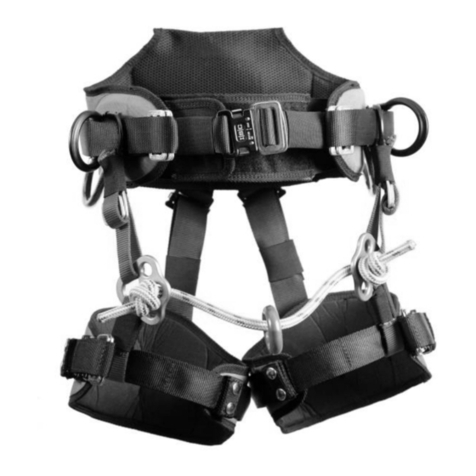
ANSI Z359.11 and CSA Z259.10 recognize the use of this harness only within the capacity range of 130 - 310 lbs.
Buckingham harnesses only can be used by a person with a maximum weight of 420 lbs. when fully equipped and only when used
with an equivalently weight rated energy absorbing lanyard / accessories. Note: This maximum weight does not apply to body belts
attached to a harness.
Fall protection equipment, (i.e. fall arrest, work positioning belts, retrieval, suspension etc.) should not be resold or provided to
others for re-use after use by original user as assurance cannot be granted that a used product meets criteria of applicable
standards and is safe for use to a subsequent user.
Only Buckingham Mfg. Co. or those people authorized in writing by Buckingham Mfg. Co. may make repairs to this equipment.
Equipment subjected to impact loading must be immediately removed from service, destroyed and discarded.
In the event of a fall, the employer must have a rescue plan and the means to implement it.
Attach only locking connecting devices meeting standards / regulations for intended use for fall arrest, positioning and suspension
to rear fall arrest D-ring on harness and fall arrest anchor point, saddle / belt D-rings and attachment points.
Only positioning connecting devices should be attached to side D-rings, as side D-rings are not intended for fall arrest.
Do not connect any tools, accessory loops / snaps, etc. to the positioning D-rings. D-rings are for attachment of connecting device
locking snap hooks only.
For units with Work Position Web Loop(s): Buckingham recommends attachment only to carabiner. Buckingham Mfg. does not
recommend attachment of a metal connector, other than a carabiner, to a web loop fall arrest attachment unless the web loop is
protected by an integral wear piece, the connector meets the requirements of ANSI Z359.12 (3600 lbf. rated gate), the snap hook
lock mechanism cannot inadvertently be depressed, and the web loop fall arrest attachment point is inspected prior to each use.
Attachment of a metal connector, such as a locking snap hook, to a web loop fall arrest attachment with no wear piece can cause
premature wear of the webbing and stitching. This degradation can cause the web loop layers to separate and be incapable of
supporting your weight.
If connecting to a personal fall arrest system by attaching directly through the web loop of an energy absorber carefully inspect the
inside of the web loop for cuts, abrasions, broken strands, or excessive wear.
Buckingham harnesses are manufactured with a breakaway lanyard parking attachment that is generally located in the sternal
area of the harness. This lanyard parking attachment is designed only to store unused lanyard legs to help reduce tripping and
entanglement hazards. Lanyard parking attachments are designed to breakaway at no more than 120 lbf. and are not to be used
as load bearing anchor points.
Fall arrest anchor points must support a minimum of 5000 lbf. per attached worker and be independent of worker support.
For fall arrest, always keep anchor point above rear fall arrest attachment. If climbing above anchor point, attach to a new anchor
point higher up. When anchor point to allow for connection above the fall arrest attachment device is not available, lanyard
positioning must be such that free fall will be limited to a maximum of 6 feet and there will be no contact with a lower level.
Never use an energy absorbing lanyard for positioning. Unit can open and extend which could result in a fall.
Always attach the energy absorbing lanyard to the rear fall arrest attachment device included on the users equipment.
Always visually check that: 1) each snap hook / carabiner freely engages D-ring or anchor point, 2) keeper / gate is completely
closed with each use. Never rely solely on the feel or sound of a snap hook / carabiner engaging.
Make sure each snap hook / carabiner is positioned so that its keeper / gate is never load bearing.
Never use combinations of components or sub systems, or both, which may affect or interfere with the safe function of each other.
Ensure there is no pressure on the snap hook locking mechanism sufficient to depress it as this will, due to its length, render it
incompatible with currently designed rings and make it very susceptible to rollout.
Never disable locking keeper / gate on snap hook / carabiner, punch holes in or alter a connecting device in any way.
Avoid contact of this equipment with sharp edges, abrasive surfaces, high temperature surfaces, welding, or other heat sources,
electrical hazards or moving machinery. When not in use, store to prevent exposure to the elements as well as over exposure to
sunlight (U.V. degradation).
Avoid contact of this equipment with chemicals that may damage the material. If in doubt, contact Buckingham Mfg. Co.
This equipment is for personal use only, not towing or hoisting.
Never work without independent fall arrest protection if there is danger of a fall.
Always visually check that all buckles and snap hooks or carabiners are properly closed before use.
Shoulder D-rings / attachments (optional) are intended for rescue / retrieval purposes only.
Product covered under these instructions / warnings should not be resold / redistributed or re-used after use by original user
INSPECTION
Inspection should occur prior to each use of the harness by the user and at a minimum of once a year by a competent
person. Carefully inspect the harness for indications of wear, deterioration or impact loading. The inspection should
include, but not be limited to, inspecting for:
product with all leather strength components. If found, immediately cease use, discard and replace as product does not meet
existing standards
webbing cuts, kinks, abrasions, burns, excessive swelling, excessive wear, discoloration, cracks, charring, broken fibers, loose
stitching, chemical or physical exposures and buckle holes in strap are not damaged
loose, bent or pulled rivets, bent grommets, and broken, cut or burned threads
tongue of buckle does not bind on buckle frame
nicks, cracks, distortion, excessive wear or corrosion of hardware (buckle, "D"-ring, etc.)
check hook and loop fastener chest strap closure by adhering the hook and loop fastener securely together. When removing the
hook from the loop, if there is little or no resistance, cease use and replace immediately. Hook and loop fastener will require a
notable force to separate.