manuals.online logo
Brands
  1. Home
  2. •
  3. Brands
  4. •
  5. Cal-Royal
  6. •
  7. Lock
  8. •
  9. Cal-Royal CR3000 User manual

Cal-Royal CR3000 User manual

Other manuals for CR3000

1

Other Cal-Royal Lock manuals

Cal-Royal NM Series User manual

Cal-Royal

Cal-Royal NM Series User manual

Cal-Royal CRCODE-202 Owner's manual

Cal-Royal

Cal-Royal CRCODE-202 Owner's manual

Cal-Royal SDLP-SQ-ADA User manual

Cal-Royal

Cal-Royal SDLP-SQ-ADA User manual

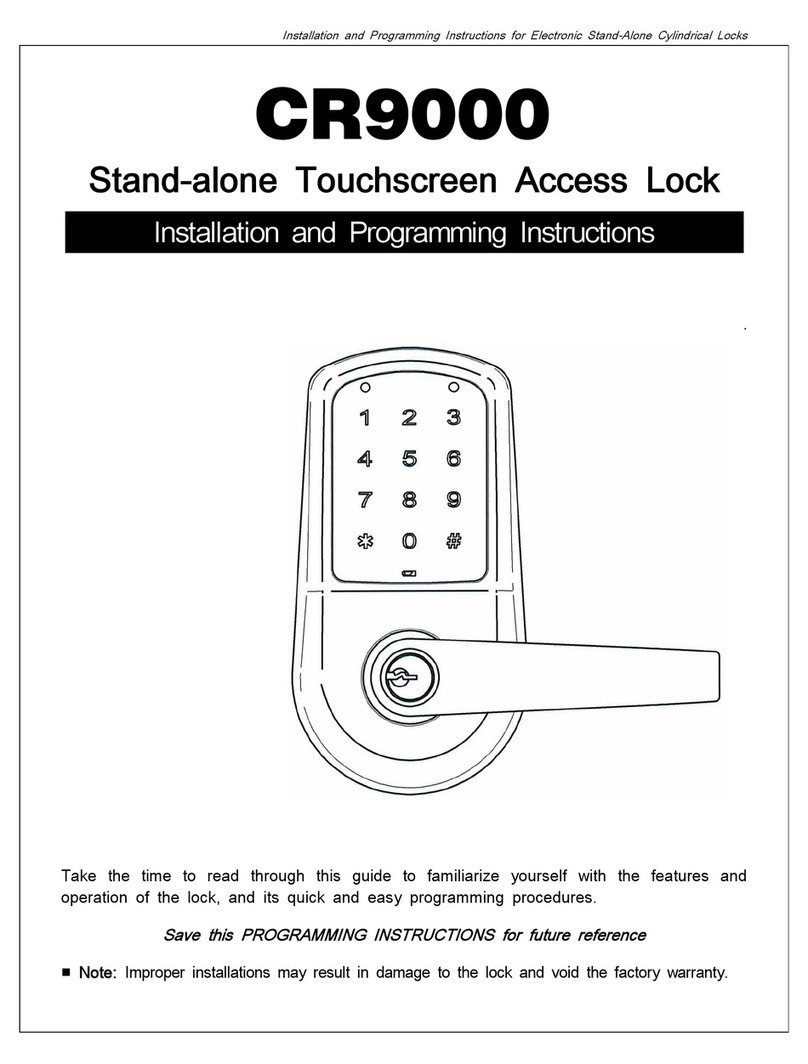
Cal-Royal CR9000 Technical specifications

Cal-Royal

Cal-Royal CR9000 Technical specifications

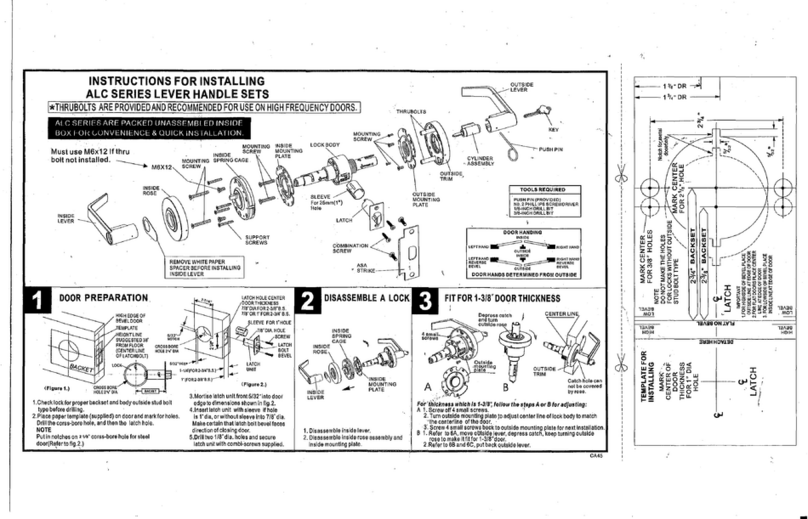
Cal-Royal ALC Series Instruction Manual

Cal-Royal

Cal-Royal ALC Series Instruction Manual

Cal-Royal M SERIES User manual

Cal-Royal

Cal-Royal M SERIES User manual

Cal-Royal CR9000 Technical specifications

Cal-Royal

Cal-Royal CR9000 Technical specifications

Cal-Royal ES1934 Series User manual

Cal-Royal

Cal-Royal ES1934 Series User manual

Cal-Royal SDLP-RND-ADA User manual

Cal-Royal

Cal-Royal SDLP-RND-ADA User manual

Cal-Royal CR3000 Quick start guide

Cal-Royal

Cal-Royal CR3000 Quick start guide

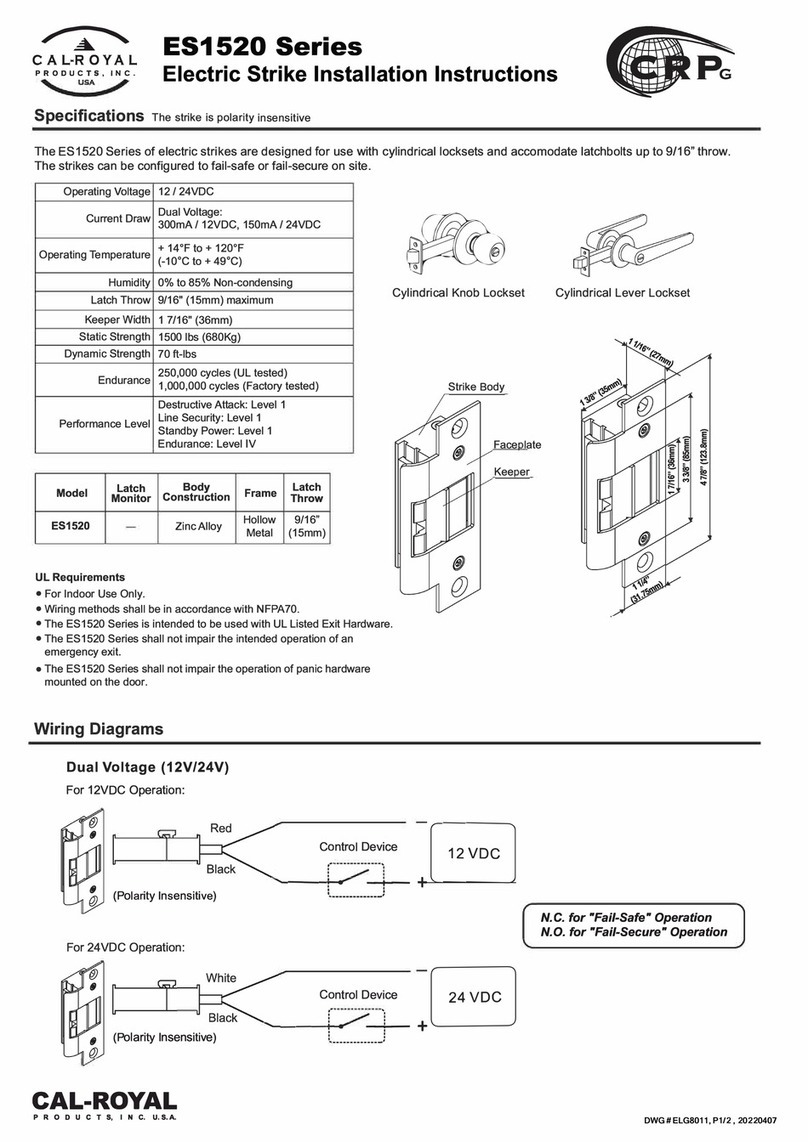
Cal-Royal ES1520 Series User manual

Cal-Royal

Cal-Royal ES1520 Series User manual

Cal-Royal ES1433 Series User manual

Cal-Royal

Cal-Royal ES1433 Series User manual

Cal-Royal CRCODE-204 Owner's manual

Cal-Royal

Cal-Royal CRCODE-204 Owner's manual

Popular Lock manuals by other brands

Magic 105 manual

Magic

Magic 105 manual

Gantner GAT NET.Lock 7020 System Installation, configuration & operation

Gantner

Gantner GAT NET.Lock 7020 System Installation, configuration & operation

Dorma Studio Classic Installation instruction

Dorma

Dorma Studio Classic Installation instruction

Securam ECSL-601 quick start guide

Securam

Securam ECSL-601 quick start guide

Sudhaus 3003 operating manual

Sudhaus

Sudhaus 3003 operating manual

Safety 1st 48517 user guide

Safety 1st

Safety 1st 48517 user guide

Pado FDS-10 user manual

Pado

Pado FDS-10 user manual

Esco systeQ Series installation instructions

Esco

Esco systeQ Series installation instructions

COMPX National D8951 instruction sheet

COMPX

COMPX National D8951 instruction sheet

secureo Key Box instruction manual

secureo

secureo Key Box instruction manual

Stock Loks C8713 instruction sheet

Stock Loks

Stock Loks C8713 instruction sheet

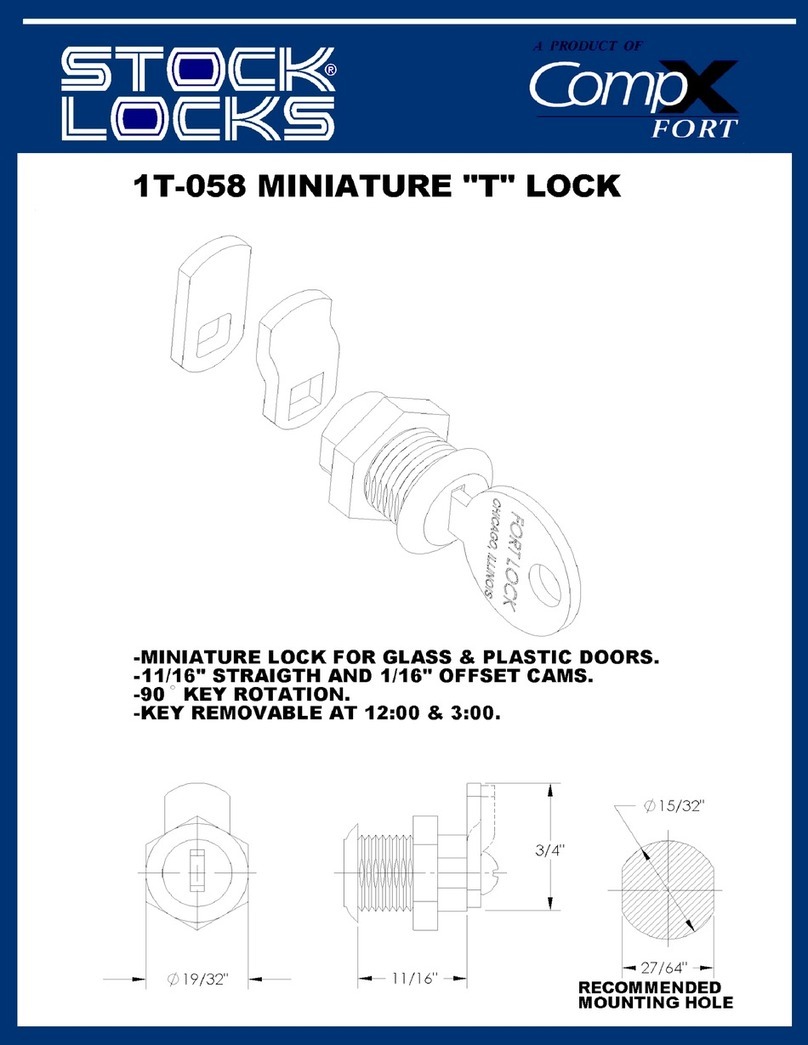
COMPX 1T-058 Information

COMPX

COMPX 1T-058 Information

Auslock T11 user manual

Auslock

Auslock T11 user manual

Stealth SAFES ShadowVault Instructions & Troubleshooting

Stealth SAFES

Stealth SAFES ShadowVault Instructions & Troubleshooting

Knox KeySecure 5 Admin & user guide

Knox

Knox KeySecure 5 Admin & user guide

Kwikset 48334/01 Quick installation guide

Kwikset

Kwikset 48334/01 Quick installation guide

Metra Electronics Door Access Terminal Combo Technical manual

Metra Electronics

Metra Electronics Door Access Terminal Combo Technical manual

Kilitronik miniK10m operating manual

Kilitronik

Kilitronik miniK10m operating manual

manuals.online logo
manuals.online logoBrands
  • About & Mission
  • Contact us
  • Privacy Policy
  • Terms and Conditions

Copyright 2025 Manuals.Online. All Rights Reserved.

C
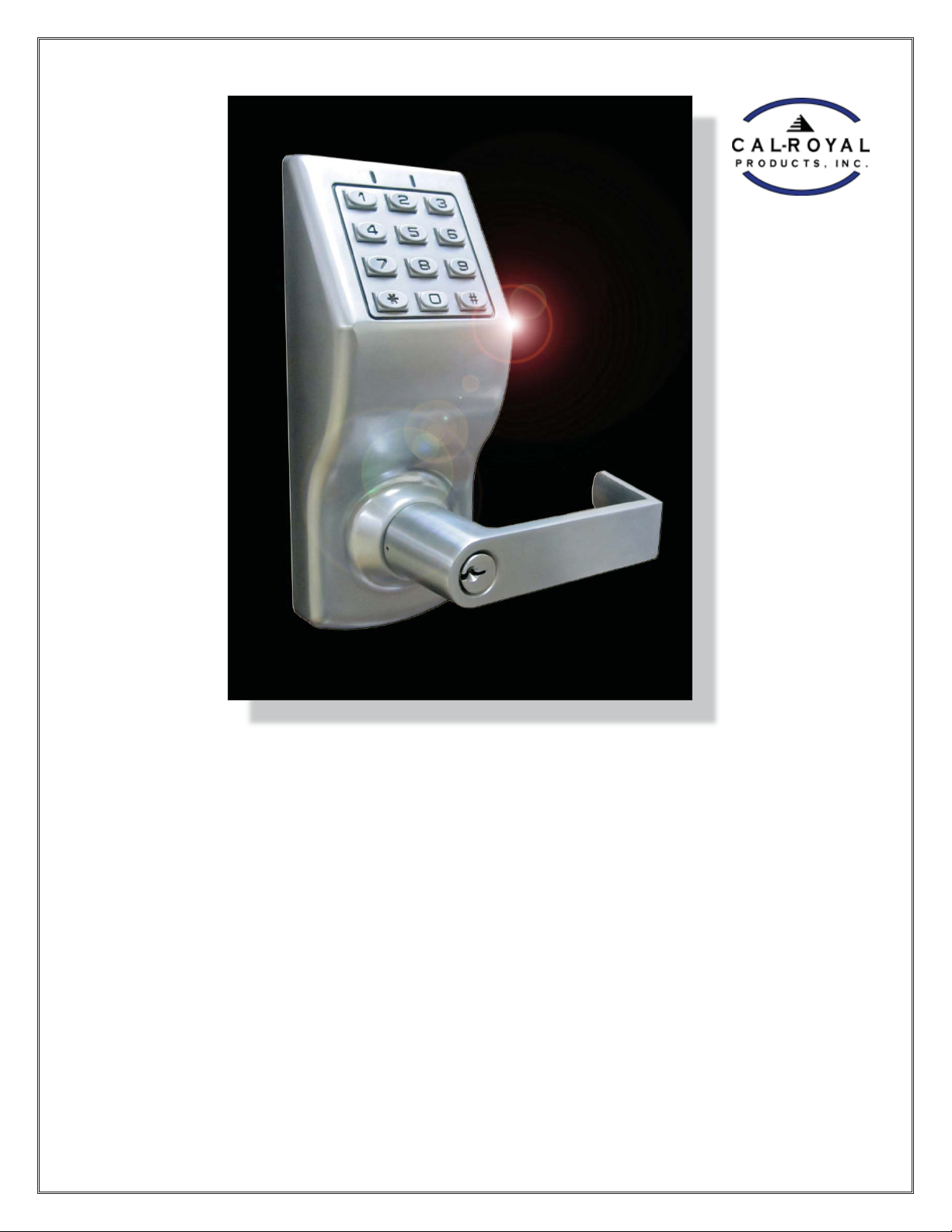
CAL-ROYAL CR3000
Digital Electronic Lock
OWNER’S MANUAL
2
THANK YOU for purchasing CAL-ROYAL CR 3000 Digital Lock.
Your new CAL-ROYAL CR3000 Digital Lock advanced features include:
1 Master Code for entry including all other functions.
1 Sub-Master Code for entry and other programming functions.
10 Manager Codes for entry and other programming functions.
90 User Access Codes for entry.
5 Service Codes (One-Time Entry Code).
2 Remote Switch Input.
2 User Disable Modes.
xDisable all user codes except Master Code.
xBank disable all user codes except Manager Codes.
Keypad Anti-Tamper Lockout (30 seconds). Keypad is disabled after 3 unsuccessful user code
entries.
Fire Alarm System (REM2)
TABLE OF CONTENTS
Connections 3
Remote Switch/Release Options 3
Initial Setup 3
Codes 3
Keypad Anti-Tamper Lockout 4
Tones and LED Indicators 4
Changing the Master Code 4
Add/Change Sub-Master Code 4
Deleting Sub-Master Code 4
Program Table 5
Add/ Change a Manager Code 5
Deleting a Manager Code 6
Add/Change a User Code 6
Deleting a User Code 6
Disabling a Manager Code 6
Disabling a User Code 7
Disable Users in One Bank 7
Disable All 7
Enable 1 Manager or User Code 7
Enable User Codes in One Bank 8
Enable All 8
Pass Time (Door Unlock) 8
Disable Users Only 8
Add Service Codes 8
Delete Service Codes 9
Delete All Service Codes 9
Enable Passage Mode 9
Disable Passage Mode 9
Code Locator Function 10
Next Available Location Finder 10
Key Press Sound Options 10
Table 1A 11
Digital electronic Lock Limited Warranty 12
3
Connections:
Remote Switch/Release Options:
Initial Setup:
Codes:
Batteries:
Use only 1.5 volt AA batteries, 4 pieces.
Low Battery:
RED LED will flash five times with beep sound before BLUE LED flashes to signify acceptance of code. Batteries should be replaced as soon as
this happens.
1. Remove batteries. Press and hold (#) while connecting the batteries back.
Release after hearing 5 beeps. Within 3 seconds, press (#) keypad 3 times. The BLUE LED will continuously light for 3 seconds and 2
beeps will be heard.
2. The unit is now clear of all programmed data and will have reverted to the factory default Master Code 12345.
NOTE: Please follow procedures above exactly otherwise unit will function abnormally. In this case, please repeat the procedure.
No other programming commands will be accepted until default Master Code has been changed.
The unit has 2 sets of terminals for remote release, labeled REM1 and REM2 on the printed circuit board.
REM1 can be connected to a push button. Pushing the button will cause the unit to unlock. The BLUE LED will light and at the same time a beep
can be heard twice.
REM2 is intended for alarm systems such as fire alarms. When activated the unit will stay unlocked for 30 minutes and RED LED will flash once
every 2 seconds while an audible alarm sound will be heard indicating that the unit is in the unlocked condition.
The lock will automatically revert to normal after 30 minutes. If necessary, the Master Code, Sub-Master Code or Manager Code can be
programmed to revert the unit to normal before the 30-minute period ends.
xCodes may be 3, 4 or 5 digits long. The length of the Master Code determines all the codes format.
xOnce the numbers of digits are selected, it cannot be changes unless all programming is erased and the default factory settings are re-
loaded.
xNo other programming commands will be accepted until default Master Code has been changed.
MASTER CODE and SUB-MASTER CODE
xThis unit is delivered with the Master Code set to 12345 (default).
xThe Master Code cannot be deleted.
xMaster Code performs all programming functions.
xSub-Master Code performs all programming functions except delete or change Master code.
MANAGERS CODE
xAll Managers Code location ends in zero. (00, 10, 20, 30, 40, 50, 60, 70, 80, 90)
xManager Codes are capable of programming and deleting user codes under his Bank. Managers are also capable of accessing the
next higher Bank until another Manager Code appears.
xUSER CODES
xDoes not have programming privileges. Codes are used for entry only.
SERVICE CODES
xService Codes are one-time codes only. It cannot be used again. Once a service code is entered, the unit will unlock but it will
automatically delete the code.
VALID CODES and PASS TIME (DOOR UNLOCK)
xPass Time is the time the unit is unlocked after a valid code is entered.
xBLUE LED will flash (with 2 beeps) after a valid code is entered.
xPass Time also determines the amount of time between two key presses. If the succeeding entry (or key press) was pressed after the
Pass Time, it is now considered as a new entry. Should this happen, wait 5 seconds for the unit to reset by itself then try entering the
code again.
INVALID CODES
xThe RED LED will flash for .5 seconds with one beep after an invalid code is entered

4
Keypad Anti-Tamper Lockout
Tones and LED Indicators (Default Setting)
Changing the Master Code: Program 991
Add/Change Sub-Master Code: Program 981
Deleting Sub-Master Code: Program 982
Assuming that the current Master Code is (1) (2) (3) (4) (5) and you want to change it to (4) (4) (4) (4) (4).
[Current Master Code] (#) (9) (9) (1) [Length of new Master Code] [New Master Code] [Length of new Master Code] [New Master Code]
EXAMPLE :Assuming that the current Master Code is (1) (2) (3) (4) (5) and you want to change it to (4) (4) (4) (4) (4).
1. Press (1) (2) (3) (4) (5) Ɣ(#) (9) (9) (1) Ɣ(5) Ɣ(4) (4) (4) (4) (4) Ɣ(5) Ɣ(4) (4) (4) (4) (4) ƔƔ
2. Wait for at least 5 seconds before trying your new Master Code.
Note: The BLUE DOTS (Ɣ) indicates the flashing BLUE LED on the unit.
The unit will unlock upon entering the Master Code and will remain unlocked while initiating the program sequence.
Once the number of digits is selected, it cannot be changed unless unit is reverted back to its factory default
settings.
[Current Master Code] (#) (9) (8) (1) [New Sub-Master Code] [New Sub-Master Code]
EXAMPLE:
Assuming that the current Master Code is (1) (2) (3) (4) (5) and you want to add a Sub-Master Code of (2) (3) (4) (5) (6).
1. Press (1) (2) (3) (4) (5) Ɣ(#) (9) (8) (1) Ɣ(2) (3) (4) (5) (6) Ɣ(2) (3) (4) (5) (6) ƔƔ
2. The unit will unlock upon entering the Master Code and will remain unlocked while initiating the program sequence.
3. Wait at least 5 seconds before trying your new Sub-Master Code.
xIf an invalid Code is entered 3 times in succession, the unit will turn off for 30 seconds to prevent tampering.
xThe unit will emit 2 beeps with flashing BLUE and RED LED at the end of the anti-tamper period.
xCR3000 will exit the anti-tamper period, even within the 30 second duration, if the remote switch is activated (REM1 or REM2).
Key press: A beep will sound and a BLUE LED will flash.
Access Granted: 2 beeps and BLUE LED will flash. When Pass Time ends, the unit relocks with a beep and a RED LED.
Invalid Code Entered: 1 beep and 1 RED LED Flash
Disabled Code entered: 1 beep and both RED and BLUE LED flashes.
New Access Code accepted: 2 beeps and 2 BLUE LED flashes.
Programming Error: 1 beep and 1 RED LED flash.
Return from anti-tamper lockout: 2 beeps and both RED and BLUE LED will flash.
Low Battery: 5 beeps and 5 RED LED flashes before access is granted.
Assuming that the current Master Code is (1) (2) (3) (4) (5) and you want to delete a Sub-Master Code.
[Current Master Code] Ɣ(#) (9) (8) (2) Ɣ(9) (8) (2) ƔƔ
1. Press (1) (2) (3) (4) (5) Ɣ(#) (9) (8) (2) Ɣ(9) (8) (2) ƔƔ
2. Sub-Master Code is deleted.
5
PROGRAMMING LIMITATIONS/SCHEDULE
PROGRAM
NO. FUNCTIONS MASTER SUB-MASTER MANAGER USER SERVICE
Unlock (Entry Only) 99 999
Unlock and Enter Programming Mode 99 9
000 Next Free Code Access Locator 99 9
009 Code Location Function 99 9
011-015 Add Service Codes 99 9
021-025 Delete Service Code 99 9
02# Delete All Service Codes 99 9
1xx Add/Change Manager Code or User Codes 99 9
2xx Deleting Manager or User Codes 99 9
3xx Disable 1 Manager or User Code 99 9
3x# Disable User Codes in 1 Bank 99 9
3## Disable All 99 9
4xx Enable 1 Manager or User Code 99 9
4x# Enable User Codes in 1 Bank 99 9
4## Enable All 99 9
902 Pass Time (Door Unlock) 99
93# Disable Users Only 99
961 Enable Passage Mode 99
962 Disable Passage Mode 99
971 Key press Sound option: Normal 99
971 Key press Sound + LED (Default) 99
972 Key press Sound Option: Click! 99
972 Key press Sound + LED 99
973 Key press sound Option: LED Only 99
981 Add/Change Sub-Master Code 99
982 Delete Sub-Master Code 9
991 Change Master Code 9
Add/Change a Manager Code: Program 1xx
Manager Codes are located at locations 00, 10, 20, 30, 40, 50, 60, 70, 80 and 90 (see table 1A on page 11).
NOTE: New Manager Codes must use the same number of digits as the (new) Master Code.
[Current Master/Sub-Master Code] (#) (1) [2-digit Location Code] [New Manager Code]
EXAMPLE:
Assuming that the current Master or Sub-Master Code is (1) (2) (3) (4) (5) and you want to add a new Manager Code of (3) (4) (5) (6) (7) in location 20.
1. Press: (1) (2) (3) (4) (5) Ɣ(#) (1) (2) (0) Ɣ(3) (4) (5) (6) (7) ƔƔ
2. The unit will unlock upon entering the Master Code and will remain unlocked while initiating the program sequence.
3. Wait at least 5 seconds before trying your Manager Code
6
Deleting a Manager Code: Program 2xx
Deleting a User Code: Program 2xx
Add/Change a User Code: Program 1xx
Disabling a Manager Code: Program 3xx
Manager Codes are located at locations 00, 10, 20, 30, 40, 50, 60, 70, 80 and 90 (see table 1A on page 11).
[Current Master/Sub-Master Code] (#) (3) [2-digit Location Code]
EXAMPLE:
Assuming that the current Master or Sub-Master Code is (1) (2) (3) (4) (5) and you want to disable a Manager Code located at location 20.
1. Press (1) (2) (3) (4) (5) Ɣ(#) (3) (2) (0) ƔƔ
2. Manager Code at the specified location is disabled.
User Codes are located at locations 01-09, 11-19, 21-29, 31-39, 41-49, 51-59, 61-69, 71-79, 81-89 and 91-99 (see table 1A on page 11).
NOTE: New User Codes must use the same number of digits as the (new) Master Code.
[Current Master/Sub-Master/Manager Code] (#)(1) [2-digit User Location] [New User Code]
EXAMPLE:
Assuming that the current Master, Sub-Master or Manager Code is (1) (2) (3) (4) (5) and you want to add a new User Code of (3) (4) (5) (6) (7) in
location 21.
1. Press: (1) (2) (3) (4) (5) Ɣ(#) (1) (2) (1) Ɣ(3) (4) (5) (6) (7) ƔƔ
2. The unit will unlock upon entering the Master Code and will remain unlocked while initiating the program sequence.
3. Wait at least 5 seconds before trying your User Code
Manager Codes are located at locations 00, 10, 20, 30, 40, 50, 60, 70, 80 and 90 (see table 1A on page 11).
[Current Master/Sub-Master Code] (#) (2) [2-digit Location Code]
EXAMPLE:
Assuming that the current Master or Sub-Master Code is (1) (2) (3) (4) (5) and you want to delete a Manager Code located at location 20.
1. Press: (1) (2) (3) (4) (5) Ɣ(#) (2) (2) (0) ƔƔ
2. Mana
g
er Code at the s
p
ecified location is deleted.
User Codes are located at locations 01-09, 11-19, 21-29, 31-39, 41-49, 51-59, 61-69, 71-79, 81-89 and 91-99 (see table 1A on page 11).
[Current Master/Sub-Master/Manager Code] (#) (2) [2-digit User Location number]
EXAMPLE:
Assuming that the current Master, Sub-Master or Manager Code is (1) (2) (3) (4) (5) and you want to delete a User Code located at location 21.
1. Press: (1) (2) (3) (4) (5) Ɣ(#) (2) (2) (1) ƔƔ
2. User Code at the specified location is deleted.
7
Disabling a User Code: Program 3xx
Disable Users in One Bank: Program 3x#
Disable All: Program 3##
Enable One Manager or User Code: Program 4xx
This feature can be used by Master, Sub-Master or Manager Codes. User Codes can only be enabled by the Manager in charge of his Bank.
Master and Sub-Master can enable all Managers and Users.
[Master, Sub-Master, Manager Code] (#) (4) [2-digit Location]
EXAMPLE:
Assuming that the current Master, Sub-Master or Manager Code is (1) (2) (3) (4) (5) and you want to enable a User Code located at location 21.
1. Press (1) (2) (3) (4) (5) Ɣ(#) (4) (2) (1) ƔƔ
2. User Code at the specified location is enabled.
User Codes are located at locations 01-09, 11-19, 21-29, 31-39, 41-49, 51-59, 61-69, 71-79, 81-89 and 91-99 (see table 1A on page 11).
[Current Master/Sub-Master/Manager Code] (#) (3) [2-digit Location Code]
EXAMPLE:
Assuming that the current Master, Sub-Master or Manager Code is (1) (2) (3) (4) (5) and you want to disable a User Code located at location 21.
1. Press (1) (2) (3) (4) (5) Ɣ(#) (3) (2) (1) ƔƔ
2. User Code at the specified location is disabled.
Banks are designated as numbers from 0-9. For instance, Bank “0” will have its manager ”00” and users 01-09; Bank “1” has Manager “10” and
Users 11-19 and so on.
[Current Master/Sub-Master/Manager Code] (#) (3) [1-digit Bank Number] (#)
EXAMPLE:
Assuming that the current Master, Sub-Master or Manager Code is (1) (2) (3) (4) (5) and you want to disable “Bank 1”.
Press (1) (2) (3) (4) (5) Ɣ(#) (3) (1) (#) ƔƔ
NOTE: If Master or Sub-Master Code was used to unlock the unit prior to the program sequence, all 9 Users and 1 Manager Code in that
Bank are disabled.
If the Manager Code was used to unlock the unit prior to the program sequence, only the 9 users in that bank are disabled.
If Master or Sub-Master Code was used to unlock the unit, it will disable all 100 Users/ Managers and will clear all 5 Service Codes.
[Current Master/Sub-Master Code] Ɣ(#) (3) (#) (#) ƔƔ
If Manager Code was used to unlock the unit, it will disable the users under that manager.
[Manager Code] Ɣ(#) (3) (#) (#) ƔƔ
NOTE: Managers cannot disable themselves.
8
Enable User Codes in One Bank: Program 4x#
Enable All: Program 4##
Pass Time (Door Unlock): Program 902-920
Disable Users Only: Program 93#
Add Service Codes: Program 011, 012, 013, 014, 015
This feature can be used by Master, Sub-Master or Manager Codes. Banks can only be enabled by the Manager in charge of his Bank.
Master and Sub-Master can enable all Banks.
[Master, Sub-Master, Manager Code] (#) (4) [1-digit Bank Number] (#)
EXAMPLE:
Assuming that the current Master, Sub-Master or Manager Code is (1) (2) (3) (4) (5) and you want to enable Bank1.
1. Press (1) (2) (3) (4) (5) Ɣ(#) (4) (1) (#) ƔƔ
2. Users at specified Bank are enabled.
[Master, Sub-Master, Manager Code] (#) (4) [1-digit Bank Number] (#)
EXAMPLE:
Assuming that the current Master, Sub-Master or Manager Code is (1) (2) (3) (4) (5).
Press (1) (2) (3) (4) (5) Ɣ(#) (4) (3) (#) ƔƔ
NOTE: If Master or Sub-Master Code was used to unlock the unit prior to the program sequence, all 100 User/Manager Codes are enabled.
(Service Codes must be reprogrammed)
If the Manager Code was used to unlock the unit prior to the program sequence, only the 9 users under that manager is enabled
Disable all 90 Users and 5 Service Codes, while managers remain active. If a new user is added while the unit is in “Disable Users” mode, the new
user will overwrite the previous stored code and will automatically be enabled.
[Master/Sub-Master Code] (#) (9) (3) (#)
EXAMPLE:
Assuming that the current Master or Sub-Master Code is (1) (2) (3) (4) (5) and you want to disable all the Users.
1. Press (1) (2) (3) (4) (5) Ɣ(#) (9) (3) (#) ƔƔ
2. All Users are now disabled.
Service Codes are single-entry Codes. They can only be entered or used once. This unit can be programmed to accept 5 Service Codes. It may
be the same code used 5 times, or it may vary from each. Service Code numbers are 011, 012, 013, 014 and 015.
Service Code 1:
[Master, Sub-Master, Manager Code] (#) (0) [Service Code Number] [Enter new Service Code]
EXAMPLE:
Assuming that the current Master, Sub-Master or Manager Code is (1) (2) (3) (4) (5) and you want to program Service Code1 with(3) (4) (5) (6) (7).
1. Press (1) (2) (3) (4) (5) Ɣ(#) (0) (1) (1) Ɣ(3) (4) (5) (6) (7) ƔƔ
2. Service Code 1 is now programmed for 1 entry with (3) (4) (5) (6) (7) passcode.
3. Repeat procedure for other Service Codes.
Pass time determines the amount of time between two key presses. It can be set between 2 to 20 seconds. Factory default is 5 seconds.
[Master/Sub-Master Code] (#) (9) [Value between 02 to 20]
EXAMPLE:
Assuming that the current Master or Sub-Master Code is (1) (2) (3) (4) (5) and you want to set the Pass time to 7 seconds.
1. Press (1) (2) (3) (4) (5) Ɣ(#) (9) (0) (7) ƔƔ
2. Pass time is now set to 7 seconds.
9
Delete Service Codes: Program 021, 022, 023, 024, 025
Delete All Service Codes: Program 02#
Enable Passage Mode: Program 961
Disable Passage Mode: Program 962
[Master, Sub-Master, Manager Code] (#) (0) [Service Code Number]
EXAMPLE:
Assuming that the current Master, Sub-Master or Manager Code is (1) (2) (3) (4) (5) and you want to delete Service Code 1.
1. Press (1) (2) (3) (4) (5) Ɣ(#) (0) (2) (1) ƔƔ
2. Service Code 1 is now deleted.
3. Repeat procedure for other Service Codes.
See table below for quick reference.
Service Codes Add Delete
1 011 021
2 012 022
3 013 023
4 014 024
5 015 025
Master, Sub-Master and Managers can delete all Service Codes.
[Master/Sub-Master/Manager Code] (#) (0) (2) (#)
EXAMPLE:
Assuming that the current Master, Sub-Master or Manager Code is (1) (2) (3) (4) (5) and you want to delete all Service Codes
1. Press (1) (2) (3) (4) (5) Ɣ(#) (0) (2) (#) ƔƔ
2. All Service Codes are now deleted.
Master and Sub-Master can enable this feature. Once enabled, the unit is unlocked continuously.
[Master/Sub-Master Code] (#) (9) (6) (1)
EXAMPLE:
Assuming that the current Master or Sub-Master Code is (1) (2) (3) (4) (5) and you want to enable passage mode.
1. Press (1) (2) (3) (4) (5) Ɣ(#) (9) (6) (1) ƔƔ
2. Unit is now unlocked until “Disable Passa
g
e Mode” is initiated.
Master and Sub-Master can disable the “Passage Mode” feature. Once initiated, the unit is back to its normal operation.
[Master / Sub-Master Code] (#) (9) (6) (2) , [Master / Sub-Master Code] , [Master / Sub-Master Code]
EXAMPLE:
Assuming that the current Master or Sub-Master Code is (1) (2) (3) (4) (5) and you want todisable passage mode.
1. Press (1)(2)(3)(4)(5) • (#)(9)(6)(2) • (1)(2)(3)(4)(5) • [WAIT FOR THE RED LIGHT AND BEEP] • (1)(2)(3)(4)(5) • [WAIT FOR THE RED LIGHT AND BEEP]
2. Unit isnow inits normal operation.
10
Code Locator Function: Program 009
Next Available Location finder: Program 000
Key press Sound Option: Program 971, 972, 973
It is important to record all Codes in TABLE 1A for future reference. In the event of losing your records, this feature will help you locate as to where
a certain Code is located in the lock’s memory. The unit will identify the Bank number (0-9) and User location (09) by flashing both the RED and
BLUE LED accompanied by a beeping sound.
[Master/Sub-Master/Manager Code] (#) (0) (0) (9) [Enter Code to be located]
EXAMPLE:
Assuming that the current Master, Sub-Master or Manager Code is (1) (2) (3) (4) (5) and you want to search for code: (1) (2) (3) (4) (5).
1. Press (1) (2) (3) (4) (5) Ɣ(#) (0) (0) (9) Ɣ(1) (2) (3) (4) (5) ƔƔ
2. If the code entered is recognized, the following sequence will occur:
a) At the start of the Code Locator sequence, the unit will flash both the BLUE and RED LED and emit one long beep.
b) The unit will identify the Bank number by flashing the BLUE LED (with beeps) from 0 to 9 times.
c) To signify the end of the Bank ID sequence, the unit will flash both the BLUE and RED LED with a long beep.
d) The unit will identify the User number by flashing the BLUE LED (with beeps) from 0 to 9 times.
e) To signify the end of the Bank ID sequence, the unit will flash both the BLUE and RED LED with a long beep.
3. If the Code is not recognized, the lock will sound one long beep with a RED LED.
Note: If the Bank or User Number is zero, the BLUE LED will not flash and no beep can be heard.
When programming a User Access Code and you are not sure of the next available location, you can use this feature to exactly locate the next
available slot using the same procedure as the “Code Locator Feature”.
[Master/Sub-Master/Manager Code] (#) (0) (0) (0)
EXAMPLE:
Assuming that the current Master, Sub-Master or Manager Code is (1) (2) (3) (4) (5) and you want to locate the next available location.
1. Press (1) (2) (3) (4) (5) Ɣ(#) (0) (0) (0) ƔƔ
2. At the start of the “Next Available Location finder” sequence, the unit will flash both the BLUE and RED LED and emit one long beep.
3. The unit will identify the Bank number by flashing the BLUE LED (with beeps) from 0 to 9 times.
4. To signify the end of the Bank ID sequence, the unit will flash both the BLUE and RED LED with a long beep.
5. The unit will identify the User number by flashing the BLUE LED (with beeps) from 0 to 9 times.
6. To signify the end of the Bank ID sequence, the unit will flash both the BLUE and RED LED with a long beep.
No flash or tone means the corresponding number is zero.
If no available location is found, the unit will a programming error tone.
xNormal Key press Sound + LED (Default)
[Master/Sub-Master/Manager Code] (#) (9) (7) (1)
xClick! Key press Sound + LED
[Master/Sub-Master/Manager Code] (#) (9) (7) (2)
xLED Only
[Master/Sub-Master/Manager Code] (#) (9) (7) (3)