Unit 1, 10 Duerdin St, Clayton VIC 3168, Australia
Tel: +61 3 9239 8088 Fax: +61 3 9239 8024
E-mail: tech@clenergy.com.au www.clenergy.com.au
01page of 15
Introduction
1. Introduction
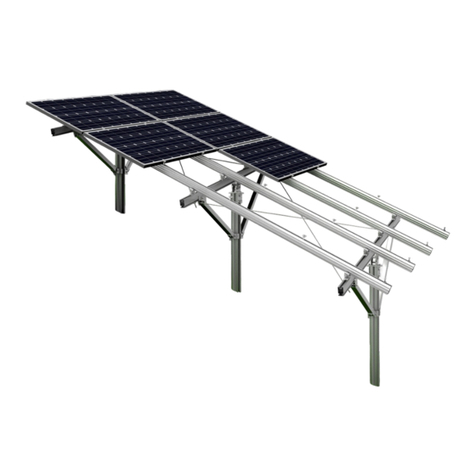
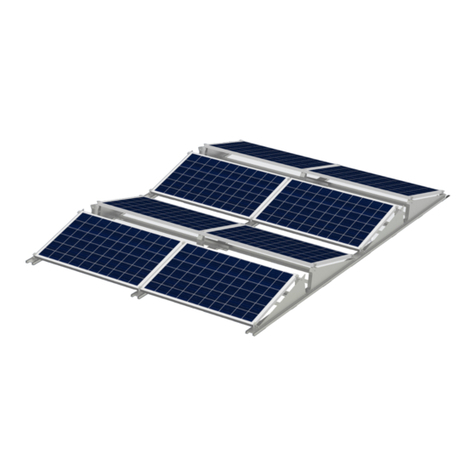
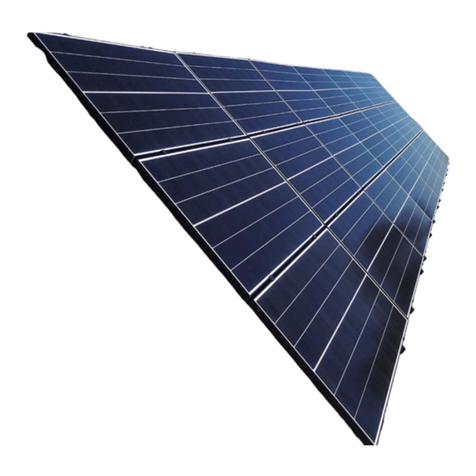
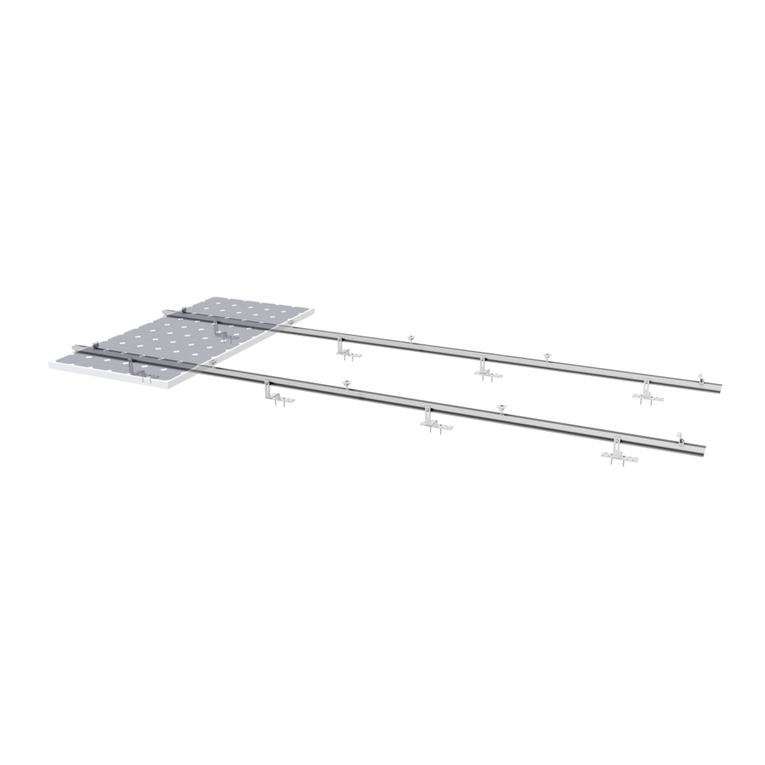
Clenergy PV-ezRack SolarTripod is suitable
for home, commercial, flat roof and even for
large scale solar installations. SolarTripod
divides 2 solutions, single row and double
rows in portrait of modules. The advantage of
SolarTripod is the pre-assembly fixed angle
brackets; it reduces the time and labour in
installation.
Please review this manual thoroughly before
installing PV-ezRack®SolarTripod ™. This
manual provides
1) Supporting documentation for building
permit applications relating to PV-ezRack®
SolarTripod ™ Universal PV Module Mounting
System;
2) Planning and installation instructions.
The PV-ezRack®SolarTripod ™ parts, when
installed in accordance with this guide, will
be structurally sound and will meet the AS/
NZS1170.2:2011 Amdt 2- 2016 standard.
During installation, and especially when
working on the roof, please comply with the
appropriate Occupational Health and Safety
regulations. Please also pay attention to any
other relevant State or Federal regulations.
Please check that you are using the latest
version of the Installation Manual, which you
can do by contacting Clenergy Australia via
email on sales@clenergy.com.au, or contacting
your local distributor in Australia.
The installer is solely responsible for:
• Complying with all applicable local or national
building codes, including any that may
supersede this manual;
• Ensuring that PV-ezRack and other products
are appropriate for the particular installation and
the installation environment;
• Ensuring that the roof, its rafters/purlins,
connections, and other structural support
members can support the array under building
live load conditions;
• Use only PV-ezRack parts as specified in this
document (substitution of any PV-ezRack part
may void the warranty and invalidate the letter
of certification);
•Recycling: Recycle: according to the local
relative statute;
•Ensuring that the roof, its rafters/purlins,
connections, and other structural support
members can support the array under building
live load conditions;
•Ensuring that screws to fix interfaces have
adequate pullout strength and shear capacities
as installed;
•Maintaining the waterproof integrity of the roof,
including selection of appropriate flashing;
•Verifying the compatibility of the installation
considering preventing electrochemical
corrosion between dissimilar metals. This may
occur between structures and the building
and also between structures, fasteners and PV
modules, as detailed in AS/NZS 5033: 2014.
Introduction
Planning
Tools & Components
System Overview
Installation Instruction
Warranty
Certification Letter
01
02
05
06
09
14
15
List of Contents