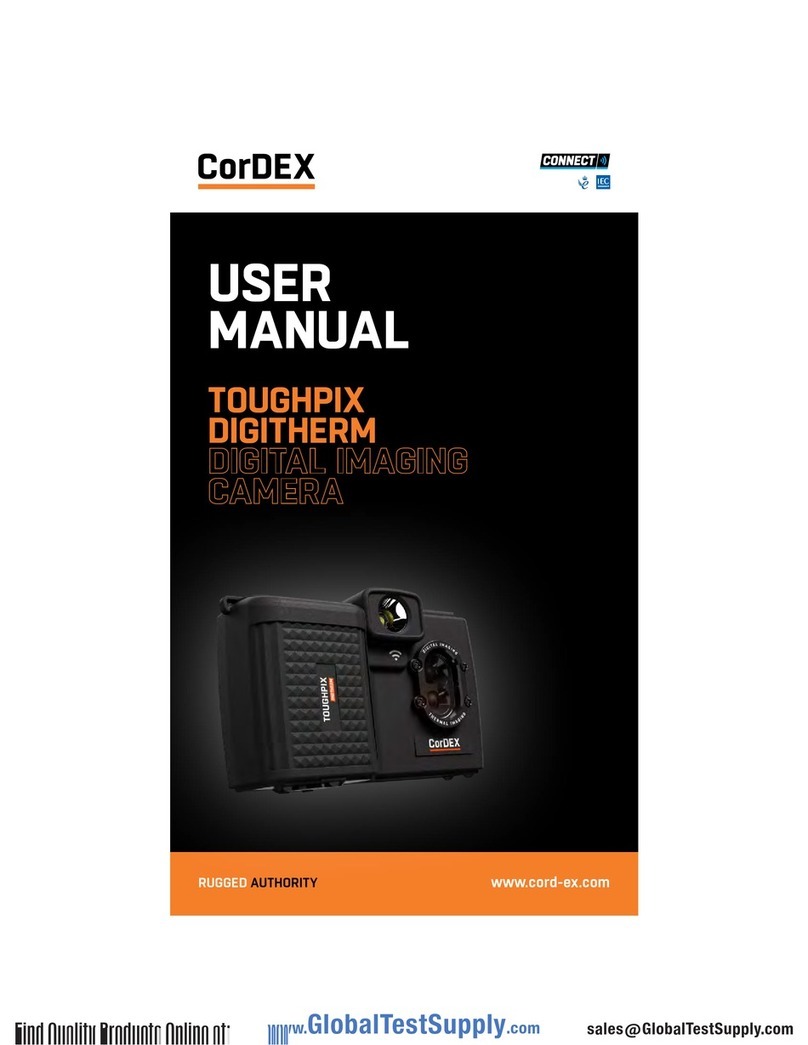
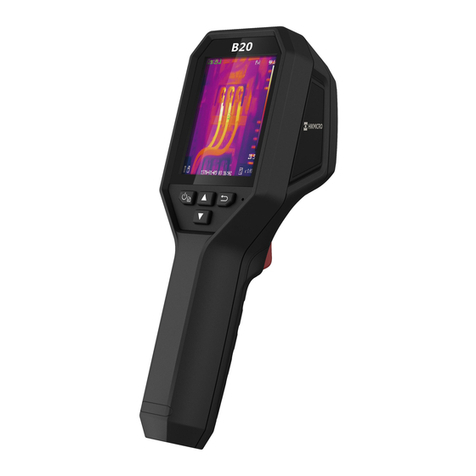
Certificate Information
ATEX / IECEx Certificate No TRAC12ATEX0037X / IECEx TRC 12.0019X
ATEX / IECEx Certificate Types • Ex ib IIC T4 Gb Tamb -10°C to +40°C (Vapor)
• Ex ib IIIC T200°C Db Tamb -10°C to +40°C (Dust)
• Ex ib I Mb (Mining)
MET Listing No E113607
MET (North American)
Certificate Type
Class I, Division 2
Class II, DIvision 2
Class III
Temperature Information
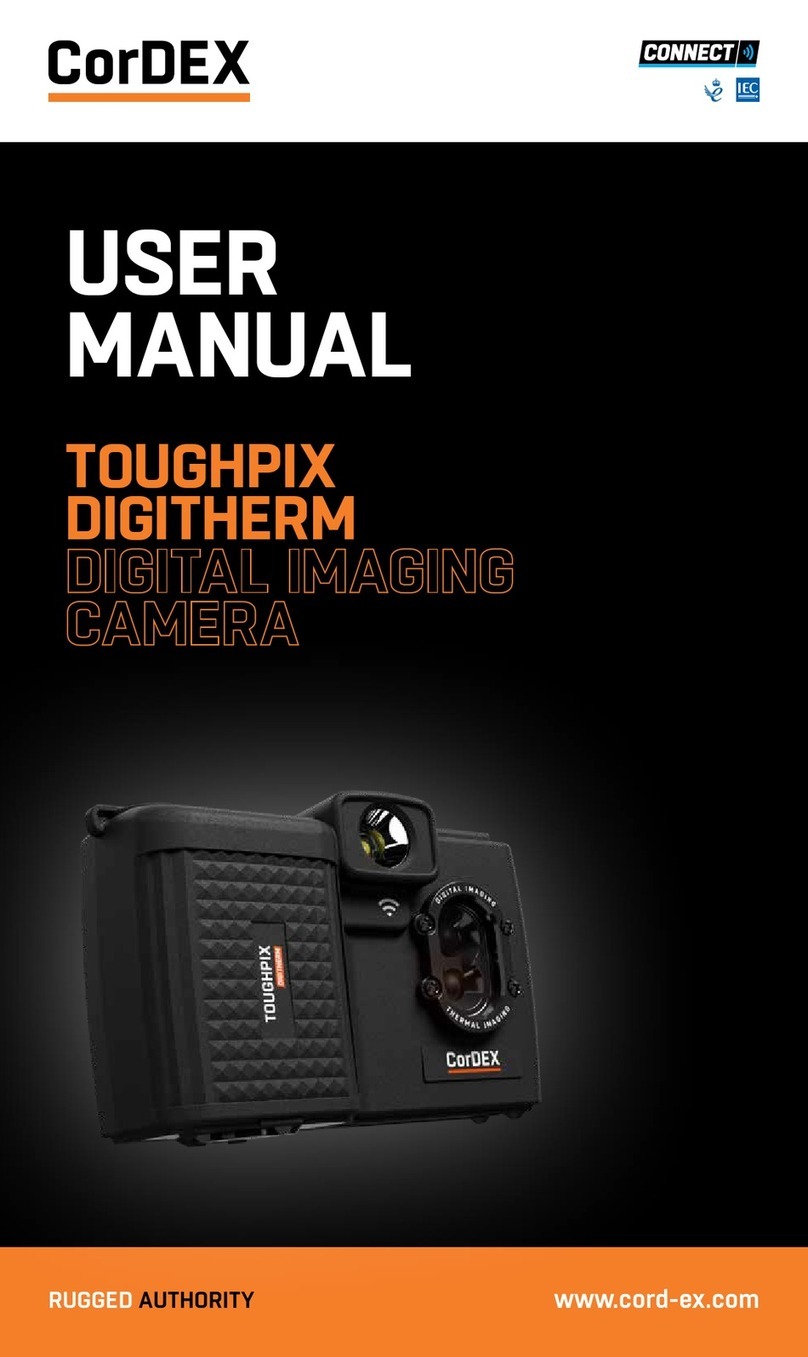
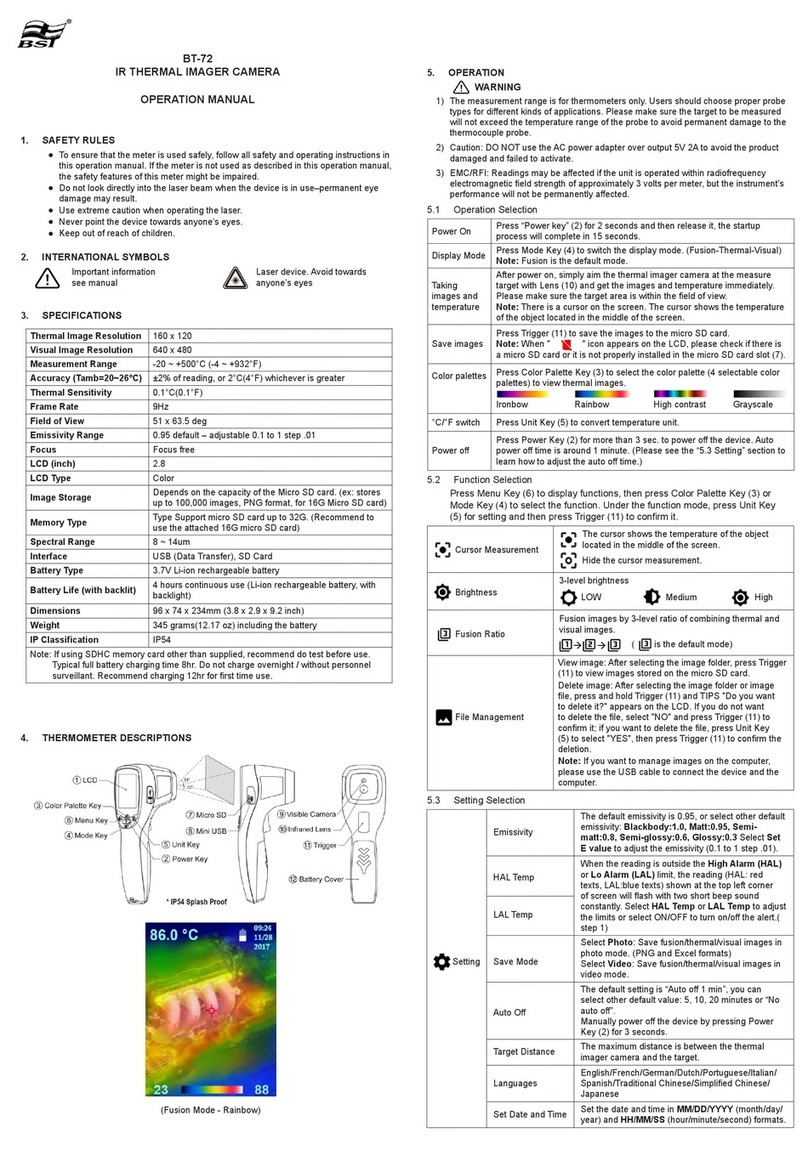
Measurement Range -4°F to 1112°F (-20°C to +600°C )
Accuracy ±2°C or 2% of reading
Imaging
Image Frequency 9Hz
Detector 320 x 240 uncooled microbolometer
Thermal Sensitivity/NETD 50mK
Spectral Range 8μm to 14μm
Field of View (FOV) 25° x 20.5°
Spatial resolution (IFOV) 1.38 mrad
Minimum focus distance ≈4” (10cm)
Lens F 1.2
Image Capture
File Storage 8GB
File Formats CDX (Radiometric) JPEG (Non-radiometric)
Voice Annotation YES
RFID Tag Reader • Operates with 13.54MHz passive tags
• Detection range up to 5cm (1.9in)
• SupportsISO/IEC15693-2,ISO/IEC18000-3 tag formats
General
Operating Temperature -4°F to 104°F (-20°C to +40°C)
Storage Temperature -40°F to +158°F (-40°C to +70°C)
Display 3.2” Backlit LCD
Software CorDEX CONNECT (Included)
Batteries Removable and Rechargeable
Battery Life Upto 8 hours
TEN SUGGESTIONS FOR
THERMOGRAPHY BEST PRACTICE
1
Ensure that the electrical or mechanical
system you are imaging is running fully loaded
to highlight thermal anomalies. A fully loaded
system will generate higher temperature
differential making it simpler to identify
problems.
2
Ensure your image is in focus – this is
important not only for image clarity but also
accurate temperature discrimination and
measurement. Focus should always be set to
the object being measured even if this means
that a surrounding area may be out of focus.
3
If working in a Zone 1 Hazardous area, ensure
that your thermal imaging camera is marked
with the appropriate certification to avoid
risk of explosion. Employers are required
to identify hazardous areas clearly for both
employees and contractors.
4
If you are looking for temperatures above
or below a temperature threshold, use an
isotherm or maximum temperature within an
area feature to clearly highlight any excess.
These features save time and increase
awareness as surveys can take several
hours where fatigue could cause an important
anomaly to be overlooked.
5
Observe a scene from different angles to
minimise thermal reflection as an unusual
warm area could just be your own thermal
reflection. Minimise solar reflection on display
screens outdoors by changing your stance or
swivelling the lens to eliminate reflection.
6
Always consider the object emissivity first
if you want to come close to an accurate
temperature measurement, but remember
that regular comparative thermography will
also show temperature changes leading to
potential failure.
7
For comparative thermography, ensure that
thermal camera settings and especially
emissivity remain consistent. Ideally system
load should also be similar although this is
often impractical.
8
Use infrared windows to image electrical
switchgear under full load in safety. Never
open cabinet doors or override protection
devices, this will put you at serious risk of
injury from arc flash. Even a change of airflow
or dust and debris being dislodged can trigger
an arc flash incident.