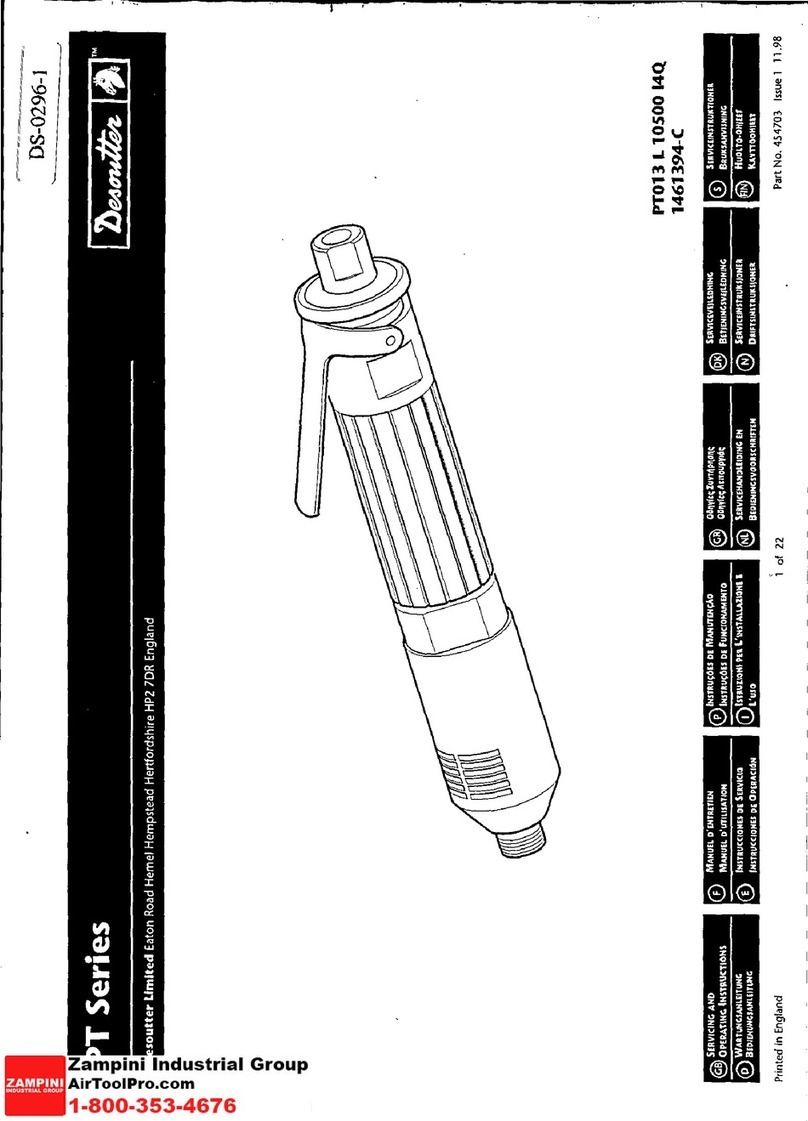
PT200-T Instructions
Desoutter
Limited
Eaton Road Hemel Hempstead Hertfordshire
HP2
7DR
England
1. Use an air supply which
is:
waterfree, filtered and regulated
to
6.3
bar.
2.
Use
impact quality sockets,
in
good condition.
3.
Eye
and ear protection must be worn.
4. Disconnect
the
air supply before handling
the
socket, adjusting
the impulse unit or dismantling the tool.
5.
keep
loose
articles
of
clothing and long hair ;may
from
the
tool
when
in
use.
6.
Hold
the tool correctly, be ready to counteract normal or sudden
movements • have both hands available.
7. Immediately
aft.et
adjusting
the
impulse unit, check for correct
operation.
8.
Do
not
we
with reduced air pressure or
in
a worn condition: the
impulse unit may not operate, resulting
in
sudden rotation
of
the
tool
handle.
9. Ensure that the workpiece
is
properly supported.
1
O.
Must
not be
used
in
explosive
atmospheres.
11. Powertools are not insulated
from
coming intocontact
with
electric
power.
VITON
RUBBER
COMPONENTS
IN
THE
EVENT
OF
FIRE,
HIGHLY
TOXIC
COMBUSTION
PRODUCTS
(INCLUDING
HYDROGEN
FLUORIDE)
CAN
CAUSE
SEVERE
PERSONAL
INJURY.
DO
NOT
HEAT
ABOVE
3oo·c.
DO
NOT
USE
A
HEAT
GUN
TO
DISMANTLE
PULSE
UNIT.
STATEMENT
OF
USE
This
product
is
designed
for
installing and removing
of
threaded fasteners.
No
other
use
permitted.
LUBRICATION
This
tool
is
designed to operate on a dry air
line.
It
can
also
operate on a
lubricated
air
line.
Service
life,
and performance may be enhanced when
a lubricated
air
line
is
used.
Printed
in
England
WEIGHT
3.3 kg.
ACCESSORIES
Arange
of
accessories are available and suitable items should be selected
from the
Accessories
Catalogue.
AIR
QUALITY
-
For
optimum performance and maximum machine
lite
we
recom mend
use
of
compressed air with a dew point between
+2°C
and+
10°C.
-
Use
a separate air
filter
installed
as
close
as
possible to the machine.
Blow
out the
hose
before
connecting.
-There
is
no disadvantage
for
the operation
of
the machine
if
the
compressed air contains a
small
quantity
of
oil
(1-5
mg/m
3).
Air
quality
according to
ISO/TC
118, quality
class
2.4.3. or3.4.4.
is
recommended.
-
With
extremely dry
air,
service
life
of
vanes may be reduced.
Compressed
air
connection and hose
size
-see the spare parts list
Make
sure that the hose
size
is
correct
SETTING
OF
TICHTE.NINC
TORQUE.
The
torque
is
adjusted by setting the adjusting screw with a groove.
Do
not
mix
up the adjusting
screw
and the
oil
filling
plug
with
hex.
key
hole.
The adjusting screw
is
to be turned clockwise to increase the tightening
torque.
Note:
It
is
recommended to start at
min.
torque setting -when the
adjustment
screw
is
screwed out approx. 7 turns
from
the bottom
position.
Do
not
screw
out more than 8 turns
from
max.
Min.
torque setting:
Set
the adjusting
screw
at
min
level
.
At
hard
joints and
min.
setting, reduced air pressure
will
improve the a'curacy.
Check
the tightening torque given on the joint
in
question.
The adjusting screw
is
accessible through the hole
in
the housing. If
necessary, turn the outgoing spindle.
After
adjusting do not forget to assemble the plug
in
the hole
in
the
housing.
CHECKING
THE
Oil
IN
THE
PULSE-UNIT
The
oil
level
shall
be checked after
every
50,000 tightenings, see
Page
7.
If
the tightening torque tends to be remarkably lower than the setting
made, or
it
the pulse frequency goes up -check the
oil
level
and
fill
with
hydraulic
oil
according to the instructions.
Change the
oil
at
the overhauls.
Use
hydraulic
oil:
22cST/40°C
(ISOVG22)
10
of
22
~
RUST
PROTECTION
AND INTERNAL CLEANING
p.:'1™
u
Water
in
the
compressed
air,
dust
and
wear particlescauserust.and sticking
of vanes,
valves
etc.
This
can be
solved
by
flushing with
oil
(some drops), running themachine
for
5-1
Oseconds and absorbing the
oil
in
a cloth.
Make this preparation before longer standstills.
OVERHAUL,
LUBRICATION AND CHANGE
OF
Oil
The
machine
is
normallyused
as
aheavy-duty machine.
It
should, therefore,
be dismantled, overhauled and cleaned after 100,000 (ambitious service
level)
to 250,000 (maximum) tightenings.
If
it
is
not running propeliy, it
should be taken
out
of
service
for
inspection.
Note: Check
or
change the 0-ring around the anvil's shaft.
Also
carefully
clean the 0-ring's groove.
The strainer at the air inlet and the exhaust silencer should be cleaned
frequently
in
order to prevent clogging, which decreases the capacity.
At
the overhauls the throttle valve and bearings must be cleaned and
lubricated with grease. Molykote
BR2
Plus
gives long intervals between
lubrications.
If
it
is
necessary
to
dismantle thevane motor. check the height and width
of
the vanes (measurements: see exploded view). The cylinder surface
must be smooth and unscored.
Note:
dean
the rotor and cylinder before changing vanes.
Apply
a thin
layer
of
grease, containing molybdenumdisulphide (Molykote
BR2
Plus),
on
to
theend faces
of
rotoror end plates.
Assemble
the motor
dry and check that it
is
running
free.
Add
two drops
of
oil
through
the air inlet and tum the motor over
so
that
oil
is
distributed over
the internal motor parts.
THREADED
CONNECTIONS
It
is
important that the machine's threaded connections are tightened
property;
i.e.
in
accordance
with
the specifications on the exploded
views.
Note:
Before
assembly,
lubricate the threads with grease.
©Copyright
1998,
Desoutter limited.
HP2
7DR.
UK.
All
rights reserved.
Any
unauthorized use or copying
of
the contents or
part thereof
is
prohibited.
This
applies
in
particular to trademarks, model
denominations, part numbers and drawings.
Use
only authorized parts.
Any
damage or malfunction caused by the use
of
unauthorized parts
is
not covered
by
Warranty or Product
Liability.
Part
No.
454763
Issue
1 11.98