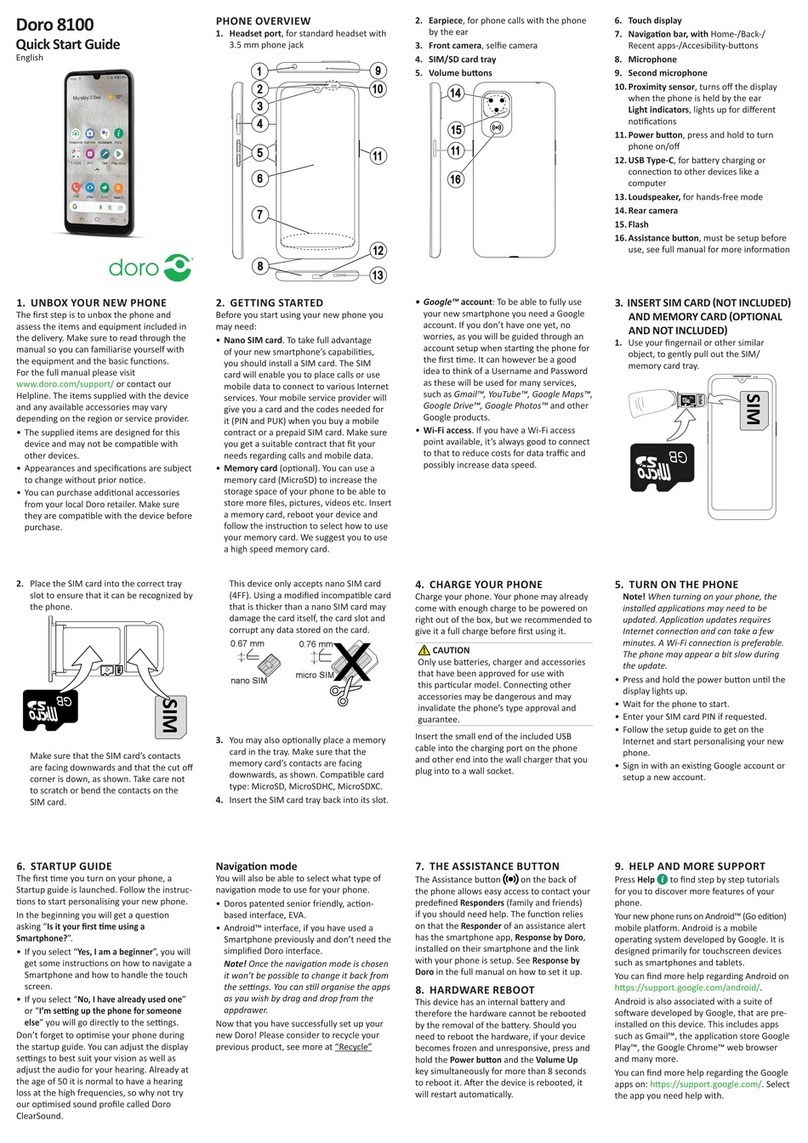
17. 19. 21.
18. 20. 22.
23. 25. 27. 29.
24. 26. 28. 30.
15.
16.
Disclaimer and Limitation Of Liability
Doro AB and its afliates, licensees and retailers assume no
responsibility for any damage or loss resulting from the use
of the unit or this guide. Doro AB and its afliates, licensees
and retailers assume no responsibility for any losses arising
from claims by third parties that may arise through the use
of the unit or this guide. Doro AB and its afliates, licensees
and retailers assume no responsibility for any damage or loss
caused by the loss of data as a result of malfunction, dead
battery, or repairs. Be sure to make backup copies of all
important data on other media to protect against data loss.
TO THE MAXIMUM EXTENT PERMITTED BY APPLICABLE
LAW, UNDER NO CIRCUMSTANCES SHALL DORO AB OR
ANY OF ITS AFFILIATES, LICENSEES AND RETAILERS BE
RESPONSIBLE FOR ANY LOSS OF DATA OR INCOME OR
ANY SPECIAL, INCIDENTAL, CONSEQUENTIAL OR INDIRECT
DAMAGES HOWSOEVER CAUSED, EVEN IF YOU HAVE BEEN
WARNED OF THE POSSIBLITY OF SUCH DAMAGES. THE FULL
EXTENT OF DORO AB’S LIABILITY SHALL BE THE COSTS OF
REPAIR OR REPLACEMENT OF THE UNIT. THE CONTENTS
OF THIS GUIDE AND UNIT ARE PROVIDED “AS IS.” EXCEPT
AS REQUIRED BY APPLICABLE LAW, NO WARRANTIES OF
ANY KIND, EITHER EXPRESS OR IMPLIED, INCLUDING,
BUT NOT LIMITED TO, THE IMPLIED WARRANTIES AND
CONDITIONS OF MERCHANTABILITY, DURABILITY, QUALITY,
OR FITNESS FOR A PARTICULAR PURPOSE, INCLUDING
ANY AND ALL WARRANTIES FOUND IN APPLICABLE
LEGISLATION, ARE MADE IN RELATION TO THE UNIT OR TO
THE ACCURACY, RELIABILITY, OR CONTENTS OF THIS GUIDE.
DORO AB RESERVES THE RIGHT TO MAKE CHANGES AND
IMPROVEMENTS TO THE UNITS AND TO REVISE THIS GUIDE
OR WITHDRAW IT AT ANY TIME WITHOUT PRIOR NOTICE.
REPRODUCTION, DISTRIBUTION OR TRANSFER OF PART
OR ALL OF THE CONTENTS OF THIS GUIDE IN ANY FORM
WITHOUT THE PRIOR WRITTEN PERMISSION OF DORO
AB IS PROHIBITED.
FCC / Industry Canada Notice
This device complies with part 15 of the FCC Rules/
Canadian ICES-003. Operation is subject to the following
two conditions: (1) This device may not cause harmful
interference, and (2) this device must accept any
interference received, including interference that may cause
undesired operation.
This equipment has been tested and found to comply with
the limits for a Class B digital device, pursuant to part 15 of
the FCC Rules/Canadian ICES-003. These limits are designed
to provide reasonable protection against harmful interference
in a residential installation. This equipment generates, uses
and can radiate radio frequency energy and, if not installed
and used in accordance with the instructions, may cause
harmful interference to radio communications. However,
there is no guarantee that interference will not occur in a
particular installation. If this equipment does cause harmful
interference to radio or television reception, which can be
determined by turning the equipment off and on, the user is
encouraged to try to correct the interference by one or more
of the following measures:
• Reorient or relocate the receiving antenna.
• Increase the separation between the equipment and the
receiver.
• Connect the equipment to an outlet on a circuit different
from that to which the receiver is connected.
• Consult the dealer or an experienced radio/TV technician
for help.
The FCC or Industry Canada can require you to stop using
your telephone if such interference cannot be eliminated.
Doro AB has not approved any changes or modications to
this device by the user. Any changes or modications
could void the user’s authority to operate the equipment.
Safety Instructions
Warning!
The unit and the accessories contain small parts.
Keep all of the equipment out of the reach of small
children.
Operating environment
Follow the rules and laws that apply wherever you are, and
always turn off the unit whenever its use is prohibited or
can cause interference or hazards. Only use the unit in its
normal user position.
This unit complies with guidelines for radiation when it is
used either in a normal position against your ear, or when
it is at least 1.5 cm from your body. If the unit is carried
close to your body in a case, belt holder or other holder,
these holders should not contain any metal, and the product
should be placed at the distance from your body specied
above. Make sure that the distance instructions above are
followed.
Parts of the unit are magnetic. The unit can attract metal
objects. Do not keep credit cards or other magnetic media
near the unit. Information stored on them can be erased.
Medical units
The use of equipment that transmits radio signals, for
example, mobile phones, can interfere with insufciently
protected medical equipment. Consult a doctor or the
manufacturer of the equipment to determine if it has
adequate protection against external radio signals, or if you
have any questions.
Comply with any notices at health care facilities instructing
you to turn off the unit while you are there. Hospitals and
other health care facilities sometimes use equipment that
can be sensitive to external radio signals.
Pacemakers
The Health Industry Manufacturers Association recommends
that a minimum separation of 15 cm be maintained
between a handheld wireless phone and a pacemaker to
avoid potential interference with the pacemaker. Persons
with pacemakers:
• Should always keep the unit more than 15 cm from their
pacemaker when the unit is turned on
• Should not carry the unit in a breast pocket
• Should use the ear opposite the pacemaker to minimize the
potential for interference
If you have any reason to suspect that interference is taking
place, turn the phone off immediately.
Safety Instructions
Areas with explosion risk
Always turn off the unit when you are in an area where there
is a risk of explosion, typically these are areas where you
normally requested to turn off your car engine. Follow all
signs and instructions.
In these areas, sparks can cause explosion or re that can
lead to personal injury or even death.
Turn off the unit at lling stations, and any other place that
has gas pumps and auto repair facilities.
Follow the restrictions that apply to the use of radio
equipment near places where fuel is stored and sold,
chemical factories and places where blasting is in progress.
Areas with risk for explosion are often – but not always –
clearly marked. This also applies to below decks on ships; the
transport or storage of chemicals; vehicles that use liquid fuel
(such as propane or butane); areas where the air contains
chemicals or particles, such as grain, dust or metal powder.
Emergency calls
Important!
Mobile phones such as this unit use radio signals,
the mobile phone network, the terrestrial network
and user-programmed functions. This means
that connection cannot be guaranteed in all
circumstances. Therefore, you should never rely solely
on a mobile phone for very important calls such as
medical emergencies.
Vehicles
Radio signals can affect electronic systems in motor
vehicles (for example, electronic fuel injection, ABS brakes,
automatic cruise control, air bag systems) that have been
incorrectly installed or are inadequately protected. Contact
the manufacturer or its representative for more information
about your vehicle or any additional equipment.
Do not keep or transport ammable liquids, gases or
explosives together with the unit or its accessories. For
vehicles equipped with air bags: Remember that air bags ll
with air with considerable force.
Do not place the unit in the area above the airbag or the
area where the airbag might expand. Serious injuries may
be caused if the mobile phone equipment is incorrectly
installed and the airbag lls with air.
It is prohibited to use the unit while in ight. Turn off the
unit before you board a plane. Using wireless telecom units
inside a plane can pose risks to air safety and interfere with
telecommunications. It may also be illegal.
Safety Instructions
Driving safely
Warning!
Use of this unit alone or with headphones (even if
used only in one ear) while driving a motor vehicle
or riding a bicycle is dangerous and is illegal in
some areas, and the user should not engage in such
conduct. Driving while operating a mobile phone is
distracting and could cause serious injury or death.
If you use this unit while driving or riding a bicycle, keep in
mind the following guidelines:
• Give full attention to driving and to the road.
Using a mobile device while driving may be distracting.
While operating any type of vehicle, riding a bicycle, or
performing any activity that requires your full attention, pull
off the road and park before making or answering a call.
• Get to know your phone and its features such as phone
book, call memory, and speakerphone.
These features help you to place your call without taking
your attention off the road. See the applicable portion of
this user’s guide for more information.
• Use a hands-free device.
Add an extra layer of convenience and safety to your unit
with one of the many hands-free accessories available.
Use of a headset or other hands-free device may be legally
required.
Several provinces and states have in recent years passed
laws making it unlawful to operate a motor vehicle while
talking on a wireless phone without use of a headset,
speakerphone, or other hands-free device.
Provincial laws and county and municipal ordinances may
also limit or ban wireless conversations for automobile
drivers. You should therefore check the status of such
laws in your area and in locations to which you travel by
car, whether or not you otherwise follow the preferred
safety practice of routinely using a hands-free device.
For SMS text messaging, it is a recommended safety
practice that you never send or view received text
messages while driving; in several provinces or states
in the future, SMS messaging by a driver is also a legal
violation.
• Position phone within easy reach.
Keep your eyes on the road. If you get an incoming call at
an inconvenient time, let your voice mail answer it for you.
• Assess the trafc before dialing, or place calls when you
are not moving or before pulling into trafc.
Try to plan calls when your car will be stationary. Never
dial, send SMS text messages, or enter other text while
you are driving.
• Let the person you are speaking with know you are driving.
If necessary, suspend the call in heavy trafc or hazardous
weather conditions. Driving in rain, sleet, snow, ice, fog,
and even heavy trafc can be hazardous.
• Do not take notes, look up phone numbers, or perform any
other activities that require your attention while driving.
Jotting down a to-do list or ipping through your
address book takes attention away from your primary
responsibility, driving safely.
• Do not engage in stressful or emotional conversations
that may be distracting. Make people you are talking with
aware you are driving and suspend conversations that
have the potential to divert your attention from
the road.
Safety Instructions
RF exposure information (SAR)
This model phone meets the government’s requirements for
exposure to radio waves.
This phone is designed and manufactured not to exceed the
emission limits for exposure to radio frequency (RF) energy
set by the Federal Communications Commission of the U.S.
Government.
The exposure standard for wireless mobile phones employs
a unit of measurement known as the Specic Absorption
Rate, or SAR. The SAR limit set by the FCC is 1.6W/kg*.
Tests for SAR are conducted using standard operating
positions accepted by the FCC with the phone transmitting
at its highest certied power level in all tested frequency
bands. Although the SAR is determined at the highest
certied power level, the actual SAR level of the phone
while operating can be well below the maximum value. This
is because the phone is designed to operate at multiple
power levels so as to use only the poser required to reach
the network. In general, the closer you are to a wireless base
station antenna, the lower the power output.
The highest SAR value for the model phone as reported to
the FCC when tested for use at the ear is 0.445 W/kg and
when worn on the body, as described in this user guide, is
0.483 W/kg (Body-worn measurements differ among phone
models, depending upon available enhancements and FCC
requirements.)
While there may be differences between the SAR levels of
various phones and at various positions, they all meet the
government requirement.
The FCC has granted an Equipment Authorization for this model
phone with all reported SAR levels evaluated as in compliance
with the FCC RF exposure guidelines. SAR information on this
model phone is on le with the FCC and can be found under
the Display Grant section of http://www.fcc.gov/oet/fccid after
searching on FCC ID: WS5DORO410G.
For body worn operation, this phone has been tested and
meets the FCC RF exposure guidelines for use with a carry
case, belt clip, or holder that contains no metal and that
positions the handset a minimum of 1.5 cm from the body.
Use of other carry cases, belt clips, or holders may not ensure
compliance with FCC RF exposure guidelines.
If you do not use a body-worn accessory and are not holding
the phone at the ear, position the handset a minimum of 1.5
cm from your body when the phone is switched on.
*In the United States and Canada, the SAR limit for
mobile phones used by the public is 1.6 watts/kilogram
(W/kg) averaged over one gram of tissue. The standard
incorporates a substantial margin of safety to give additional
protection for the public and to account for any variations in
measurements. SAR values may vary depending on national
reporting requirements and the network band.
IC Radiation Exposure Statement
This EUT is compliance with SAR for general population/
uncontrolled exposure limits in IC RSS-102 and had been
tested in accordance with the measurement methods and
procedures specied in IEEE 1528. This equipment should
be installed and operated with minimum distance 1.5 cm
between the radiator and your body.
This device and its antenna(s) must not be co-located or
operating in conjunction with any other antenna or transmitter.
Safety Instructions
Hearing aid compatibility
Your mobile device model complies with FCC rules
governing hearing aid compatibility. These rules require an
M3 microphone or higher value. The M-value, shown on the
device box, refers to lower radio frequency (RF) emissions.
A higher M-value generally indicates that a device model
has a lower RF emissions level, which may improve the
likelihood that the device will operate with certain hearing
aids. Some hearing aids are more immune than others
are to interference. Please consult your hearing health
professional to determine the M rating of your hearing aid
and whether your hearing aid will work with this device.
This device is set for direct connection to telecoilequipped
hearing aids. When both the telecoil hearing aid (T switch)
and the phone telecoil are activated, using the device with
the aided ear will provide a direct connection for audio
through your hearing aid. The quality of sound depends on
the type of hearing aid used. You should test the device
with the telecoil setting activated to determine whether your
audio performance improves.
TTY compatibility
This unit does not support TTY signaling. If you intend
to connect a TTY to the unit, this unit should not be
purchased and, if already purchased, it should be returned
for a refund.
Care and Maintenance
Your unit is a technically advanced product and should be
treated with the greatest care. Negligence may void the
warranty.
• Protect the unit from moisture. Rain/snowfall, moisture
and all types of liquid can contain substances that
corrode the electronic circuits. If the unit gets wet, you
should remove the battery and allow the unit to dry
completely before you replace it.
• Do not use or keep the unit in dusty, dirty environments.
The unit’s moving parts and electronic components can
be damaged.
• Do not keep the unit in warm places. High temperatures
can reduce the lifespan for electronic equipment, damage
batteries and distort or melt certain plastics.
• Do not keep the unit in cold places. When the unit warms
up to normal temperature, condensation can form on the
inside which can damage the electronic circuits.
• Do not try to open the unit in any other way than that
which is indicated here.
• Do not drop the unit. Do not knock or shake it either. If
it is treated roughly the circuits and precision mechanics
can be broken.
• Do not use strong chemicals to clean the unit.
• Do not disassemble or open crush, bend or deform,
puncture or shred.
• Do not modify or remanufacture, attempt to insert foreign
objects into the battery, immerse or expose to water or
other liquids, expose to re, explosion or other hazard.
Care and Maintenance
• Only use the battery for the system for which it is
specied.
• Only use the battery with a charging system that has been
qualied with the system per IEEE-Std- 1725-2006. Use
of an unqualied battery or charger may present a risk of
re, explosion, leakage, or other hazard.
• Do not short circuit a battery or allow metallic conductive
objects to contact battery terminals.
• Replace the battery only with another battery that has
been qualied with the system per this standard, IEEE-
Std-1725-2006. Use of an unqualied battery may
present a risk of re, explosion, leakage or other hazard.
• Promptly dispose of used batteries in accordance with
local regulations.
• Battery usage by children should be supervised.
• Avoid dropping the phone or battery. If the phone or
battery is dropped, especially on a hard surface, and
the user suspects damage, take it to a service center for
inspection.
• Improper battery use may result in a re, explosion or
other hazard.
The advice above applies to the unit, battery, AC power
adapter and other accessories. If the phone is not working
as it should, please contact the place of purchase for
service. Don’t forget the receipt or a copy of the invoice.
Battery disposal and recycling information
When the battery in this unit has reached the end of its useful
life, please dispose of it according to your local environmental
laws and regulations. For information about recycling cell
phone batteries, go to: http://www.rbrc.org
The symbol above means that according to local laws and
regulations your product should be disposed of separately
from household waste. When the battery in this unit has
reached the end of its useful life, take it to a collection
point designated by local authorities. Some collection points
accept products for free. The separate collection and
recycling of your unit will help conserve natural resources
and ensure that it is recycled in a manner that protects
human health and the environment.
Warranty and technical data
This product is guaranteed for a period of 12 months
from the date of purchase. In the unlikely event of a fault
occurring during this period, please contact the place of
purchase. Proof of purchase is required for any service or
support needed during the guarantee period.
This guarantee will not apply to a fault caused by an
accident or a similar incident or damage, liquid ingress,
negligence, abnormal or improper usage, non-maintenance
or any other circumstances on the user’s part. Furthermore,
this guarantee will not apply to any fault caused by a
thunderstorm or any other voltage uctuations. As a matter
of precaution, we recommend disconnecting the charger
during a thunderstorm.
Except as required by applicable law, batteries are
consumables and are not included in any guarantee.
This guarantee does not apply if batteries other than DORO
original batteries are used.
EXCEPT FOR THE WARRANTY EXPRESSLY SET FORTH
HEREIN, DORO AB DISCLAIMES AND EXCLUDES ALL
REPRESENTATIONS, WARRANTIES AND CONDITIONS,
WHETHER WRITTEN OR ORAL, EXPRESS OR IMPLIED,
STATUTORY OR OTHERWISE WITH RESPECT TO THE
UNIT AND ELEMENTS OR ACCESSORIES THEREOF,
INCLUDING, BUT NOT LIMITED TO, WITHOUT
LIMITATION, IMPLIED WARRANTIES AND CONDITIONS
OF MERCHANTABILITY, DURABILITY, QUALITY OR
FITNESS FOR PARTICULAR PURPOSE, INCLUDING ANY
AND ALL WARRANTIES AND CONDITIONS FOUND IN
APPLICABLE LEGISLATION.
Support
For assistance, please contact:
Website: www.doro.com
Telephone: 1-888-611-3676
Specications
Network: 850/1800/1900 Triple Band
Dimensions: 125 mm x 52 mm x 16 mm
Weight: 95 g (including battery)
Battery: 800 mAh/3.7V Li-ion battery
© 2010 Doro AB. All rights reserved.
Bluetooth®is a registered trademark of Bluetooth SIG, inc.
eZiType™ is a trademark of Zi Corporation.
vCard is a trademark of the Internet Mail Consortium.
FCC ID: WS5DORO410G
IC: 8175A-DORO410GSM
Version 1.0