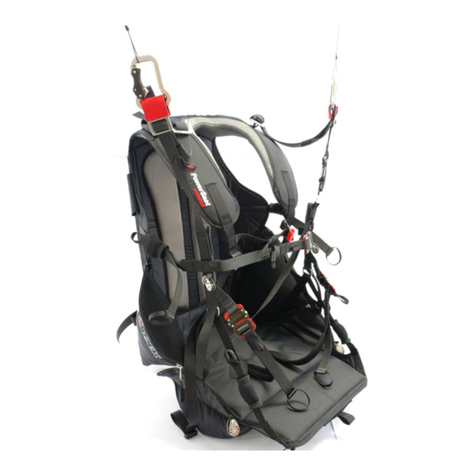
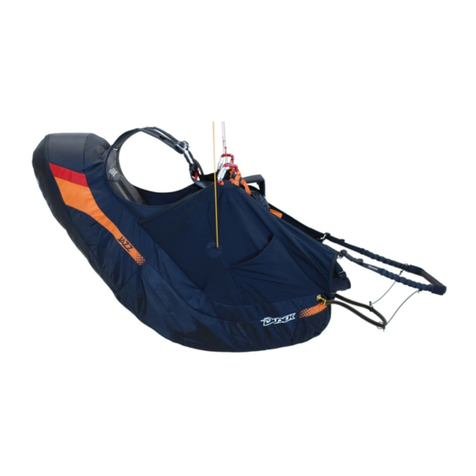
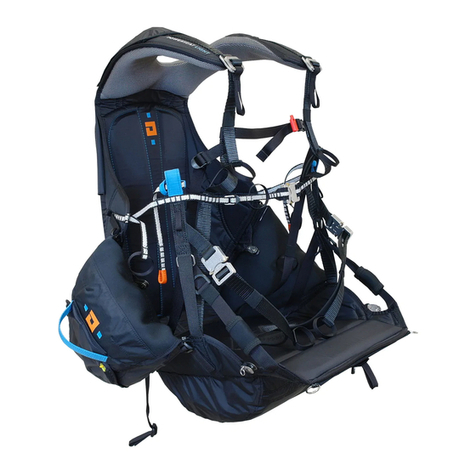
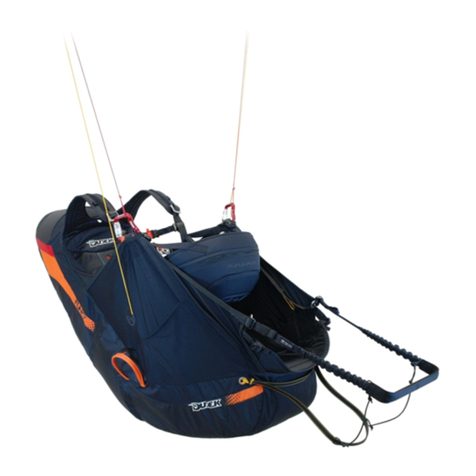
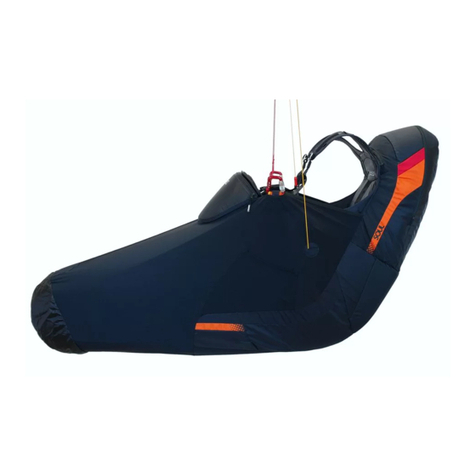
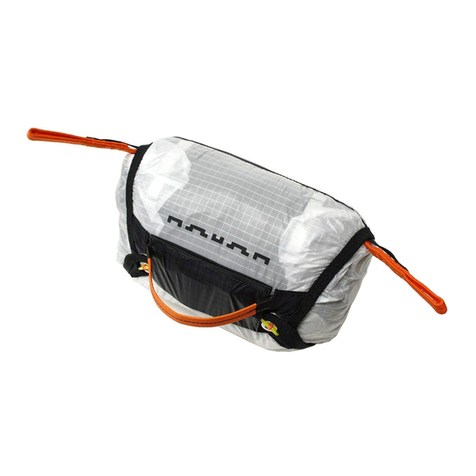
Dudek DISCO User manual

Light harness for beginner and middle-experienced pilots
User manual
v 1.2 09/2016
Please read this manual carefully before your first flight.

Congratulations!
Thank you for choosing the Disco harness. e have done our best to present you with a highest quality product,
fulfilling all safety requirements and offering maximum functionality. Please read this manual carefully before using the
harness for the first time. This will help you utilize all features of the Disco, thus maximizing comfort and fun factor of
each flight. e wish you a lot of safe and enjoyable airtime!
Contents
1. Safety 2
2. Description 2
3. Footrest 3
4. Speedbar 3
5. Rescue chute installation 4
6. Harness/paraglider connection 9
7. Harness/tow connection 9
8. Straps adjustment 9
9. Pockets 11
10. I mpact pad 12
11. Before flight 12
12. Using rescue chute 12
13. Landing 13
14. ater landing 13
15. Tandem flying 13
16. Cleaning and storage 13
17. Operation and repairs 13
18. Technical data 14
1. Safety
Paragliding is a potentially hazardous sport. hen flying a paraglider you have to accept risks of injury and/or even
death. Incompetent or improper use of the harness may add to those risks. In case of any doubts please ask your
dealer or manufacturer.
Dudek Paragliders do not bear any responsibility for damages or injuries resulting from paragliding
activities.
2. Description
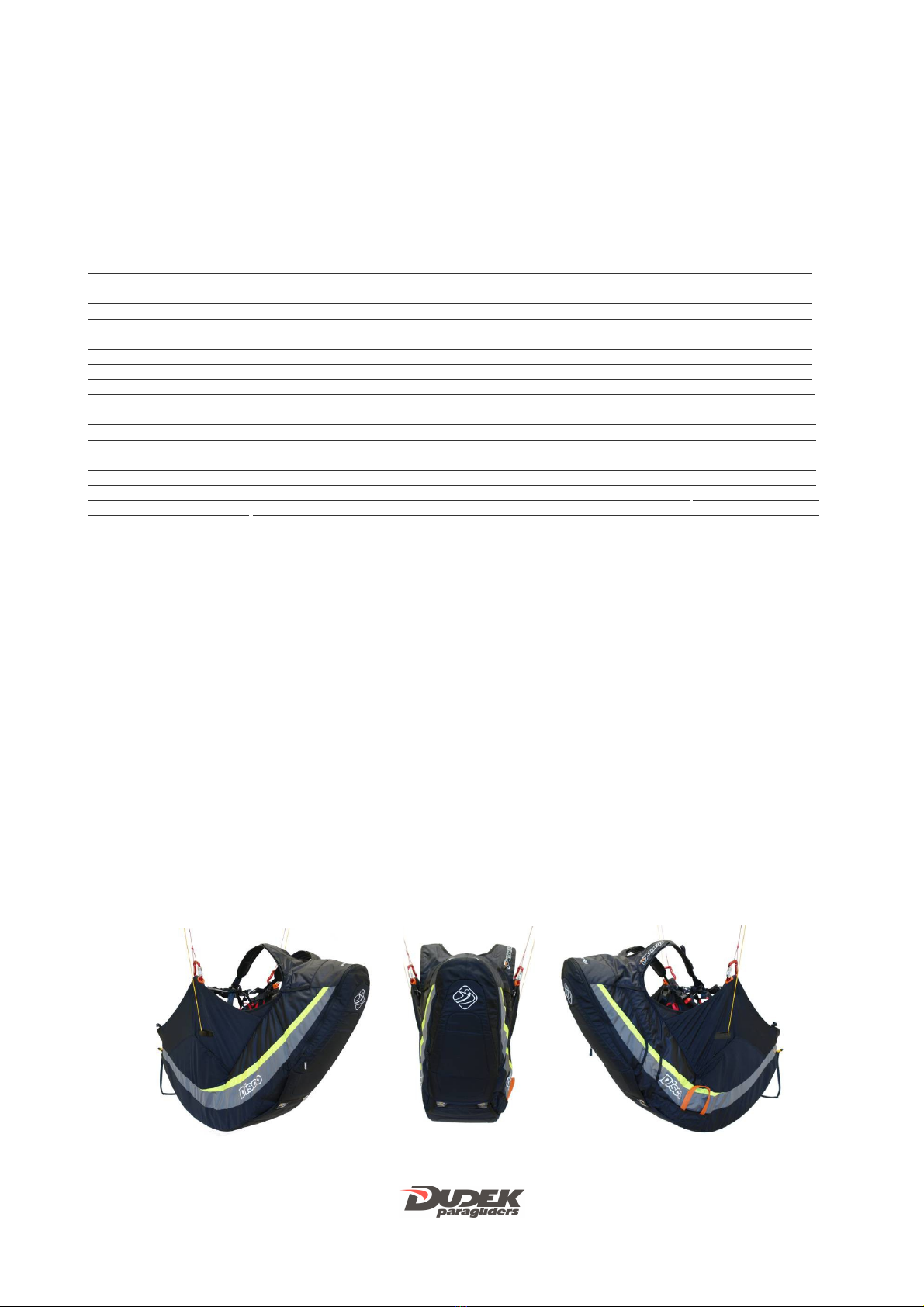
Disco is a light harness for beginner and middle-experienced pilots. Due to light and durable materials of best quality
the Disco weighs just 3,05 kg in S size. It is an ideal proposition for freshly trained and week-end pilots. Small weight
and dimensions make long treks on foot easier. Reduced, elastic seat plate used in Disco harness is an intermediate
solution between a "hammock" and traditional, rigid seat plate harnesses. Comfortable back support and new,
ergonomic seating present you with maximum snugness during long flight hours. Large adjustment range make sure
every single pilot will be able to find his optimum. Redesigned strap scheme brings great stability and significantly
reduces danger of launching with unclipped leg/chest straps. 15 cm thick airfoam impact pad offers very good
protection of the pilot's spine. Integrated rescue chute container is located on the back, behind the impact pad.
Release handle is fixed in easily accessible area on the right side of the harness. There is an additional cache under
seat plate. The Disco features features easily replaceable, ball-bearing Duroll pulleys in order to improve the
speedsystem operation. The Disco is capable of flying with a footrest, available as option.
2

3. Footrest
The Disco is capable of flying with a footrest. It enhances comfort in long flights, help sitting into the harness after
launch and positiviely influences steering. The footrest should be fixed in four points as shown. The footrest length is
adjustable. Its lower part is elastic, contracting when not in use. Designed in this way the footrest does not disturb
you during launch and is easier to find in flight. The footrest is an optional equipment, available in S, M, L, and XL
sizes.
Elastic part
Footrest
Legth adjustment
Fixing to the carabiners
Fixing to the
fore parts of the seat.
4. Speedbar
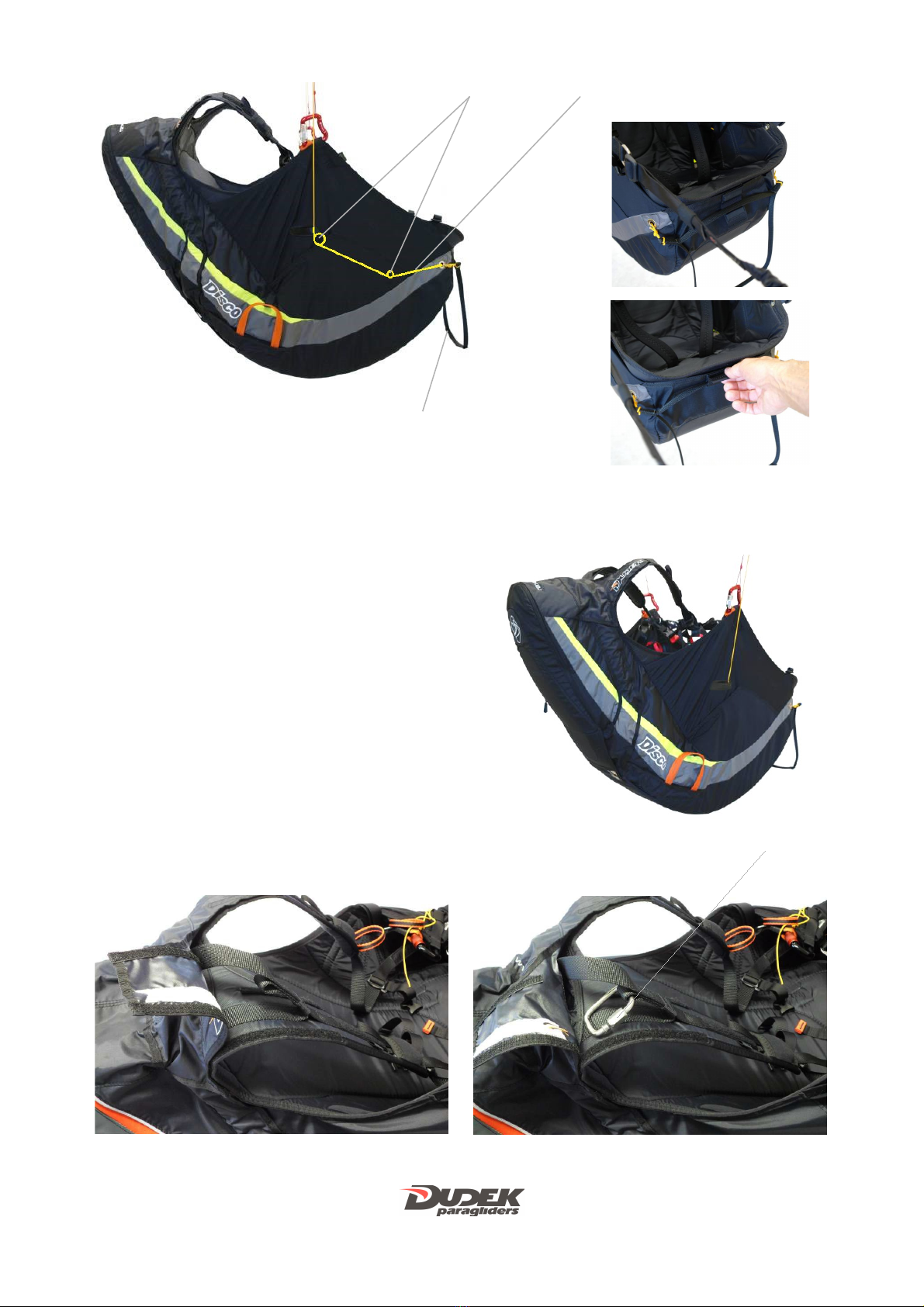
Speedbar lines must be led through respective rings and pulleys (under the seatplate and on the back support). Then
put it through metal loops in the pod and fix a stoper, accompanied by speedsystem clip. Connect the speedbar to the
footrest with a rubber band (if there is one). Find the best length of the rubber so that speedbar will be easily
accessible in flight. In order to adjust the whole system you have to sit in the harness while it is hanged by the
paraglider’s risers. At full speedbar the pulleys on the risers should touch. hen necessary, adjust the lines later
according to your experience in flight.
!
Do not adjust the speedsystem lines while in flight.
3

Pulleys Speedsystem line
Speedbar
5. Rescue chute installation
The Disco has an integrated container for the rescue chute,
located on the back behind the impact pad. Release handle
is fixed in easily accessible place on the right side of the harness.
It is possible to install a steered rescue chute as well in the Disco.
The volume of container min/max – 5800/6500 cm3.
Pictures below show the attachment of a steered reserve chute. You need two rectangular links like Maillon Rapide C6.
Tighten them with a wrench so that they will stay closed firm.
4

1
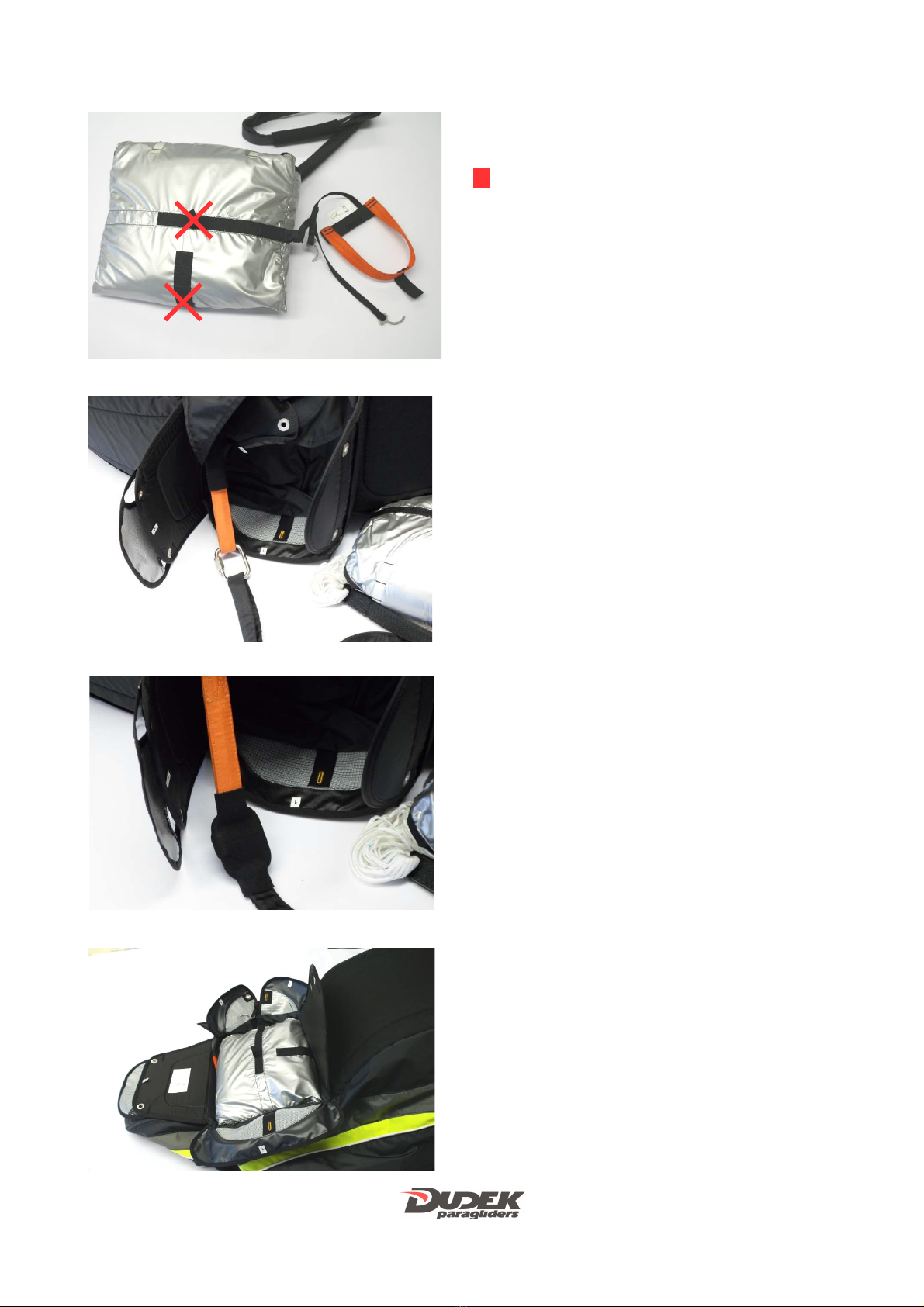
Attach the release handle to the rescue chute bag.
!
The handle must be attached to the side of the bag,
as shown on the picture. Do not fix it to the loop
on the middle of the bag.
2
Connect the rescue chute riser to the
V-strap of the harness with locked quicklink
Maillon Rapide C6 or C7. It should be locked with a
wrench so that a chance opening is impossible.
3
After locking the quicklink safeguard the straps by
applying neoprene cover to keep them in place.
4
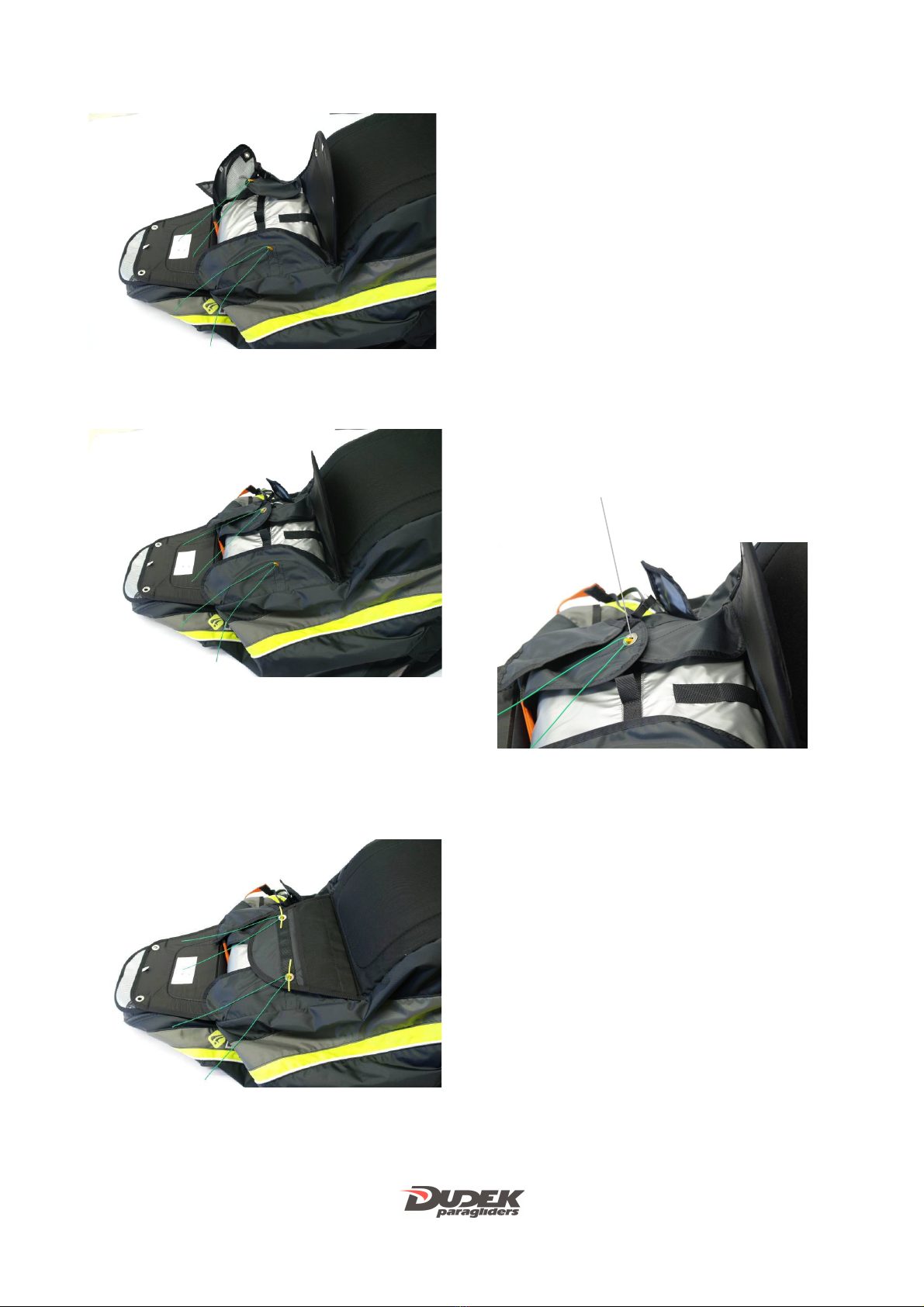
Put the rescue chute in the container with suspension
lines facing downward. The lines and riser of the canopy
must be stoved in the rear part of the container. It is a
bit deeper there.
5

5
Lead the assist lines through the loops of the #1 flaps.
6
Flap #1 is divided in two. Place the strap connecting
release handle to the rescue chute between both parts
of the flap. Lead the assist line through the fragment
equipped with metal loop.
7
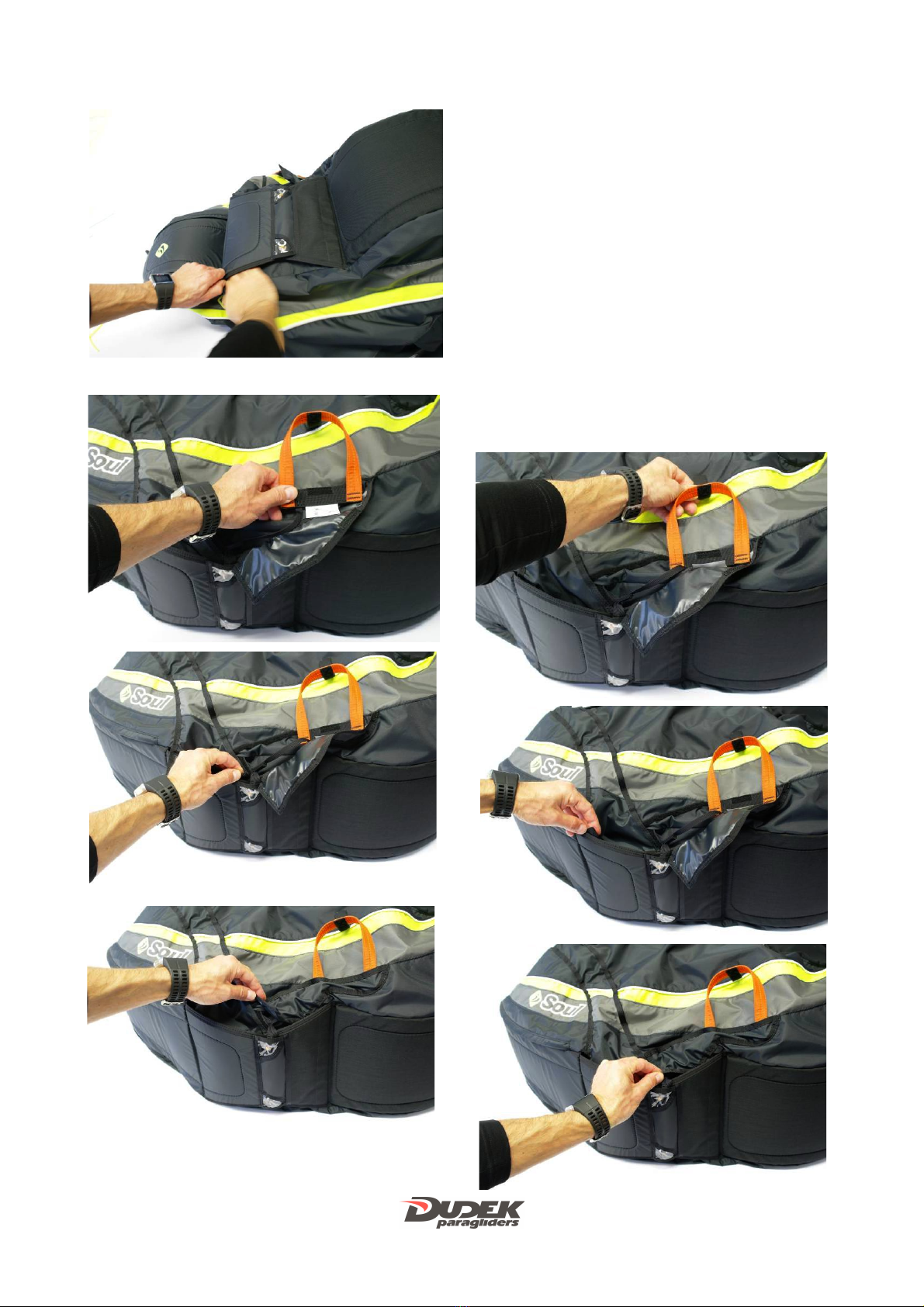
Lead the assist lines through the loops of the #2 flap.
In order to facilitate closing it may be a good idea to use
temporary pins beside assist lines.
6

8
Lead the assist lines through the loops of the #3 flap,
with optional use of temporary pins.
9
Close the container with regular pins and remove the
assist lines. Put them under the pins first, so that
container loops are not damaged by friction as shown on
the picture.
10
Close the lid covering the pins.
7

11
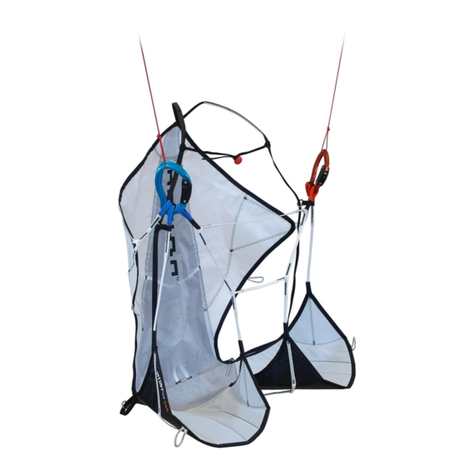
See that #1 flaps inside the container are not folded and
properly guard the rescue chute.
12
Fix the the release handle on a Velcro strap. Close the V-
strap channel, hiding the excess under #3 flap.
8

!
If you are installing the rescue chute for the first time, it is necessary to run a test opening in order to make sure the
container was correctly closed and to get familiar with release force required. In order to do that hang the harness, sit
in it, grab the release handle and pull it vigorously away from the harness, perpendicular to the flight direction. hen
running this exercise it is not recommended to throw the rescue away, as it will result in opening the canopy bag. Pack
the chute into the container again.
!
To avoid accidental opening of the rescue system, pins closing the container must be checked before each
flight!
The rescue chute must be periodically aired and repacked, according to its manual. Proven equipment for the Disco
harness is the Globe 120 or Globe 90 rescue chute, manufactured by Dudek Paragliders. Installation of many other
parachutes (including steered reserves) is possible, as long as they fit in the container.
6. Harness/paraglider connection
The Disco harness is equipped with aluminium carabiners Dudek 20 kN strength.
Use them to connect the harness to the risers. Another thing to connect before
launch are the speedsystem lines of the harness to the speedsystem of the risers.
It is recommended to replace main carabiners with new ones after 300 hrs airtime.
!
efore launch check if the carabiners are locked and guarded against accidental opening.
7. Harness/tow connection
The only safe way of attaching the tow line is a dedicated tow release. The Disco does not feature any dditional points
to fix the tow release, therefore it is to be mounted directly on the harness carabiners or the canopy risers.
8. Harness straps adjustment
!
efore adjusting the straps please install rescue chute and fill the back pocket as for normal flight. Watch
out for symmetry – left and right side should be adjusted the same. First, test flight should be done in
easy weather conditions, with necessary corrections applied afterwards.
Do not adjust the harness while flying.
9

8.1 Shoulder straps
Thanks to adjustable shoulder straps the Disco can accommodate pilots of almost any height. They should stay on
your shoulders rather tight, with just a little play. Too short straps will make difficult comfortable seating after launch
and can limit your movement in flight. A clip on the shoulder straps will make sure they stay in place during launch
and flight. Additionally, there is an alarm whistle fixed to the clip.
8.2 Side straps
They determine the seat/backrest angle. Initial adjustment should be done before the first flight, with the harness
hanged from a ceiling. All settings are to be verified during first flight and can be further modified at any time. Bear in
mind that when the backrest is reclined too much, there is increased risk of getting a twist in case of a big deflation.
8.3 Leg straps
The leg straps are the most important safeguard against falling out of the harness. Their adjustment must allow for
easy launching and proper seating in the air. Too short straps can make you uncomfortable and restrain your starting
run. Too long straps can make seating into harness impossible without using your hands. In the Disco harness both leg
straps are joined with the chest strap, significantly reducing risk of launching without leg straps closed. Their length
affects stability of the harness in flight, either. For increased comfort both of the leg straps are covered with soft
neoprene.
Length adjustment buckles
10
Table of contents
Other Dudek Accessories manuals

Dudek
Dudek Techno User manual

Dudek
Dudek POWERSEAT LIGHT User manual

Dudek
Dudek GROUNDMASTER User manual

Dudek
Dudek Soul User manual

Dudek
Dudek Light 90/110 User manual

Dudek
Dudek POGO 3 User manual

Dudek
Dudek PowerSeat comfort User manual

Dudek
Dudek SIT&FLY 260 User manual

Dudek
Dudek Sit&Fly 90/110 User manual

Dudek
Dudek Funky 2018 User manual