010819
Use caution. Take action to avoid sharp and/or abrasive surfaces and edges.
Avoid electric hazards. Use caution when performing arc welding. Arc flash from arc welding operations, including accidental arcs from
electrical equipment, can damage equipment and are potentially fatal.
Examine the work area. Be aware of the surroundings and workplace hazards that may impact safety, security, and the functioning of fall arrest
systems and components. Hazards may include but not be limited to cable or debris tripping hazards, equipment failures, personnel mistakes,
moving equipment such as carts, barrows, fork lifts, cranes, or dollies. Do not allow materials, tools or equipment in transit to contact any part
of the fall arrest system. Pay special attention to the lifeline. Do not work under suspended loads.
4.2 Anchorage:Examine the work area and take action to address hazards. See paragraph 2.4. Falls are a serious hazard when working at height.
All anchoring situations present different clearance values, performance characteristics, and requirements.
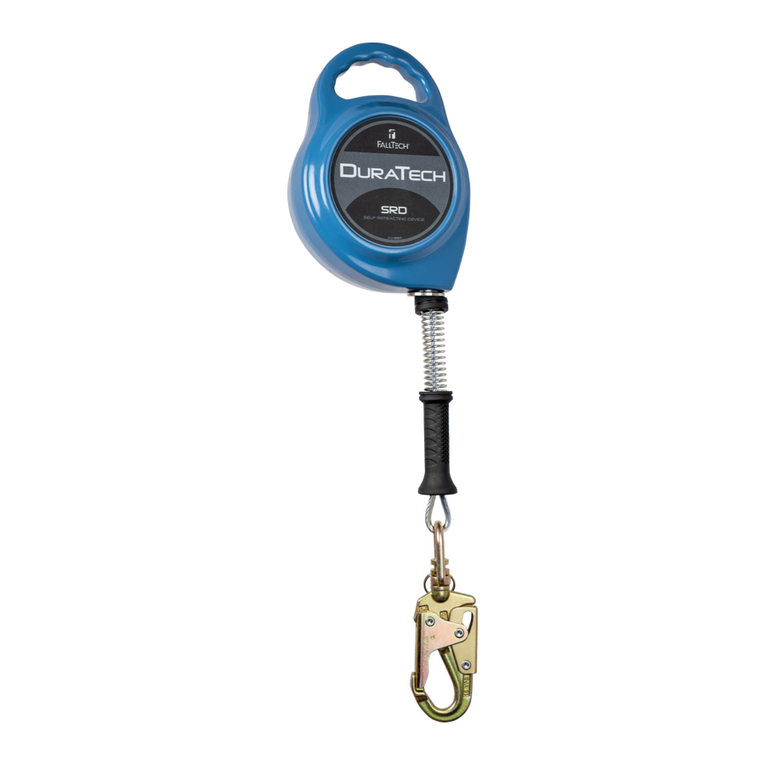
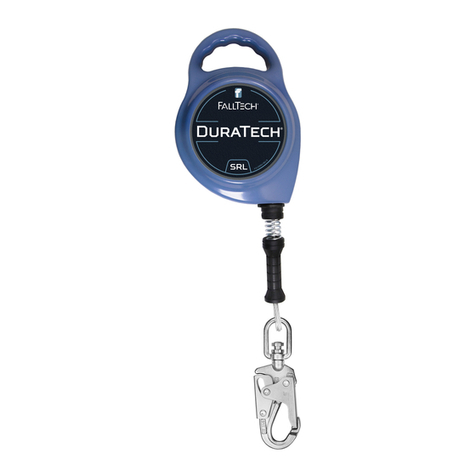
Table 4 provides typical performance attributes of a FallTech DuraTech 6' Mini Single/Twin SRD, for workers up to a maximum total weight of 310
lbs, for both overhead and non-overhead anchor attachment. See paragraph 3.5.1. The qualified person may find this data useful in determining
anchor location. Attachment below the level of the D-ring must be under the supervision of a qualified person. There are several closely related
facets of fall hazard management with a PFAS;
•Anchorage
•Minimum Required Fall Clearance (MRFC)
Overhead (above the FBH D-ring) Anchorage
Non-overhead (below the FBH D-ring) Anchorage
•Swing Fall and Expanded Work Zone
•Installation and Use of the SRD
NOTE: OSHA 1926.502 and 1910.66 require that anchors for a PFAS be able to hold at least 5,000 pounds of weight per person or maintain a safety
factor of at least two (twice the impact load) under the supervision of a qualified person. Also ensure the anchor point will provide sufficient
MRFC.
4.3 Minimum Required Fall Clearance: The MRFC is the minimum distance a user needs between himself and the nearest obstruction (or ground)
below the walking/working surface to avoid serious injury or death in case of a fall event. The user of this equipment must determine the MRFC for
units discussed in this manual to ensure adequate clearance exists in the fall path, as shown in Figures 3A and 3B. Variables discussed in this
manual include the height of the anchor point relative to the user’s FBH D-ring, i.e., overhead or non-overhead anchorage condition, plus swing fall,
and how an expanded work zone affects these variables.
4.3.1 Overhead (Above the D-ring) Anchorage Condition: In an overhead anchorage condition, the SRD is installed anywhere in the allowable
attachment area, overhead or non-overhead, to a maximum of 5' below the user's FBH D-ring. The overhead condition MRFC calculation, shown in
Figure 3A, has three metrics, labeled A, B, and C, then a subtotal, D. A swing fall condition adds another metric, E, and then the grand total, the
MRFC, is F. All metrics are measured from the walking/working surface. These metrics are defined as;
A = SRD deceleration distance is the distance the energy absorber requires to deploy when slowing and arresting the fall.
B = D-ring shift and harness stretch is the distance the harness will shift upward on the user's body during a fall event.
C = Safety margin is the clearance factor of safety as defined as the distance between the lowest extremity of the worker's body at fall arrest
and the highest obstruction the worker might otherwise make contact with during a fall.
D = is the sub-total of A – C. If the anchor is directly overhead there is no swing fall component in this calculation, and D is the MRFC without a
swing fall condition.
E = If a swing fall condition does exist, metric E factors it in. Find the value of metric E by consulting Chart 1, and add it to D to get the value of F.
F = The sum of A – D, plus E (the swing fall component) is F. F is the MRFC, including the swing fall component.
4.3.2 Non-Overhead (Below the D-Ring) Anchorage Condition: In a non-overhead anchorage condition, the SRD is installed anywhere in the
allowable attachment area, which ranges from the level of the users FBH D-ring to a maximum of 5' below the D-ring.
The non-overhead condition MRFC calculation, shown in Figure 3B, has five metrics, labeled A, B, C, D, and E, then a subtotal F, another metric, G,
then a grand total, the MRFC, is H. All metrics are measured from the walking/working surface. These metrics are defined as;
A = Free fall distance due to below the D-ring anchorage condition
B = SRD deceleration distance is the distance the energy absorber requires to deploy when slowing and arresting the fall.
C = Additional Deceleration Distance due to Below D-ring attachment
D = D-ring shift and harness stretch is the distance the harness will shift upward on the user's body during a fall event.
E = Safety margin is the clearance factor of safety as defined as the distance between the lowest extremity of the worker's body at fall arrest
and the highest obstruction the work might otherwise make contact with during a fall.
F = is the subtotal of A – E. F is the MRFC for non-overhead anchorage condition with no swing fall.
G = If a swing fall condition does exist, metric G factors it in. Find the value of metric G by consulting Chart 1, and add it in to get the value of H.
H = The sum of A through F, including G (the swing fall component) is H. H is the MRFC.
4.4 Swing Fall and Expanded Work Zone:A swing fall occurs when the worker moves laterally and is no longer directly under the anchorage. See
Figure 6 in Appendix B for a general discussion. This lateral movement expands the work zone. If the user strikes an obstruction, the lower level, or
the ground during a swing fall, serious injury or death can occur. Swing falls when using an SRD also greatly increase the MRFC. Swing falls from
non-overhead and anchorages are extremely hazardous. Use caution and take action to minimize swing fall hazards. For a discussion of overhead
anchorage conditions, see Figure 4A. For a discussion of non-overhead anchorage conditions, see Figure 4B. Chart 1 provides detailed instructions
to calculate swing fall requirements for an overhead and non-overhead anchorages.
WARNING
An expanded work zone combined with an SRD used in a non-overhead (below the D-ring) condition, can be extremely hazardous.
DO NOT attach the unit to any point more than 5 feet below the level of the FBH D-ring.
4.5 Installation And Use Of The SRD: The SRD may be installed and used as a single unit, or as a twin.
4.5.1 Single SRD: One SRD with two orientation options;
Housing attached to the harness: The SRD housing end is installed to the dorsal D-ring of a FBH and the leg end attached to an anchorage. The
anchorage may range from overhead, to as low as 5' below the dorsal D-ring for a worker up to 310 lbs maximum.