5
FERNO/MAN/03/10/202UK MEGASUS
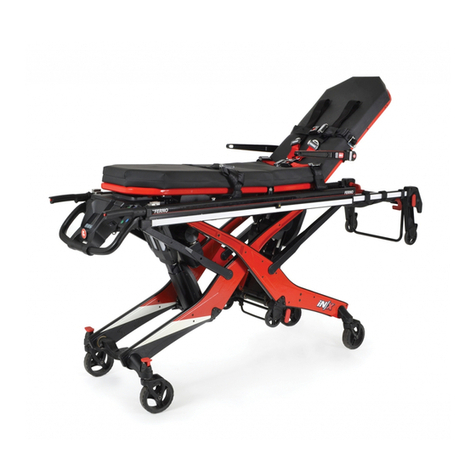
Height Adjustment –Do not raise the trolley when located in the vehicle lock.
The height adjustment must not be raised when the trolley is loaded above 200
kg.
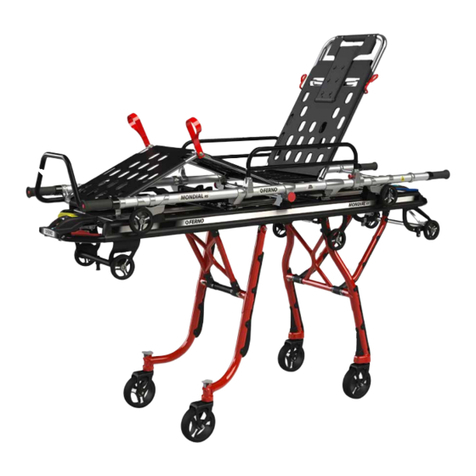
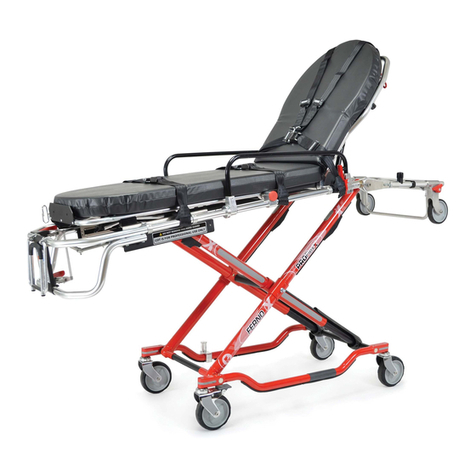
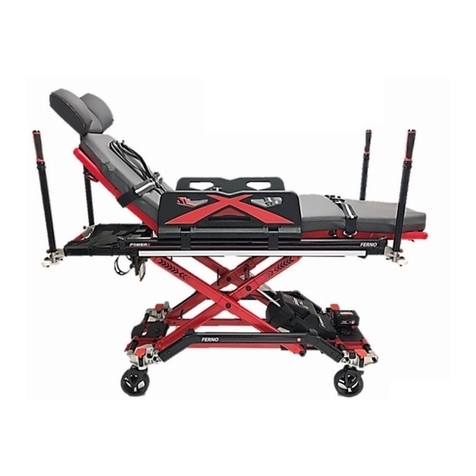
1. The height adjustment of the Megasus is achieved by a simple hydraulic pumping
action.
2. The raising and lowering action is achieved by means of foot pedals, which are
located on each side of the trolley. NOTE ensure pedals on both sides are clear
before operating.
3. The foot pedal is a rocker action about an off centre pivot, the longer pedal is for
raising the trolley top and the shorter for lowering.
4. To raise the trolley, operate the long side of the foot pedal through full strokes to
achieve the desired height, this operation may be better achieved with two wheel
brakes engaged.
5. To lower the trolley, depress the short pedal. Slight repositioning of the foot
pedal will control the rate of lowering.
6. Using two operators, making use of both pump pedals, can ease the raising a
heavily laden trolley. Practice is advised to achieve unison of action.
Wheeling the Trolley
1. Transporting a patient should be done with the side rails raised and restraints
fastened.
2. The trolley is best rolled by two attendants, one pulling and the other assisting with
guidance and steering as necessary.
3. If low obstacles (such as door sills) are encountered, roll up to them squarely and
lift the leading wheels over the obstacle using the corner frame grips. Repeat for
the trailing wheels.
4. High obstacles such as kerbs or steps, rough terrain, etc. should be recognised as
potentially hazardous to smooth rolling and trolley balance and may require
physical assistance or an alternative route.
5. Ensure that the restraints are fastened around the patient (see page 10).
Place the trolley in the lowest position possible. However, the trolley may be
wheeled in an elevated position along hospital corridors or similar smooth
surfaces, provided that the patient is securely strapped to the trolley and that the
two attendants are in control of the patient and trolley at all times.
6. To lift the trolley top and base together the operator sited at the foot end needs to
lift slightly before the head end operator. This is necessary to ensure that the
lifting notches engage. Apart from the fully raised position there are two other
positions at which the lifting notches engage these are at mid lift and just above
fully lowered. When lifting from the fully lowered position the top and base will
separate slightly prior to the notch engaging, this is a normal action. It is
recommended that this process is practiced on an un-laden trolley.