6Hilge GmbH & Co. KG | BA.001.ADY.001.09.16.GB
Operating manual
GEA Hilge HYGIANAI/II/III Adapta®
Safety
2.3 Identification of instructions in the operating
manual
Symbols
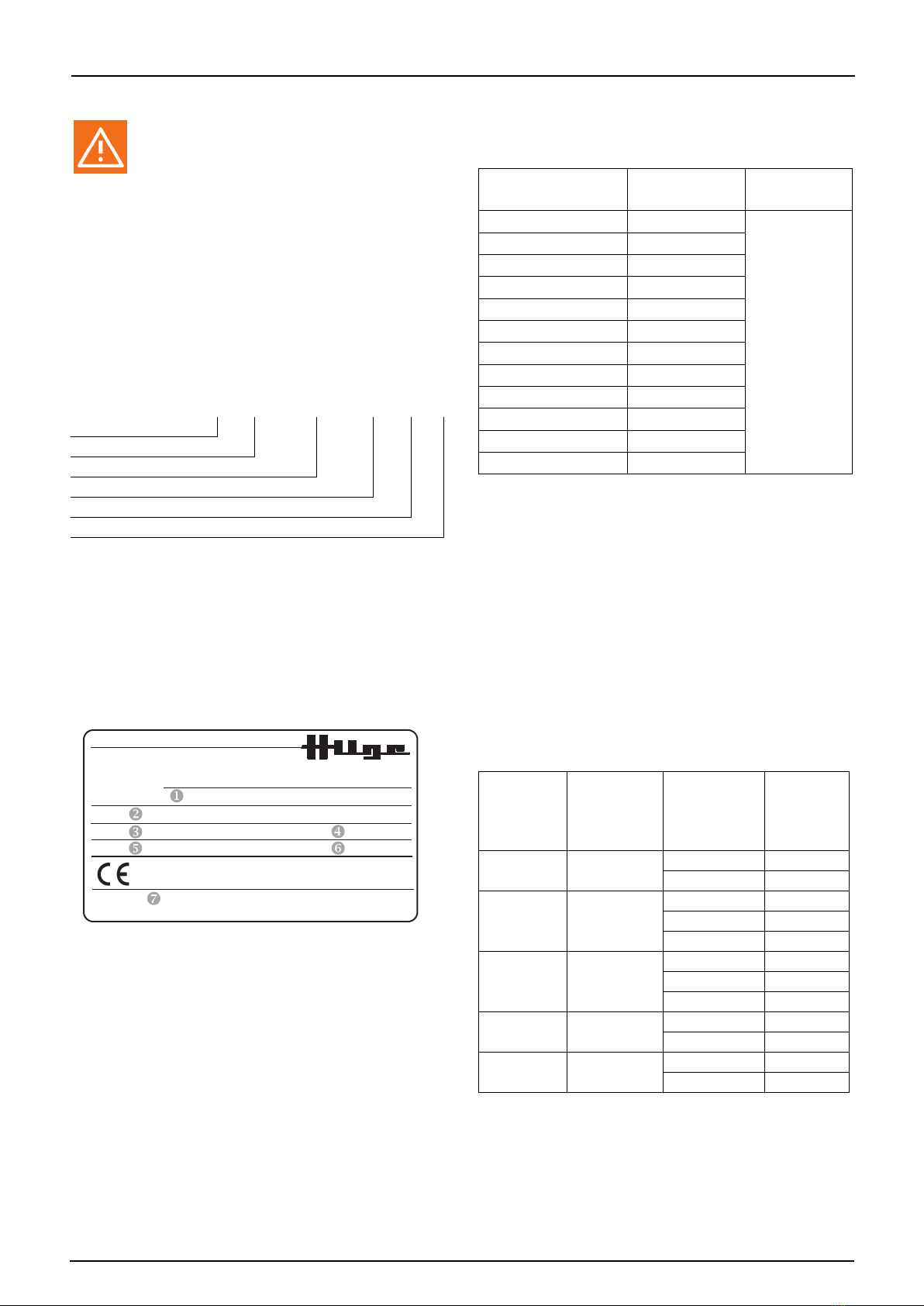
The safety instructions presented in this operating manual are
identified as shown below.
Fig. 1: Symbols for safety instructions
Signal words
The following signal words are used to classify the safety
instructions:
DANGER (A)
Characterises an imminent hazard with a high risk which can
cause death or serious bodily injury.
WARNING (B)
Characterises a possible hazard with a medium risk which can
cause death or bodily injury if it is not avoided.
CAUTION (C)
Characterises a hazard with a minor risk which can cause
minor or medium-level bodily injury if it is not avoided.
Do not remove instructions from pump
Instructions attached directly to the pump, such as a direction-of-
rotation arrow, must be noted and kept in completely legible
condition.
Damaged or illegible instructions must be replaced.
2.3.1 Structure of safety instructions
The safety instructions are structured as follows and use the
symbols and signal words shown here:
Example:
2.4 Qualification and training of personnel
The employees operating, maintaining, inspecting, and installing
the pump must have the appropriate qualifications for this work.
The operator must define in detail the tasks for which the
employees are responsible, the tasks of which they are in charge,
and the manner in which they are supervised.
If the employees do not have the necessary knowledge, they
must be instructed and trained accordingly. This can be done, if
necessary, by the manufacturer/supplier under contract to the
operator. The operator must also ensure that the employees fully
understand the contents of the operating manual.
2.5 Dangers caused by failure to follow the
safety instructions
If these safety instructions are not followed, employees, the pump
and the environment will be in danger.
Failure to follow the safety instructions can lead to the loss of the
right to file claims for damages.
Failure to follow instructions can, for example, lead to the
following hazards:
• breakdown of important functions of the pump/system
• failure of recommended methods of maintenance and repair
• endangerment of personnel by electrical, mechanical, and
chemical hazards
• endangerment of the environment by leakage of hazardous
materials.
2.6 Safety-conscious work
The safety instructions given in this operating manual, the
existing national regulations for accident prevention, and any
applicable internal working, operating, and safety instructions of
the operator must be followed.
2.7 Safety instructions for the operator/user
SIGNAL WORD
Description of danger!
▲Possible consequence.
►Action to eliminate the danger.
DANGER
Electric shock if electrical parts are touched!
▲Death, serious bodily injury, damage to prop-
erty.
►Before attempting to diagnose any fault,
make sure that the main switch has been
switched off. It must be ensured that the
power supply cannot be accidentally
switched on.
A
BC
WARNING
Hot or cold mechanical components!
▲Serious bodily injury.
►Take structural measures to prevent contact
with them!
WARNING
Trapping hazard!
▲Death, serious bodily injury, damage to prop-
erty.
►Do not remove protection against contact
with moving parts (e.g. coupling guard) while
the pump is in operation.
►Replace defective safety equipment immedi-
ately.
WARNING
Contact with hazardous substances (e.g. inhala-
tion)!
▲Death, serious bodily injury, damage to prop-
erty.
►Drain away leakage of hazardous pumped
liquids in such a way that there is no danger
to personnel or to the environment.
►Follow legal regulations.
►If shaft seal fails, switch off the pump.
Replace seal before next start-up.
WARNING
Tripping hazard from electric power cable!
▲Death, serious bodily injury.
►Route the electric power cable in such a way
that no one can trip over it (in case of porta-
ble pumps).