Icare HOME Patient Guide ENGLISH 5www.icare-usa.com4
HOW DOES THE
TONOMETER WORK
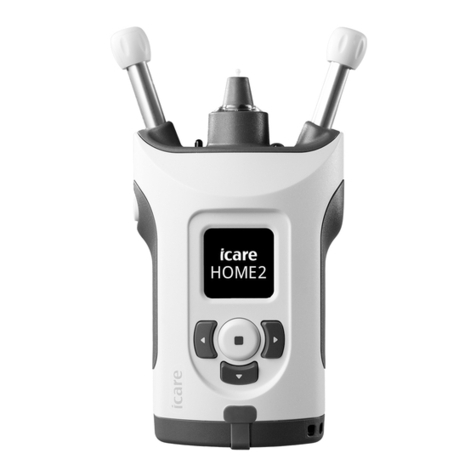
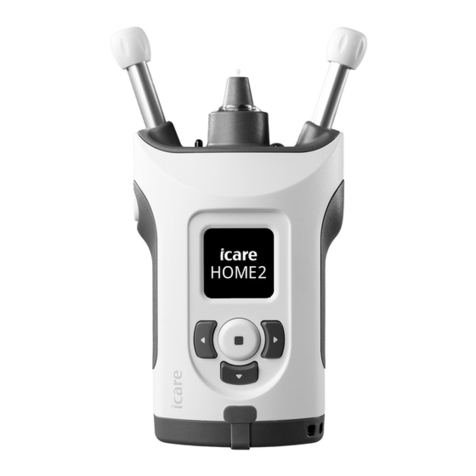
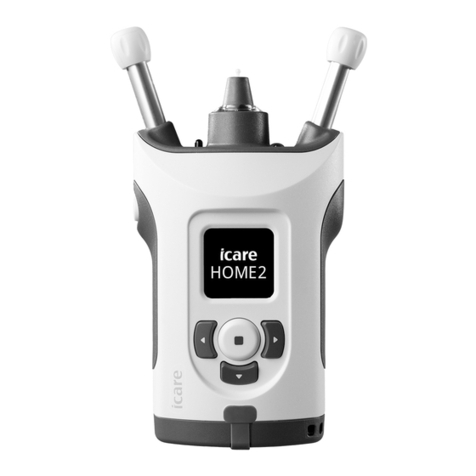
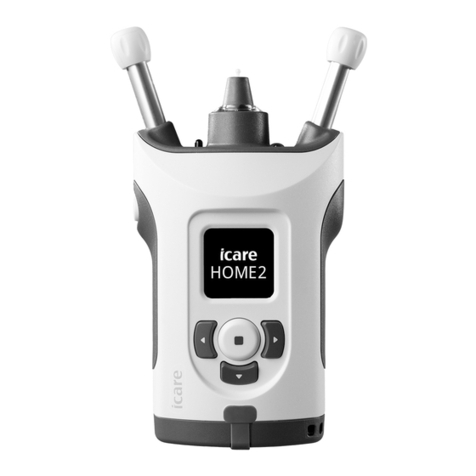
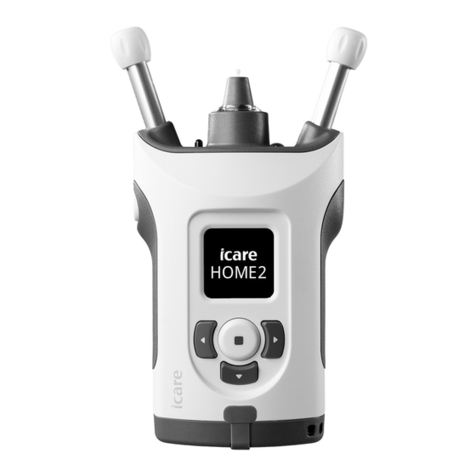
The tonometer measures your eye pressure using
a disposable probe that gently contacts your eye
during the measurement. You may need a mirror
to help you determine the correct measurement
posion. The recommended frequency of measure-
ments is 3-4 mes per day with a maximum of 5-6
mes per day.
A complete measurement is a series of six very rap-
id measurements. It may take from several seconds
to a minute to take the measurement. The probe
moves to the cornea and back during each of the
six rapid measurement. Aer the series of six mea-
surements, the tonometer calculates your nal eye
pressure and stores it in the tonometer’s memory.
The probe is disposable, but you can use the same
probe for both eyes if the health care professional
instructed you to measure both eyes. Dispose of
the probe in a normal trash container or a metal
waste bin aer you have taken the measurements
for both eyes.
The tonometer includes infra-red eye recognion
sensors to idenfy which eye, right or le, you
are measuring. It is important not to cover these
sensors with your ngers, hand, hair etc., because
covering the sensors causes an error. It is also im-
portant to keep objects such as pillows away from
the temple side of your eye, as they produce an
infrared reecon that causes an error.
It is important that you carefully read all instruc-
ons in this guide before using the tonometer.
CONTRAINDICATIONS
You should not be prescribed the HOME
tonometer if you:
• Have an acve ocular infecon
(for example, pink eye)
• Had recent trauma to your eye
• Cannot demonstrate you are able to use the
Icare HOME tonometer aer training and fail
to complete the cercaon procedures.
This includes poor agreement between
Goldmann applanaon tonometry (GAT)
and Icare HOME measurements.
• Have disabling arthris or diculty handling
the Icare tonometer
• Have a severe diculty in opening your eyes
including abnormal contracons or twitches
of the eyelid
• Have involuntary, rapid and repeve
movement of the eyes