Page 4 of 8 SB30X-XXX-X (en)
GENERAL DESCRIPTION
The ARO® shock blocker pulsation dampener is designed
to work with 1:1 ratio pumps having an outlet pressure not
exceeding 120 psi (8.3 bar). The shock blocker will eectively
reduce material pressure variations, surges and shock to pip-
ing and delivery in uid systems during pump reversal. It can
significantly contribute to pulse reduction in low pressure
spray applications.
Accurate selection of wetted material will assure longest ser-
vice life and minimize down time. Several material options
are available for the body and diaphragm materials. Fluid
section materials available include: aluminum, cast iron and
stainless steel. For specific fluid compatibility, consult the
chemical manufacturer.
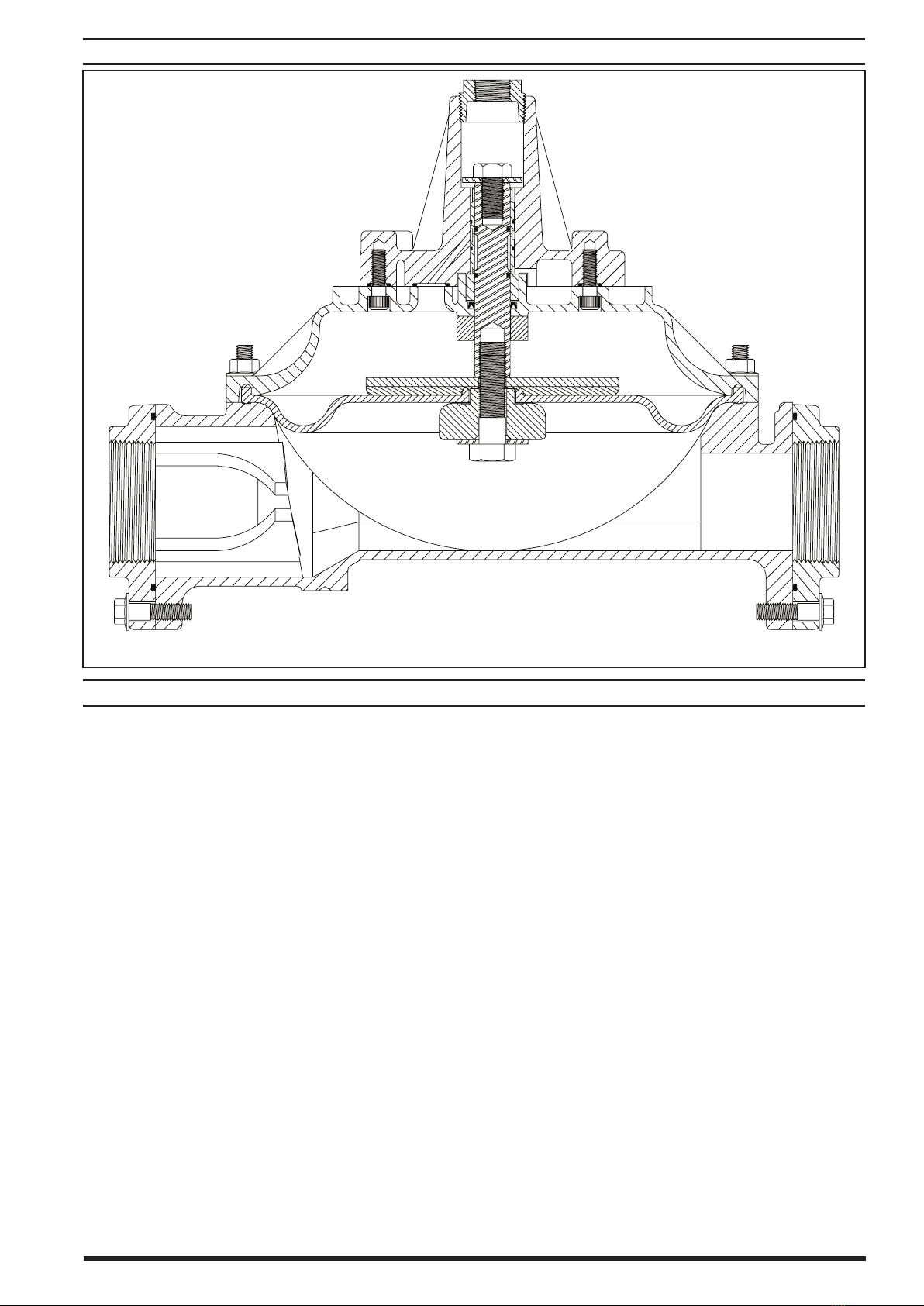
The shock blocker uses a single air pressurized, flexible di-
aphragm working against the fluid line pressure. Several
diaphragm material options are available to allow custom
matching to the uid material for best compatibility (refer to
the model description chart).
Shock blocker units can also be added in series to provide
additional dampening on the material.
Pressure relief through the exhaust port is a normal compen-
sating function of the control valve in the shock blocker. It
will automatically adjust itself to the required operating pres-
sure once the material pressure has been applied. The pres-
sure supplied to the shock blocker needs to be equal to the
material pressure to provide the proper dampening eect.
AIR AND LUBE REQUIREMENTS
EXCESSIVE AIR PRESSURE. Can cause pulsa-
tion dampener damage, personal injury or property
damage.
yA filter capable of filtering out particles larger than 50
microns should be used on the air supply. There is no lu-
brication required other than the“O”ring lubricant which
is applied during assembly or repair.
yIf lubricated air is present, make sure that it is compatible
with the“O” rings and seals in the air motor section of the
pump.
OPERATION
DO NOT EXCEED 120 PSI (8.3 BAR). Operating
at higher pressure can cause explosion, resulting in prop-
erty damage or severe injury.
yPressure relief through the exhaust port is a normal
compensating function of the control valve in the shock
blocker. It will automatically adjust itself to the required
operating pressure once the material pressure has been
applied.
yOperate the system for a few minutes to equalize air and
uid chambers of the pulsation dampener.
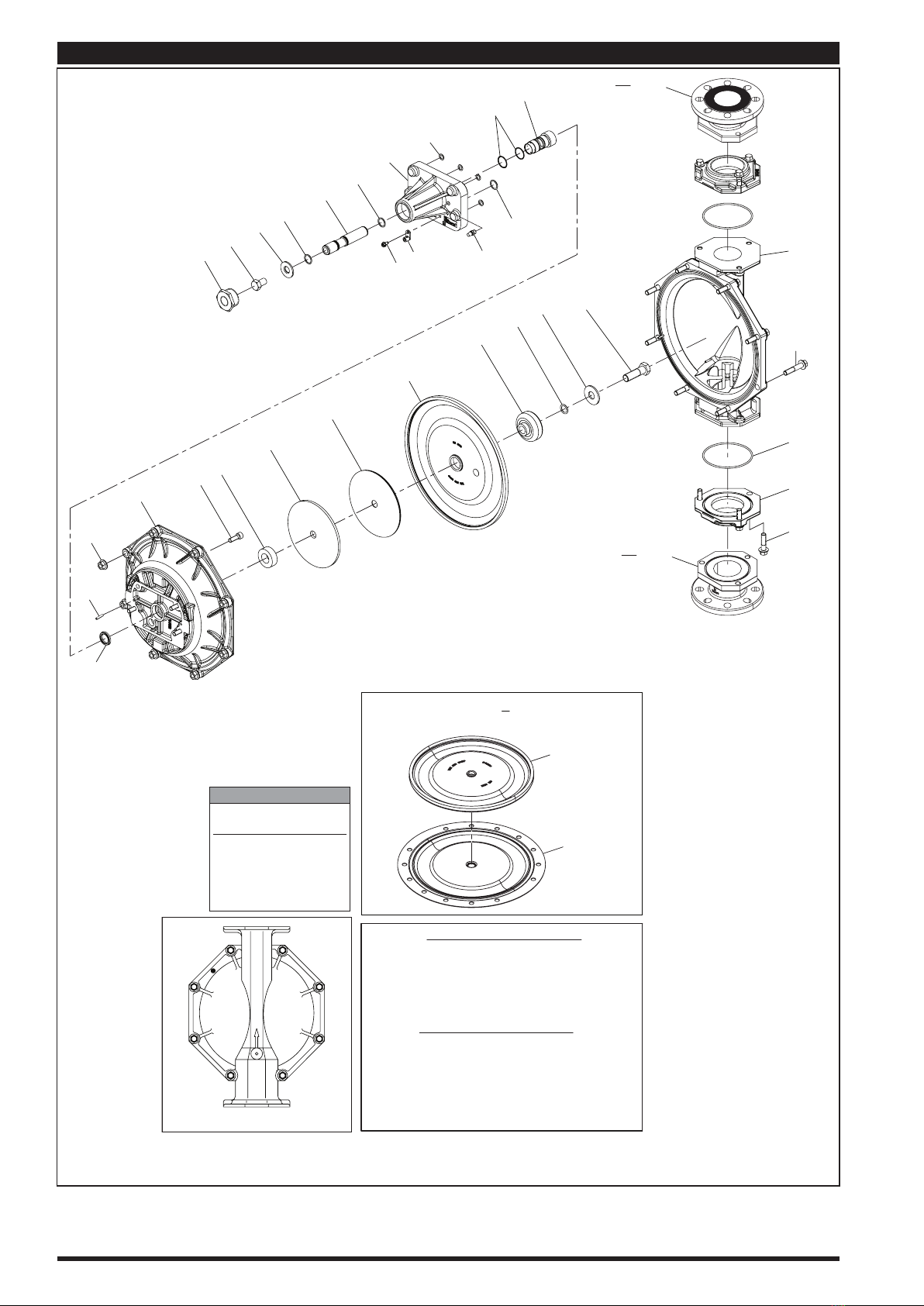
PARTS AND SERVICE KITS
Refer to the part views and descriptions as provided on pag-
es 5 and 6 for parts identication and Service Kit information.
yCertain ARO “Smart Parts” are indicated which should be
available for fast repair and reduction of down time.
MAINTENANCE
yProvide a clean work surface to protect sensitive internal
moving parts from contamination from dirt and foreign
matter during service disassembly and reassembly.
yKeep good records of service activity and include pump
in preventive maintenance program.
yBefore disassembling, empty captured material in the
uid cap by tipping the pulsation dampener on end.
FLUID SECTION DISASSEMBLY
1. Remove (107) reducing bushing.
2. Remove six (26) screws, releasing two (4) anges and (11)
“O”rings.
3. Remove eight (27) screws and (29) nuts, releasing (15)
uid cap.
4. Secure (14) screw in a vise, with (101) air valve body up-
ward.
5. Using a 15/16” socket on (186) screw, unthread and re-
move (186) screw and (9) washer.
6. Remove (68) air cap from (7) diaphragm and compo-
nents.
7. Remove (14) screw from the vise. Unthread and remove
(1) rod, releasing (2) stopper, (5) back-up washer, (7) or (7
and 8) diaphragms, (6) washer and (9) washer from (14)
screw.
8. Remove four (131) screws, releasing (101) air valve body
from the (68) air cap.
9. Remove (144)“U” cup from (68) air cap.
10. Remove (103) sleeve from (101) air valve body.
FLUID SECTION REASSEMBLY
yClean and inspect all parts. Replace worn or damaged
parts with new parts as required. Lubricate all replace-
ment parts and metallic moving parts with Lubriplate®
FML-2 grease upon reassembly.
1. Grease and assemble two (172)“O” rings to (103) sleeve.
2. Assemble (103) sleeve into the (101) air valve body.
3. Grease and assemble (70 and 173) “O” rings to (101) air
valve body.
4. Grease and assemble (144)“U”cup into (68) air cap.
5. Assemble (101) air valve body to (68) air cap.
6. Assemble four (131) screws, securing (68) air cap. NOTE:
Tighten (131) screws to 20 - 30 ft lbs (27.1 - 40.7 Nm).
7. Assemble (9) washer, (6) washer, (7) or (7 and 8) dia-
phragms, (5) back-up washer and (2) stopper to (14)
screw. NOTE: For models with PTFE diaphragms: Item (8)
Santoprene diaphragm is installed with the side marked
“AIR SIDE” towards the pump center body. Install the
PTFE diaphragm (7) with the side marked “FLUID SIDE”
towards the (15) uid cap.
8. Assemble (1) rod to (14) screw.
9. Grease and assemble two (173)“O” rings to (1) rod.
10. Place this assembly into (68) air cap.
11. Assemble (9) washer and (186) screw into (101) air valve
body and thread into (1) rod. Clamp (14) screw in a vise,
with (186) screw upward, and tighten (186) screw to 65 -
70 ft lbs (88.1 - 94.9 Nm).
12. Remove assembly from the vise and assemble to (15)
uid cap, securing with eight (27) screws and (29) nuts.
NOTE: Tighten (27) screws to 60 - 70 ft lbs (81.3 - 94.9
Nm).
13. Grease and assemble two (11)“O” rings to two (4) anges.
14. Assemble two (4) anges to (15) uid cap, securing with
four (26) screws. NOTE: Tighten (26) screws to 60 - 70 ft
lbs (81.3 - 94.9 Nm).
15. Apply Lubriplate FML-2 grease to threads of (101) air
valve body. Apply PTFE tape to threads of (107) reducing
bushing and assemble to (101) air valve body.