TFP1485
Page 7 of 20
Installation
The TYCO DV-5aValve with Preaction
Type A Trim is to be installed in accor-
dance with this section.
NOTICE
DV-5AAutomatic Water Control Valves
are designed to be used in freshwa-
ter systems. When the supply is from
an alternative source such as brackish
water, saltwater, or contains additives
such as foam, the limited warranty is
reduced to one year from the time of
installation. An increase in frequency of
inspections is required when the valve
is exposed to such supplies and other
corrosive conditions or chemicals that
could impact valve materials or the
operation of the assembly. The system
and all components must be designed
accordingly for the increased demand.
It is required to thoroughly flush the
valve and trim assembly with freshwa-
ter and reset to the set condition after
each operation.
Proper operation of the DV-5aValve
depends upon its trim being installed in
accordance with the instructions given
in this technical data sheet. Failure to
follow the appropriate trim diagram
may prevent the DV-5aValve from func-
tioning properly, as well as void approv-
als and the manufacturer’s warranties.
The DV-5aValve must be installed in a
readily visible and accessible location.
The DV-5aValve and associated trim
must be maintained at a minimum tem-
perature of 40°F (4°C).
Heat tracing of the DV-5aValve or its
associated trim is not permitted. Heat
tracing can result in the formation of
hardened mineral deposits that are
capable of preventing proper operation.
Always open the system control valves
slowly to avoid a sudden rush of water
entering the system.
The DV-5aValve is to be installed in
accordance with the following criteria:
Step 1. All nipples, fittings, and devices
must be clean and free of scale and
burrs before installation. Use pipe
thread sealant sparingly on male pipe
threads only.
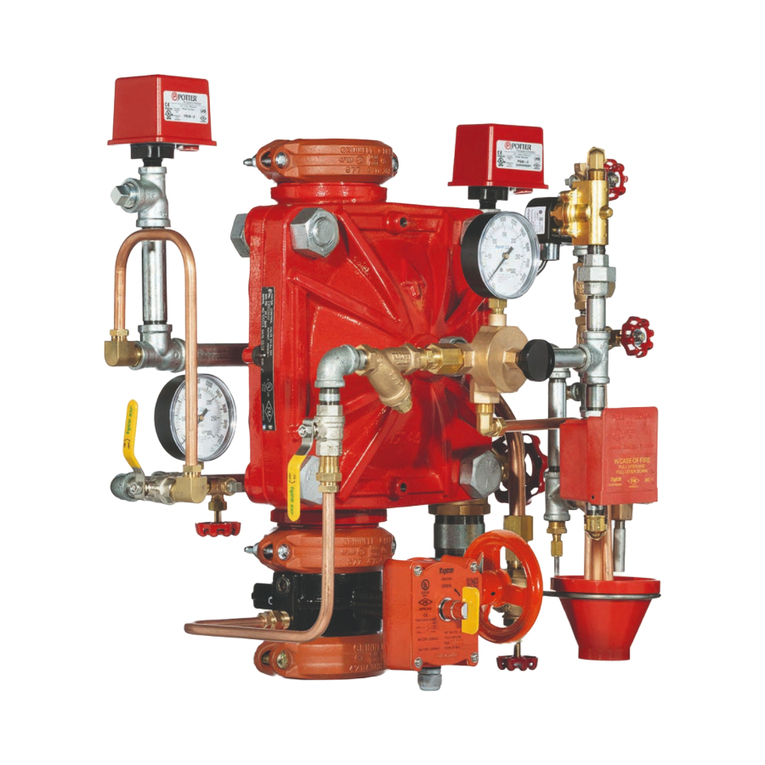
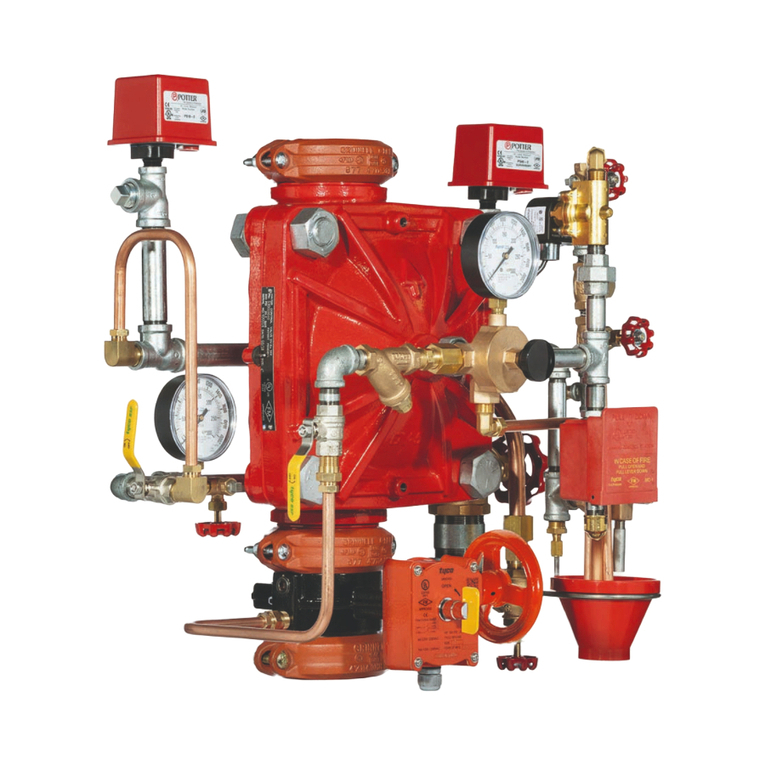
Step 2. The DV-5aValve must be
trimmed in accordance with Figure 5.
Note:If the addition of an Alarm Control
Valve is desired or required by the local
AHJ, the Alarm Control Valve noted as
Item H in Figure 8 is to be a separately
ordered electronically supervised nor-
mally open valve.
Step 3. Care must be taken to ensure
that check valves, strainers, globe
valves, etc. are installed with the flow
arrows in the proper direction.
Step 4. Drain tubing to the Drip Funnel
must be installed with smooth bends
that will not restrict flow.
Step 5. The Main Drain and Drip Funnel
Drain may be interconnected provided
a check valve is located at least 12 in.
(300 mm) below the Drip Funnel.
Step 6. Suitable provision must be
made for disposal of drain water. Drain-
age water must be directed such that
it will not cause accidental damage to
property or danger to persons.
Step 7. Connect the Diaphragm Supply
Valve to the inlet side of the System
Main Control Valve in order to facilitate
setting of the DV-5AValve (Ref. Figure
8).
Step 8. Provisions must be made for
installation of an Inspector's Test Con-
nection (ITC) at the most hydraulically
demanding location of the sprinkler
system. The maximum orifice size of
the ITC is to be no greater than the
smallest orifice sprinkler installed in
the system.
Step 9. An Air Maintenance Device,
as described in the Technical Data
section, must be provided for air supply
connection.
Step 10. A desiccant dryer, when spec-
ified, is to be installed between a drip
leg and the Air Maintenance Device.
Step 11. The Supervisory Low Pres-
sure Alarm Switch is to be adjusted to
provide a low air alarm at approximately
0,4 bar below the system air pressure
requirement shown in Graph B.
Step 12. Unused Pressure Alarm
Switch connections must be plugged.
Step 13. The Pressure Relief Valve pro-
vided with the Preaction Type A Trim is
factory set to relieve at a pressure of
approximately 3,1 bar, which can typi-
cally be used for a maximum system
pressure of 2,8 bar. The Pressure Relief
Valve may be reset; however, it must be
reset to relieve at a pressure which is
in accordance with the requirements of
the authority having jurisdiction.
To reset the Pressure Relief Valve, first
loosen the jam nut and then adjust the
cap accordingly, clockwise for a higher
pressure setting or counter clockwise
for a lower pressure setting. After ver-
ifying the desired pressure setting,
tighten the jam nut.
Step 14. Conduit and electrical con-
nections are to be made in accordance
with the applicable standards of the
approval agency.
NOTES:
The dew point of the pilot line air pressure must be maintained
below the lowest ambient temperature to which the dry pilot
actuation system will be exposed. Accumulation of water in the
pilot line connection to the Actuator will lower the air pressure
at which the actuator will open and possibly prevent proper
operation. Also, introduction of moisture into the pilot lines
exposed to freezing temperatures can create an ice buildup
that could prevent proper operation of the Actuator.
An air dryer must be installed where the moisture content
of the air supply is not properly controlled at less than the
required value.
It is recommended that an AMD-3 Nitrogen Maintenance
Device be utilized in dry pilot actuation system applications
where the dew point must be maintained below -29°C. Refer
to Technical Data Sheet TFP1241.
WATER SUPPLY PRESSURE IN BAR
AIR PRESSURE IN BAR
1,0
0
2,0
4,0 6,0 10,0
8,0 12,0 14,03,0
SYSTEM AIR PRESSURE
RANGE OF ACTUATOR OPENING PRESSURE
GRAPH B
DV-5aVALVE - PREACTION TYPE A SYSTEM
AIR PRESSURE REQUIREMENTS