1. INTRODUCTION
Thank you for purchasing the KISAE Abso DC to DC Battery Charger. With our state of the art,
easy to use design, this product will offer you reliable service for providing a multi-stage, multi-
input battery charger to charge the different types of batteries you have installed in either your
home, boats, RV caravan, 4WD or commercial vehicle. This manual will explain how to use this
unit safely and effectively.
2. PRODUCT DESCRIPTION
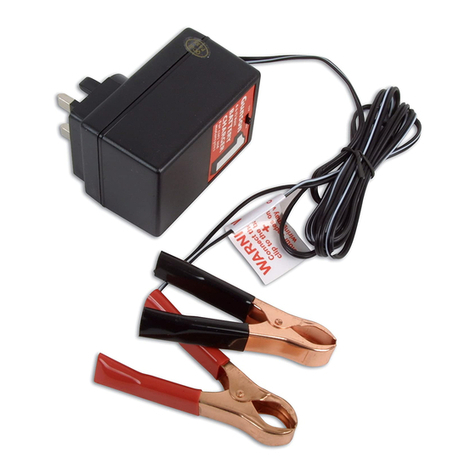
The DC to DC Battery Charger includes the items list below:
Base unit
Owner’s manual
3. UNDERSTANDING THE UNIT
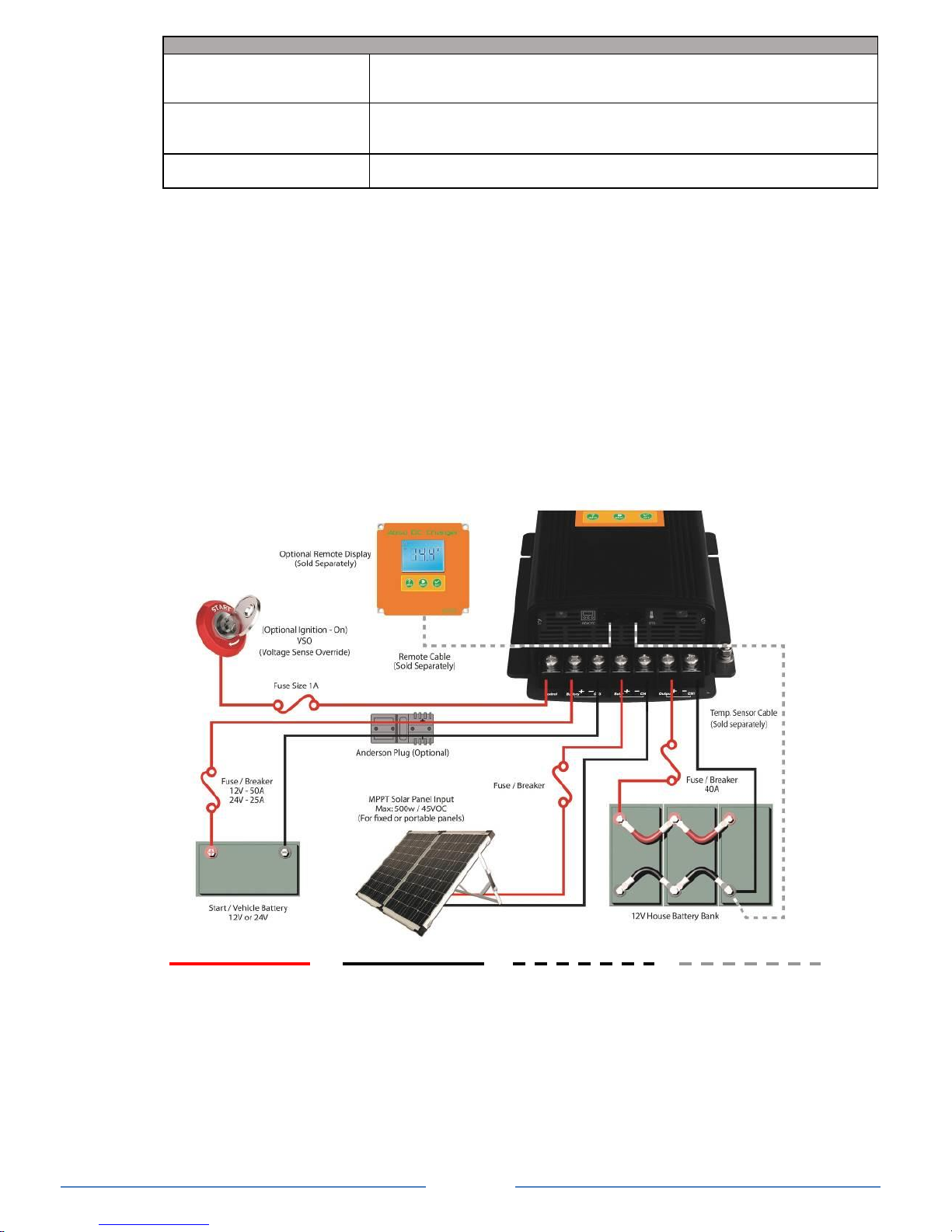
The DC to DC Battery Charger is a fully automatic multi-stage, multi-input battery charger with the
ability to charge from either an alternator linked to a battery, or via solar power with the Maximum
Power Point Tracking (MPPT) Solar Controller. With two inputs available, the house battery will
be charged from either the engine while underway, or via the solar panels when stationary. The
process to choose either engine or solar is fully automatic and both functions are controlled from
within the unit itself without the need for external relays.
During normal operation the DC to DC Battery Charger will do a full charge cycle to float stage on
the house battery bank with ability to choose either GEL, AGM, Flooded, Custom Programmable
or Lithium. Once float stage is reached the charger transitions to a power supply mode to support
any on-board DC loads.
Multi-stage Charging Process –GEL, AGM, Flooded & Program Modes
The DC to DC Battery Charger is a fully automatic, set and forget charger. It is designed to
quickly and accurately recharge your deep cycle batteries utilizing charger algorithms that help to
maximize the life of your specialized deep cycle batteries.
The DC to DC Battery Charger features multi-stage smart charging technology that enables the
charger to be connected to your battery bank permanently. With the input of multiple sources, you
can be assured of charging your batteries whenever underway; or when the sun is shining on
your solar array.
As dictated by battery manufactures recommendations, deep cycle batteries require a multi-stage
charge sequence for perfect, fast and accurate charging. The DC to DC Battery Charger delivers
three primary charge stages.
Stage 1 –Bulk or Boost charge: The battery is charged at full rated output current of the charger until the
battery reaches its final charging voltage, known as its absorption voltage. In this step, around 80%
of the battery is recovered as fast as possible.
Stage 2 –Absorption Charge: With the charger voltage held steady, the remaining 20% is replaced with the
charger allowing the current to taper off as the battery approaches full charge.
Stage 3 –Float: Finally, in the float stage the charger voltage is lowered and held at a constant and safe
predetermined level. This prevents the battery from being overcharged, yet allows the charger to
supply enough current to make up for the self-discharge losses of the battery, while supporting any
additional loads connected to the battery (such as DC lighting and refrigerators). This stage allows
for the charger to be used as a DC power supply.
Lithium Charging Process
The DC to DC Battery Charger has a specific charging profile for Lithium batteries. It has its own
charging voltage and current settings that needs to be set by the user. It also requires the user to
set the charger termination current (“L” setting). Once the user defined charge voltage is reached,
the charger will start reducing the current output and the charging process will terminate when the
charging current drops to the set termination current. This can take anywhere between 3 to 15
minutes. The unit will then act as a power supply to support additional loads connected to the
battery while the DC to DC Battery charger powered from either the vehicle or solar inputs. A Bulk
re-start will occur when battery voltage drops below 13.3V DC.