SECTION
I
General Information
1.1
Introduc
t
ion
This section contains a description of the Model
520
Thermo-
meter/Controller, its applications, general specifications, major
assemblies supplied and accessory equipment available.
1.2
Description and Applications
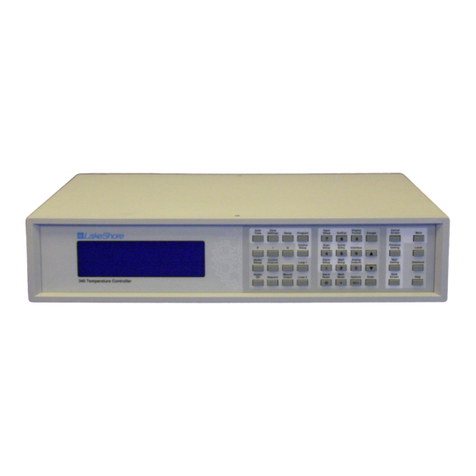
The Model
520
Cryogenic Temperature Thermometer/Controller is
housed in an aluminum case and is rack mountable with the
RM-5H
rack
mount kit in a standard
19"
relay panel.
All
connections are at the
rear
of
the case with
all
normal operating controls on the front panel.
The instrument is line operated from either
115
volt or
230
volt mains,
50
or
60
Hertz.
The controller has the performance features needed for use with
silicon or gallium-arsenide diodes, germanium, carbon-glass, platinum,
or other resistance thermometers,
or
any
sensor with a voltage response
less than four volts or a resistance of less than
40,000
ohms. The
520
is designed to accept a voltage signal or resistance equivalent signal
from a temperature sensitive transducer, compare this signal with an internal
set point voltage or resistance equivalent voltage, amplify and process
their difference (error signal), and drive an external heating element.
Sensor currents from
1
microampere to
3
milliamperes can be
selected from the front panel. Use of analog control means constant
and immediate correction for temperature changes. Ample range of gain,
reset, and rate have been designed into the
520
to assure fast response,
low offset error, and high stability.
The Gain control
of
the Model
520
has
1X
and
3X
steps similar
to
those for the current supply. As a result, loop gain
of
the system can
be kept constant even when sensor current must be changed
to
avoid sensor
self-heating or because of low signal value.
A
heater output current of up
to
one ampere is available
to
drive up to a
25
ohm load. Smaller load resistances will reduce the
maximum power below
25
watts as will higher resistance loads due to the
voltage limiting of the power supply of the output stage. The maximum
heater current may
be
set from
10
mA
to 1
ampere
in
1X
and
3X
steps
which enables output power to be varied in decade steps over five orders
of
magnitude.
-1-