14 Speedway5 User Manual Speedway5 User Manual 15
Lithium
Safety precautions for Lithium battery
1. Care
Lithium batteries should be protected from direct exposure to children and pets.
2. Performance
① Lithium battery is affected by external temperature. In winter, when
the temperature is low, the performance of the battery is temporarily deteriorated and
the mileage and power output is reduced.
② Lithium battery has a characteristic that discharge performance is reduced by more
than 15% when charging / discharging 300 times or more. If usage time is shortened
due to long usage, it should be replaced with a genuine one through the nearest point.
3. Charging
①Lithium battery should be used only with genuine battery and charger
supplied from the manufacturer. Any problems caused by use of battery made by the manufacturer,
mixed use, or using the charger are not covered by the manufacturer.
② Charging the lithium battery with a non-genuine charger may cause malfunction or fire.
③ The lithium battery should be charged in a well-ventilated, dry place and around the charger in a
place where there is no inflammable material.
④ Lithium battery should be charged at 0 ~ 45 ℃and discharged within -10 ~ 60 ℃. Charging or
discharging at a temperature outside this range may cause malfunction, fire or explosion.
⑤ In case of moving from cold outside to warm indoor, please charge it after 1 ~ 2 hours. This is to
prevent condensation from occurring inside the product due to temperature difference.
4. Storage
①Lithium batteries should be kept away from snow, rain and direct sunlight. Do not store or
charge them in a trunk or hot room. Select a dry place and store at room temperature (10 ~ 20 ℃).
② When storing for more than 3 months, charge the remaining battery level to 70 ~ 80% (do not
store full charge).
5. Trouble symptom, safety
①Lithium battery should be discontinued immediately if it is damaged
or leakage of battery, sour odor, appearance deformation, etc., and contact the place of purchase to
get technical support and service.
② If overheat, smoke or ignition is detected in a product with lithium battery, immediately stop
charging and use, move the product outdoors as soon as possible, and then use a fire extinguisher
to evolve. Do not spray water or immerse the product in order to evolve, which is more dangerous.
③ Lithium battery pack has very high energy density, so if you charge the battery for a long time
in case of short-circuit, leakage, bad battery, etc., there is a possibility of ignition. Therefore, you
should avoid charging for a long time without a person, and charging must be done while the person
is aware that the risk of unexpected fire can be avoided.
6. Misuse If
the lithium battery is short-circuited or the polarity is changed, or if the battery is
impacted, malfunction or fire may result. If you think that the battery has been impacted, you should
stop charging and using it and visit the nearest point for inspection.
7. Water inflow
It should be controlled to prevent water inflow into the lithium battery. There is a risk
of fire or electric shock if the charger is connected while moisture is present.
8. Caution
Disconnect the battery from the main unit and prohibit recharging, reinstalling, or using
other applications.
9. Disposal
DisposalWhen disposing of the lithium battery, the battery should be separated from the
product at the point of purchase or near the point so that the charge and discharge terminals are not
short-circuited. Dispose of it as industrial waste when disposing of it.
Battery disassembly prohibited
Battery disassembly, modification and repair are not covered under warranty.
Danger
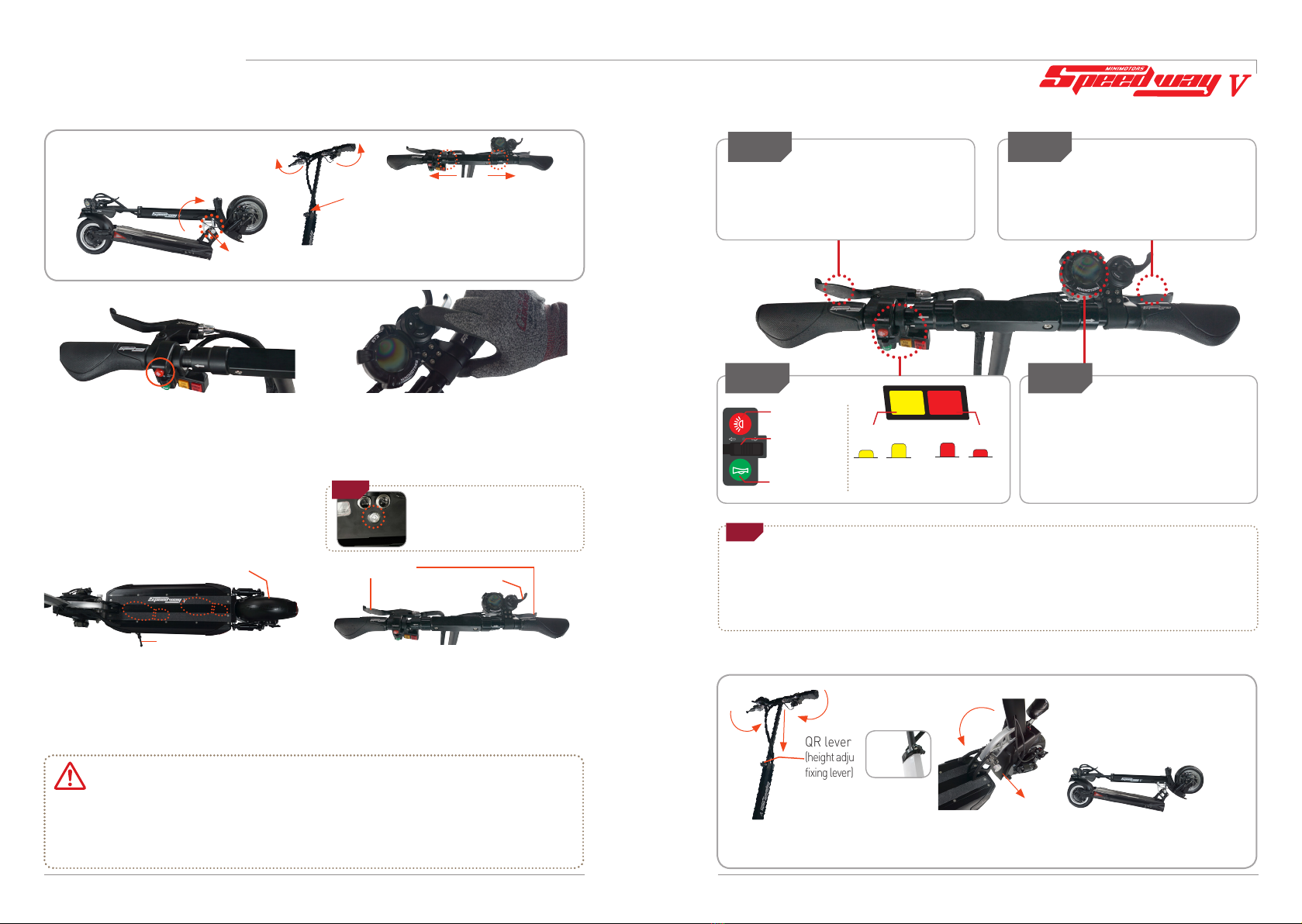
1. Check throttle and handle
• Operate the accelerator throttle lever about 2 ~ 3 times to check whether it returns
to the home position.
• Be careful that excessive throttle leaning and manipulation of the throttle can cause
malfunction due to internal parts damage.
• Check the fastening condition and clearance of the QR lever on the handle.
*Check that the fixed shaft is working smoothly and check that it is correctly
positioned where the fixed shaft and the body are in contact before use, and
check the deformation of the connecting part and the related parts. If there
is any abnormality, stop using it immediately and use it after inspection.
If you encounter any of the following situations while driving, stop driving immediately and
contact your nearest branch or service center for proper measures. If you provide pictures and
videos to get accurate diagnosis, professional counseling is available..
●Unusual heating of the motor
●Brake braking status error
●Error messages on the instrument cluster
●When the throttle is returned to its original position
●When the throttle is returned to its original position
* In this case, stop driving immediately.
Danger
●abnormal noise is generated
●Product smoke, ignition, sour odor
● When rain or wet with water or in a similar situation
●When other driving is judged to be unreasonable
1) Required checking before use
• The brake braking force is sufficient to check the operating condition. If the braking force is significantly
lowered, use it immediately after inspection and action.
• Check that the brake pad is not worn, that the cable is not loose.
• If there is an unusual feeling or noise during operation, check for
breakage, wear and deformation of the inner wire of the brake
cable.
• Check that the bolts and nuts of the brake fixing parts are not
loose, and that the disc is not deformed or damaged.
2. Check brake and cable
• Check the front and rear tires for wear and punctures and check the proper air pressure
(45 to 50 psi) for the tire. When the shortage of air is shortened, the possibility of puncture
increases, so check always.
• It is necessary to judge the replacement time by observing the appearance of the tire such
as tire damage, uneven wear.
3. Check tire pressure and uniaxial condition
• Make sure that the bolts and nuts of all parts of the product are tight and free
from loosening. Check the fastening condition and clearance of the folding
and fixing parts of the handle (QR lever, fixed shaft).
4.Tightening check such as folding part and handle part
Safety guidelines before driving