Supplementary User Instructions
WLL has not been exceeded. Scenarios in which
the product is subjected to variable load over a
prolonged period of time, will carry the risk of
inducing fatigue. Consider this when deciding
service intervals.
The rating of lifting accessories in European
Standards assumes the absence of exceptionally
hazardous conditions. Exceptionally hazardous
conditions include oshore activities, the lifting
of persons and lifting of potentially dangerous
loads such as molten metals, corrosive materials or
ssile materials. In such cases the degree of hazard
should be assessed by a competent person and the
working load limit adjusted accordingly.
6. Assembly
Generally, Modulift products are used as part of
a lifting rig used in lifting operations. Lifting rigs
tend to contain many dierent types of lifting
accessories interconnected.
Modulift are experts in designing and
manufacturing modular products, that need
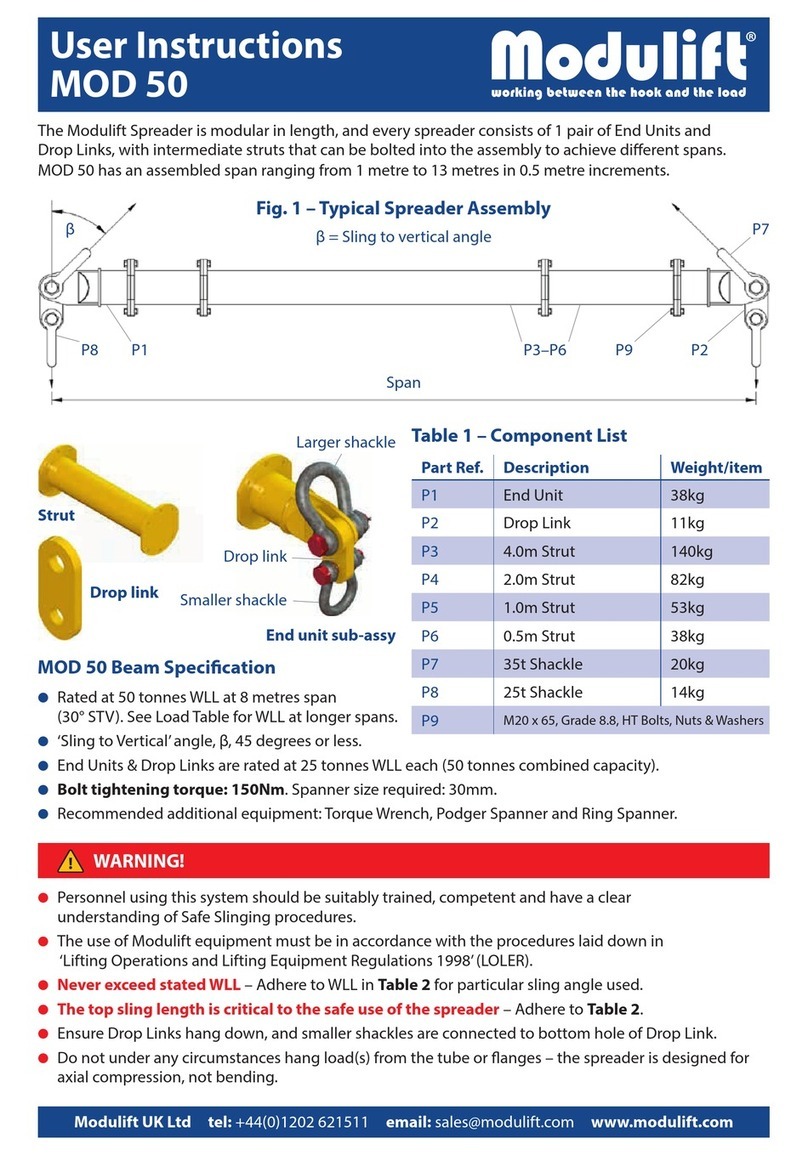
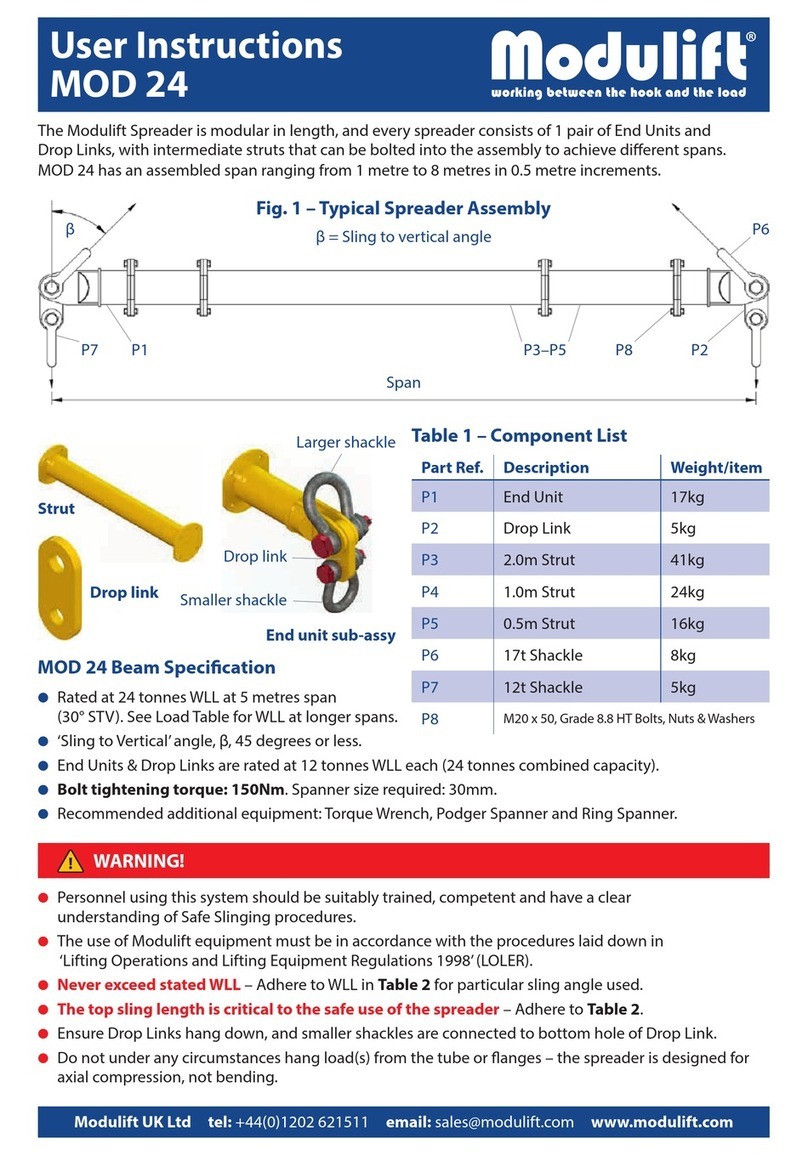
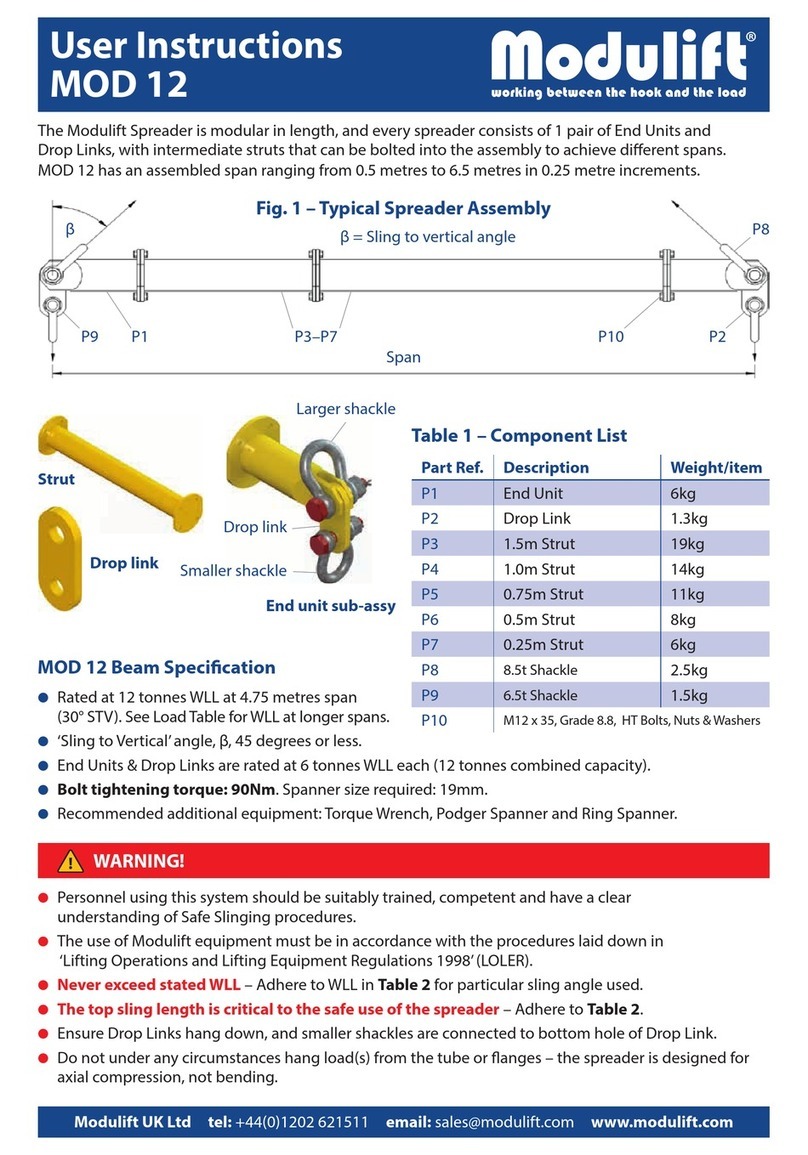
assembly prior to use. Follow the User Instructions
regarding assembly, paying particular attention to
ensuring bolts, nuts & washers are tightened to the
required tightening torques.
Additional rigging accessories such as slings are
usually either connected directly to the Modulift
product, or via connection shackles and other
accessories. These additional rigging accessories
manufactured by other manufacturers will have
their own User Instructions and EC declarations,
refer to these specic instructions/declarations
and ensure these rigging accessories are properly
assembled & used.
7. User instructions
Modulift’s products must only be used after reading
and understanding the specic User Instruction(s).
8. Lifting: Planning and Operations
It is required by law that any company undertaking
a lifting operation must ensure it is planned and
carried out according to a safe system of work.
Requirements may vary from country to country,
but should as a minimum follow the following
guidelines:
All lifting operations must be planned by a suitably
trained and experienced competent person.
Planning a lifting operation should include:
● Risk Assessment – identifying all hazards and
mitigating the risk
● Method Statement – step-by-step guide for
onsite personnel to follow
● Determining complexity of lift rating
● Details of qualied personnel to be involved
in the lift e.g. slinger/signaller, lift supervisor,
riggers
● Detailed force calculations used to determine
correct sizing of lifting equipment being used in
the rig
● Details of sling lengths to ensure the hook is
directly over the CoG
● Sizing of slings to take into account oset CoG as
there will be higher forces on the heavy side
● Accuracy of weight and CoG position of the
items to be lifted – by calculation or weighing
● Safety factor applied to the weight of the skids
being lifted
● Stability calculation: the CoG is above the
connection points in the top skid – check for
toppling
● Site details, permissible oor loadings, access
etc.
● P.P.E. for all personnel
● Name of qualied AP (Appointed Person) that
has prepared the lift plan, and their contact
details in case of issues
All operators to follow safe sling procedures and
to be suitably trained and experienced, competent
persons. Operators must check equipment WLL for
the specic congurations against the plan / rig
drawing.
A competent person must check the rig prior to
commencing the lift. The path of the load that it
will be maneuvered through must be checked for
obstacles. The safety of other persons not involved
in the lift must be considered. Any deviations to the
planned lift must be discussed and agreed with the
person responsible planning the lift.