NI USB-9263 User manual

USER GUIDE AND SPECIFICATIONS
NI USB-9263
4-Channel, ±10 V, 16-Bit Analog Voltage Output Module
This user guide describes how to use the National Instruments USB-9263
and lists the device specifications.
Introduction
The NI USB-9263 provides a USB interface for four channels of analog
output with integrated signal conditioning. The NI USB-9263 consists
of two components: an NI 9263 module and an NI USB-9162 carrier, as
shown in Figure 1.
Figure 1. NI USB-9263 Components
NI 9263
NI USB-9162
NI USB-9263
Hi-SPeed USB Carrier
NI USB-9162
Hi-Speed USB Carrier
NI USB-9162

NI USB-9263 User Guide and Specifications 2 ni.com
Dimensions
Figure 2 shows the NI USB-9263 device dimensions.
Figure 2. NI USB-9263 Device in Millimeters (Inches)
Safety Guidelines
Operate the NI USB-9263 only as described in these operating instructions.
Hot Surface This icon denotes that the component may be hot. Touching this component
may result in bodily injury.
Safety Guidelines for Hazardous Voltages
If hazardous voltages are connected to the module, take the following
precautions. A hazardous voltage is a voltage greater than 42.4 Vpk or
60 VDC to earth ground.
Caution Ensure that hazardous voltage wiring is performed only by qualified personnel
adhering to local electrical standards.
Caution Do not mix hazardous voltage circuits and human-accessible circuits on the same
module.
Caution Make sure that devices and circuits connected to the module are properly
insulated from human contact.
25.34
(0.998)
Hi-Speed USB Carrier
NI USB-9162
140.23 mm
(5.521 in.)
137.82 mm
(5.426 in.)
120.68 mm
(4.751 in.)
118.26 mm
(4.656 in.)
88.12 mm
(3.469 in.)
25.34 mm
(0.998 in.)

©National Instruments Corporation 3 NI USB-9263 User Guide and Specifications
Caution When module terminals are hazardous voltage LIVE (>42.4 Vpk/60 VDC),
you must ensure that devices and circuits connected to the module are properly
insulated from human contact. You must use the NI 9932 connector backshell kit,
illustrated in Figure 3, to ensure that the terminals are not accessible. Refer to the Module
Dimensions In Millimeters (Inches) section for more information about the backshell.
Figure 3. NI 9932 Connector Backshell
Information Resources
Refer to ni.com/manuals for the most recent documentation. Refer to
ni.com/info and enter rdusbrd for more information about
documentation related to this device.
Installing the Software
Software support for the NI USB-9263 for Windows Vista/XP/2000 is
provided by NI-DAQmx. The DAQ Getting Started Guide, which you can
download at ni.com/manuals, offers NI-DAQmx users step-by-step
instructions for installing software and hardware, configuring channels and
tasks, and getting started developing an application.
Installing Other Software
If you are using other software, refer to the installation instructions that
accompany your software.
Example Programs
The NI-DAQmx disk contains example programs that you can use to get
started programming with the NI USB-9263. Refer to the NI-DAQmx for
USB Devices Getting Started Guide that shipped with your device, and
is also accessible from Start»All Programs»National Instruments»
NI-DAQ, for more information.

NI USB-9263 User Guide and Specifications 4 ni.com
Mounting the NI USB-9263 to a Panel
Threaded inserts are located in the NI USB-9263 for mounting it to a panel.
Refer to Figure 4 for dimensions.
Figure 4. Module Dimensions In Millimeters (Inches)
Installing the NI USB-9263 Device
Before installing the device, you must install the software you plan to use
with the device. Refer to the Installing the Software section of this guide
and the documentation included with the software for more information.
Installing the NI 9263 Device into the NI USB-9162 Carrier
The NI 9263 module and NI USB-9162 carrier are packaged separately.
Refer to Figure 5 while completing the following assembly steps:
1. Make sure that no signals are connected to the NI 9263 module and the
USB cable is not connected to the device.
2. Remove the protective cover from the 15-pin D-SUB connector.
72.2 mm
(2.84 in.)
85.7 mm
(3.37 in.)
76.1 mm
(3.00 in.)
Threaded Insert
M3 x 0.5
8.5 mm (0.34 in.) Max Depth

©National Instruments Corporation 5 NI USB-9263 User Guide and Specifications
3. Align the I/O module with the carrier, as shown in Figure 5.
Figure 5. Module Installation
4. Squeeze the latches and insert the NI 9263 module into the
NI USB-9162 carrier.
5. Press firmly on the connector side of the NI 9263 module until the
latches lock the module into place, as shown in Figure 6.
Figure 6. Locking Module into Place
Connecting the NI USB-9263 to a Computer
Plug one end of the USB cable into the NI USB-9263 and the other end into
an available USB port on the computer. Refer to the NI-DAQmx for USB
Devices Getting Started Guide that shipped with your device, and is also
accessible from Start»All Programs»National Instruments»NI-DAQ,
for more information.
1 High Voltage Screw Terminal Backshell
1

NI USB-9263 User Guide and Specifications 6 ni.com
LED Indicator
The NI USB-9263 device has a green LED next to the USB connector. The
LED indicator indicates device status, as listed in Table 1. When the device
is connected to a USB port, the LED blinks steadily to indicate that the
device is initialized and is receiving power from the connection.
If the LED is not blinking, it may mean that the device is not initialized or
the computer is in standby mode. In order for the device to be recognized,
the device must be connected to a computer that has NI-DAQmx installed
on it. If your device is not blinking, make sure your computer has the latest
version of NI-DAQmx installed on it, and the computer is not in standby
mode.
Wiring the NI USB-9263 Device
Caution A high voltage screw terminal backshell must be installed when using hazardous
voltages (>42.4 Vpk, 60 VDC).
Note Table 2 illustrates the accessories available from ni.com for use with the
NI USB-9263.
Table 1. LED State/Device Status
LED State Device Status
Not lit Device not connected or in suspend.
On, not blinking Device connected, but no module installed.
Single-blink Operating normally.
Double-blink Connected to USB Full-Speed port. Device
performance might be affected. Refer to the
Specifications section for more information.
Quadruple-blink Device error. Refer to ni.com/support.
Table 2. Accessories
Accessory Accessory Description
NI 9932 10-position strain relief and
high-voltage connector
NI 9936 10 screw-terminal plugs

©National Instruments Corporation 7 NI USB-9263 User Guide and Specifications
The NI USB-9263 has a 10-terminal, detachable screw-terminal connector
that provides connections for four analog output channels. Each channel
has a terminal to which you can connect the positive lead of a voltage
signal, AO. The NI USB-9263 also has common terminals, COM, that are
internally connected to the isolated ground reference of the module. Refer
to Table 3 for the terminal assignments for each channel.
Wiring for High-Vibration Applications
National Instruments recommends using ferrules for terminating wires to
the detachable screw-terminal connector or using the NI 9932 backshell kit
to protect the connections when you use the NI USB-9263 in high-vibration
applications. Refer to Figure 7 for an illustration.
Figure 7. 10-Pin Detachable Screw-Terminal Connector with a Ferrule
Table 3. Terminal Assignments
Module Terminal Signal
0AO 0
1Common (COM)
2AO 1
3Common (COM)
4AO 2
5Common (COM)
6AO 3
7Common (COM)
8No Connection
9Common (COM)
0
1
2
3
4
5
6
7
8
9
Ferrule

NI USB-9263 User Guide and Specifications 8 ni.com
Connecting a Load to the NI USB-9263
Connect the positive lead of the load to the AO terminal. Connect the
ground of the load to a COM terminal.
Figure 8. Connecting a Load to the NI USB-9263
NI USB-9263 Circuitry
The NI USB-9263 channels share a common ground that is isolated
from the other modules in the system. Each channel has a digital-to-analog
converter (DAC) that produces a voltage signal. By default, NI-DAQmx
software allows you to write scaled values to the analog output channels.
Refer to your software documentation for more information.
Each channel also has overvoltage and short-circuit protection. For more
information about the overvoltage and short-circuit protection, refer to the
Specifications section.
Figure 9. Output Circuitry for One Channel
When the module powers on, the output channel drives the power-on
voltage. Refer to the Specifications section for more information about
power-on voltage. Refer to your software documentation for information
about configuring initial output values in software.
NI USB-9263
COM
AO
Load
AO
COM
NI USB-9263
Amplifier
Isolated DAC Overvoltage/
Short-Circuit
Protection

©National Instruments Corporation 9 NI USB-9263 User Guide and Specifications
Specifications
The following specifications are typical for the range 0 to 60 °C, unless
otherwise noted. All voltages are relative to COM unless otherwise noted.
Output Characteristics
Number of channels ............................... 4 analog output channels
DAC resolution ...................................... 16 bits
Type of DAC.......................................... String
Startup voltage ....................................... 0 V1
Power-down voltage .............................. 0 V2
Output range........................................... ±10 V
Operating voltage
Nominal .......................................... ±10.7 V
Minimum ........................................ ±10.4 V
Maximum........................................ ±11 V
Current drive .......................................... ±1 mA per channel max
Output impedance .................................. 2 Ω
Accuracy
Stability
Gain drift......................................... 14 ppm/°C
Offset drift....................................... 110 μV/°C
1 When the device powers on, a glitch occurs for 20 μs peaking at –1.5 V.
2 The power-down voltage peaks at 1.8 V before exponentially dishcarging to 0 V in 100 μs. You can add a 10 kΩto reduce the
peak voltage.
Error
Percentage
of Reading
Percent of
Range*
Calibrated, max (–40 to 70 °C) 0.35% 0.75%
Calibrated, typ (25 °C, ±5 °C) 0.03% 0.1%
Uncalibrated, max (–40 to 70 °C) 2.2% 1.7%
Uncalibrated, typ (25 °C, ±5 °C) 0.3% 0.25%
* Range equals ±10.7 V

NI USB-9263 User Guide and Specifications 10 ni.com
Protection
Overvoltage .....................................±30 V
Short-circuit.....................................Indefinitely
Update time1
Noise
Updating at 100 kS/s .......................600 μVrms
Not updating ....................................260 μVrms
Slew rate .................................................4 V/μs
Crosstalk .................................................76 dB
Settling time (100 pF load, to 1 LSB)
Full-scale step..................................20 μs
1 V step............................................13 μs
0.1 V step.........................................10 μs
Capacitive drive ......................................1,500 pF min
Monotonicity ..........................................16 bits
DNL ........................................................±1 LSBs max
INL (endpoint)........................................±12 LSBs max
Power Requirements
Current consumption from USB.............500 mA, max
Suspend mode..................................2.5 mA, max
Bus Interface
USB specification ...................................USB 2.0 Hi-Speed
1 Full performance requires the use of a USB 2.0 Hi-Speed host controller and USB 2.0 hubs.
Number of Channels Update Time
One 3μs min
Two 5μs min
Three 7.5 μs min
Four 9.5 μs min
Table of contents
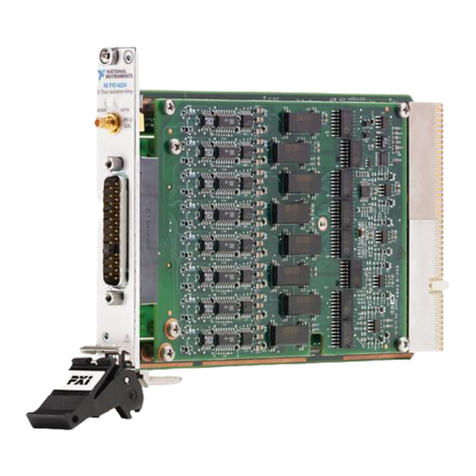
Other NI Control Unit manuals









Popular Control Unit manuals by other brands
Festo
Festo Compact Performance CP-FB6-E Brief description
Elo TouchSystems
Elo TouchSystems DMS-SA19P-EXTME Quick installation guide
JS Automation
JS Automation MPC3034A user manual
JAUDT
JAUDT SW GII 6406 Series Translation of the original operating instructions
Spektrum
Spektrum Air Module System manual
BOC Edwards
BOC Edwards Q Series instruction manual

KHADAS
KHADAS BT Magic quick start
Etherma
Etherma eNEXHO-IL Assembly and operating instructions
PMFoundations
PMFoundations Attenuverter Assembly guide
GEA
GEA VARIVENT Operating instruction
Walther Systemtechnik
Walther Systemtechnik VMS-05 Assembly instructions
Altronix
Altronix LINQ8PD Installation and programming manual