7
9. Extraction du clip
Si necessaire, détacher la plaque de vérouillage.
Pousser sol du acon doucement vers le haut et tirer quelques cm par le front. Puis, sortir acon vers dessous.
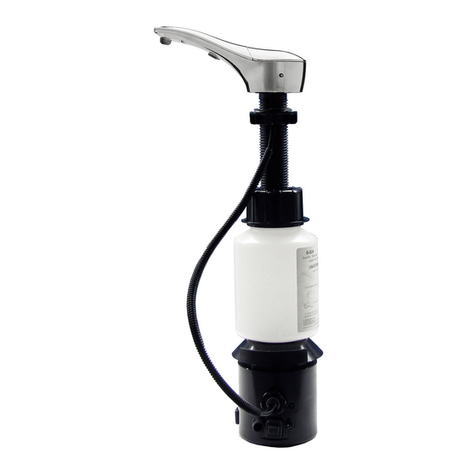
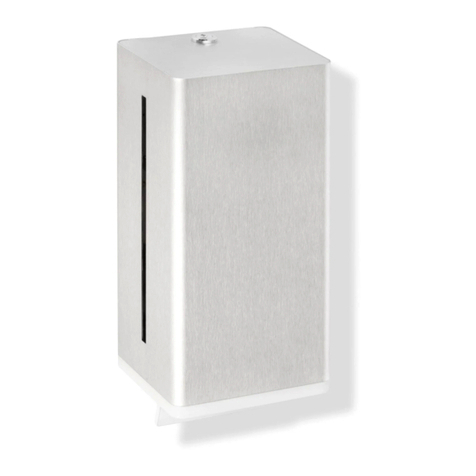
Prendre le distributeur de la plaque murale: pousser la languette d’ârret et tirer l’appareil par le haut.
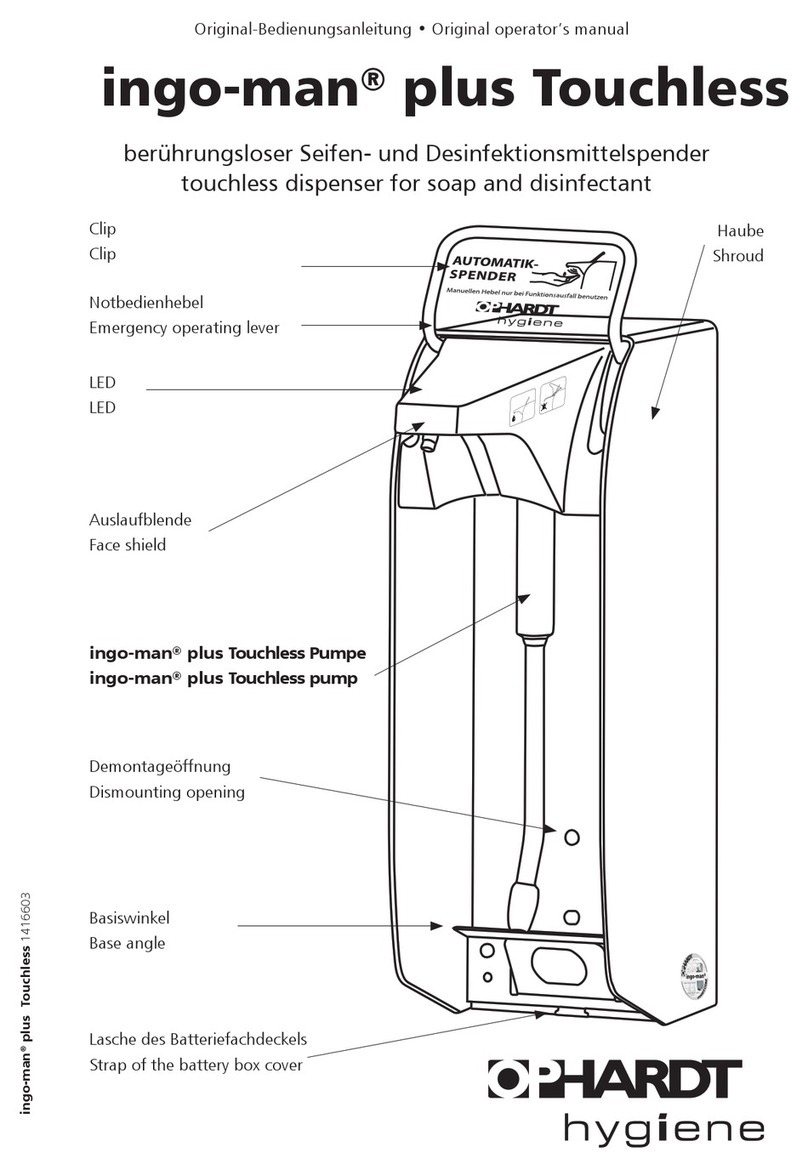
9.1 Tourner le distributeur 180 degree en manière que vous voyez le bôitier (voir illustration 9.1).
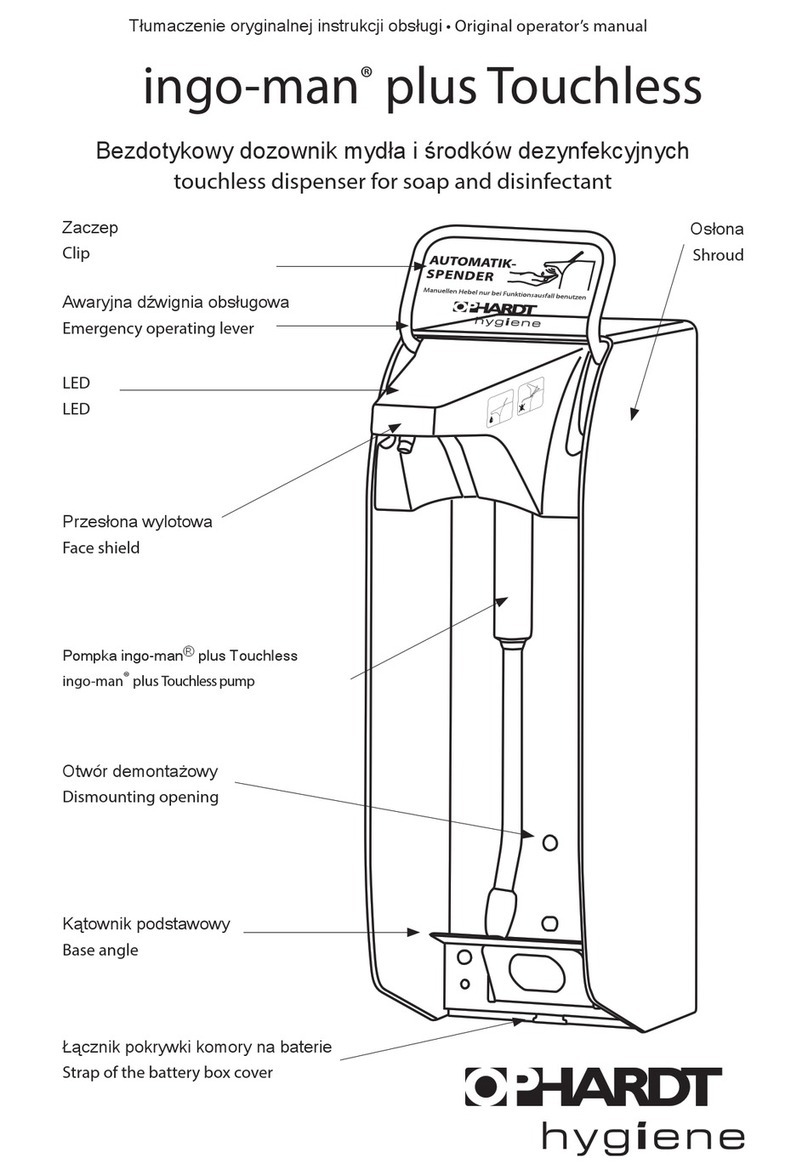
9.2 Pousser le barreau en inox suspendu (qui est localisé en arrière en haut) avec le pouce en direction de la pompe. Simultané-
ment prendre le bec d’éculement (localisé à l’avant) avec l’autre main, décrocher-le, et le mettre à côté.
9.3 Pousser le clip doucement de l’intérieur vers l’extérieur hors de la bordure (voir illustration 9.2).
Procéder l’assemblage à l’envers (voir illustration 9.3).
9.2 Using your thumb, press the spring-loaded metal pin, located on the upper, back-side of the dispenser, in the direction of
the pump. At the same time, use your other hand to carefully unhinge and remove the face shield from the front side of the
dispenser.
9.3 Carefully press on the clip from the inside outwards, to release it from its socket (see image 9.2).
Assemble in reverse order (see image 9.3).
10. Allgemeine Pegehinweise
Das Robert Koch-Institut empehlt: „Bei beiden Spenderarten (Anm.: Händedesinfektionsmittel- und Seifenspender) müs-
sen die xen Außen- und Innenteile aufbereitbar sein. Das ist auch maschinell möglich. […] Sichtbare Verunreinigungen
des äußeren Gehäuses und aller ohne weitere Manipulation zugänglichen Teile sowie Tropfnasen am Auslass sind durch
Wischdesinfektion zu beseitigen. Für Bedienhebel empehlt sich eine tägliche Wischdesinfektion durch den Reinigungs-
dienst. Umfang und Frequenz der Kontrollen und der Innenaufbereitung von Spendern sollten im hauseigenen Hygiene-
plan festgelegt werden, z.B. halbjährig.“ [Quelle: Robert Koch-Institut, Empfehlungen zur Händehygiene, 2016]
Um eine einwandfreie Funktion des Spenders zu gewährleisten, ist eine regelmäßige Reinigung von Hand oder im RDG
erforderlich.
Manuelle Reinigung: Anhaftende Produktreste regelmäßig entfernen. Spülung des Spendergehäuses und der Pumpe
mit heißem Wasser, Durchspülung der Pumpe mit heißem Wasser. Desinfektion des Spendergehäuses mit geeignetem
Flächendesinfektionsmittel möglich.
Aufbereitung im RDG: ist im dafür vorhergesehenen Programm „Spenderreinigung” mit pH-neutralem Reiniger möglich.
Achtung, Kunststoffpumpen können bei max. 65 °C aufbereitet werden!
Aufbereitung im Autoklav: der Spender und die Edelstahlpumpe sind autoklavierbar (134 °C, 2 bar, max. 20 Min. Halte-
zeit).
Dies gilt nicht für die Kunststoffrückwand, Flasche, Kunststoffpumpe.
10. Information for General Care
The Robert Koch-Institute recommends: “For both dispenser types (note: hand disinfectant and soap dispenser), the xed
outer and inner parts must be able to be reprocessed. This is also possible by machine. [...] Visible contamination of the
outer housing and all accessible parts without further manipulation as well as soilings at the outlet must be removed by
wipe disinfection. Daily wipe disinfection is recommended for operating levers. The scope and frequency of checks and
the reprocessing of dispensers should be specied in the internal hygiene plan, e.g. every six months.” [Source: Robert
Koch Institute, recommendations for hand hygiene, 2016]
In order to guarantee proper functioning of the dispenser regular manual cleaning or processing in cleaning-disinfection
devices is necessary.
Manual cleaning: Regularly remove adherent product residual. Cleaning of the dispenser housing and the pump with hot
water. Rinsing the pump with hot water. Disinfection of shroud is possible with appropriate surface disinfectants.
Processing in cleaning-disinfection devices: choose program „Dispenser cleaning” and use pH-neutral cleaning solutions.
Important: Cleaning of plastic pumps up to max. 65 °C!
Processing in autoklave: the dispenser and stainless steel pump are autoclavable with superheated steam (134 °C, 2 bar,
max. 20 min dwell time).
Plastic wall plate, bottle, plastic pumps (K pumps) are not autoclavable.
10. Entretien
L’Institut Robert Koch conseille: “Pour les deux types de distributeurs (note: distributeur de désinfectant pour les mains et
distributeur de savon), les parties extérieure et intérieure xes doivent pouvoir être reconditionnées. Ceci est également
possible à la machine. La contamination visible du boîtier extérieur et de toutes les pièces accessibles sans autre manipu-
lation ainsi que les nez d’écoulement à la sortie doivent être éliminés par désinfection par essuyage. La désinfection par
essuyage quotidien par le service de nettoyage est recommandée pour les leviers de commande. L’étendue et la fréquence
des contrôles et la préparation interne des distributeurs devraient être précisées dans le plan d’hygiène interne, par
exemple tous les six mois.” [Source: Institut Robert Koch, Recommandations pour l’hygiène des mains, 2016]