manuals.online logo
Brands
  1. Home
  2. •
  3. Brands
  4. •
  5. Paso
  6. •
  7. Amplifier
  8. •
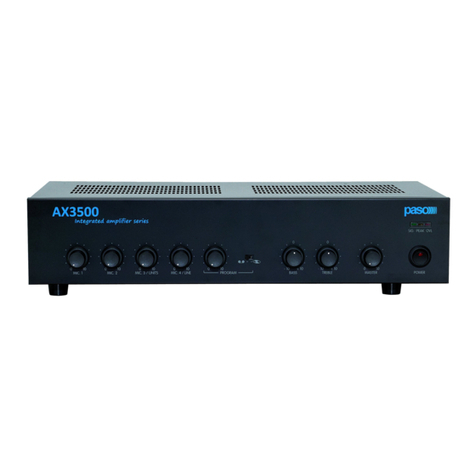
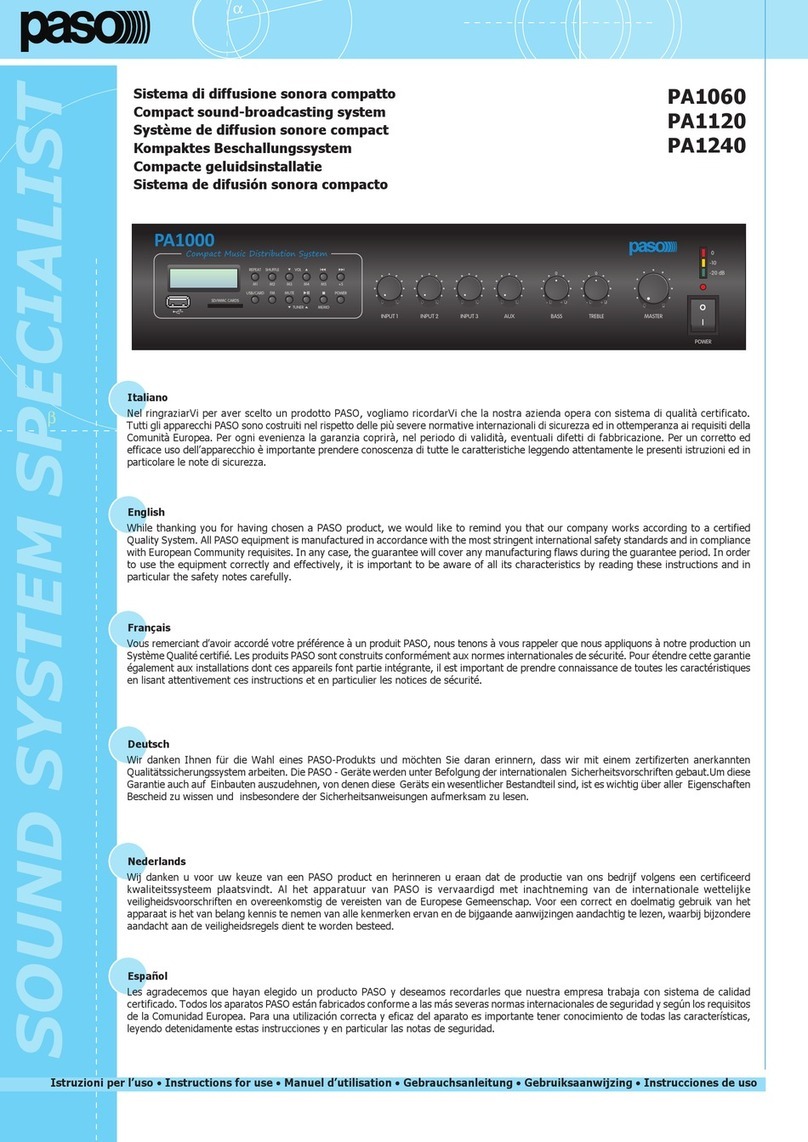
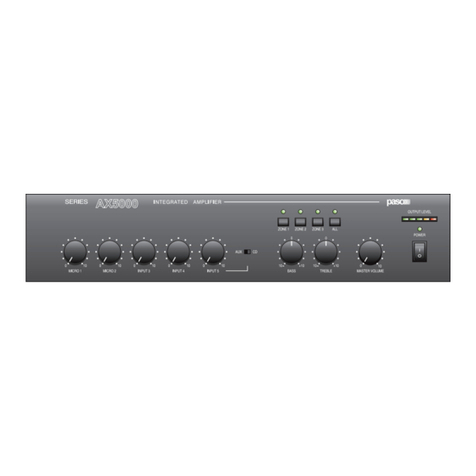
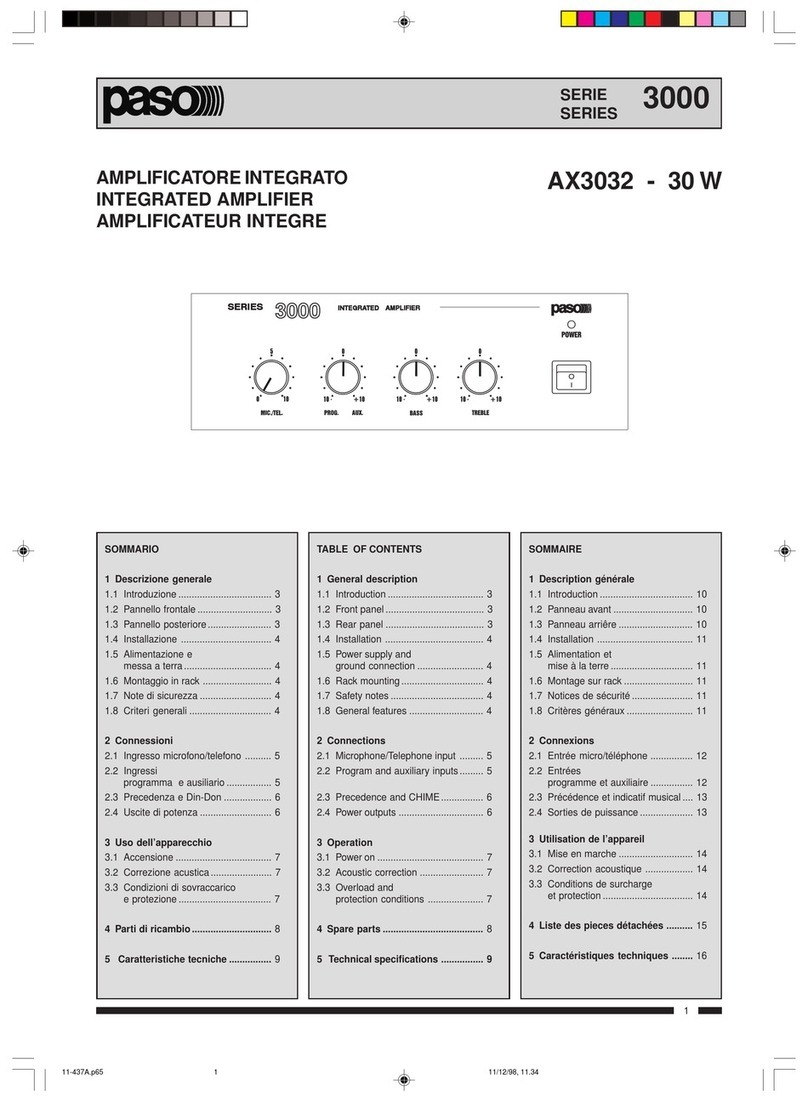
  9. Paso AX8120 User manual

Paso AX8120 User manual

This manual suits for next models

2

Other Paso Amplifier manuals

Paso PMD Series User manual

Paso

Paso PMD Series User manual

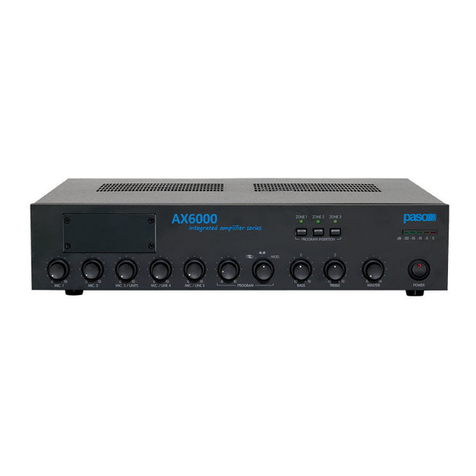
Paso AX6120 User manual

Paso

Paso AX6120 User manual

Paso 3000 Series User manual

Paso

Paso 3000 Series User manual

Paso 8000 Series User manual

Paso

Paso 8000 Series User manual

Paso AX3303 User manual

Paso

Paso AX3303 User manual

Paso AX3506 User manual

Paso

Paso AX3506 User manual

Paso AX3032 User manual

Paso

Paso AX3032 User manual

Paso PMW60-B User manual

Paso

Paso PMW60-B User manual

Paso PA8506-V User manual

Paso

Paso PA8506-V User manual

Paso 3000 Series User manual

Paso

Paso 3000 Series User manual

Paso AW5512Z User manual

Paso

Paso AW5512Z User manual

Paso P 4060 E User manual

Paso

Paso P 4060 E User manual

Paso 5000 Series User manual

Paso

Paso 5000 Series User manual

Paso PM2092-V User manual

Paso

Paso PM2092-V User manual

Paso PA1000 Series User manual

Paso

Paso PA1000 Series User manual

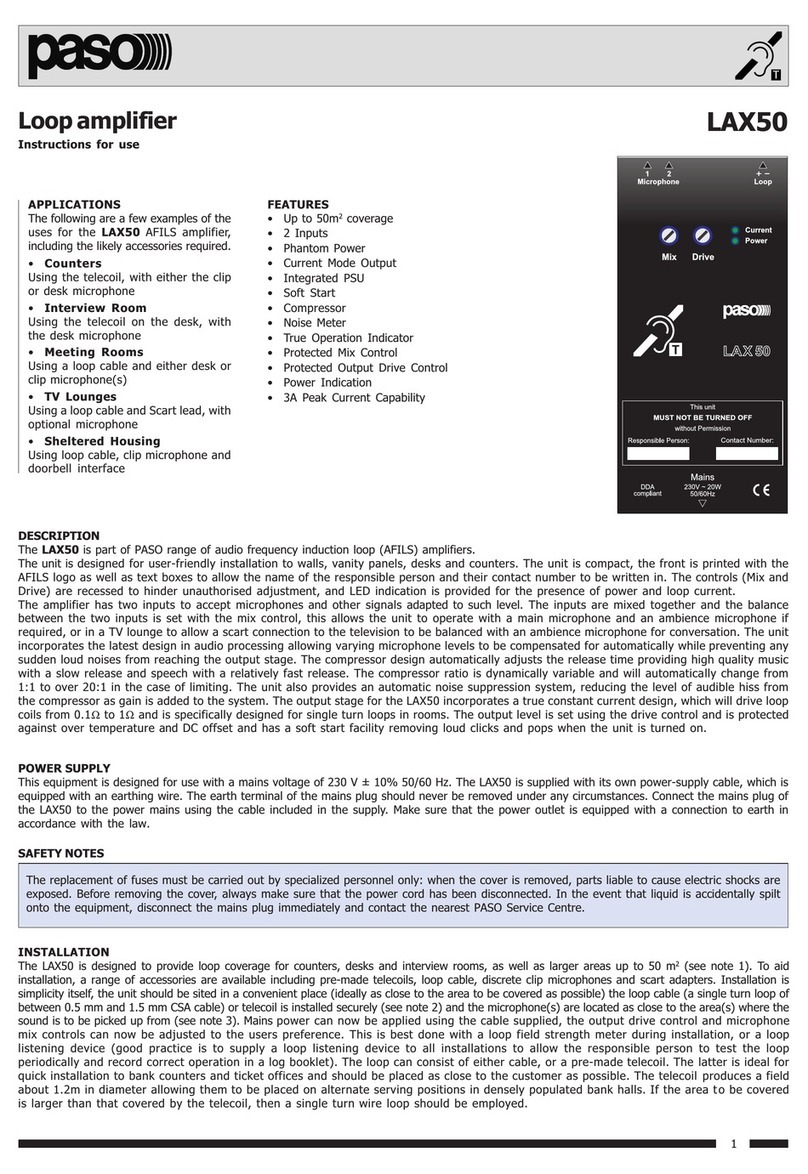
Paso LAX50 User manual

Paso

Paso LAX50 User manual

Paso LAX200 User manual

Paso

Paso LAX200 User manual

Paso DMS plus Series Technical Document

Paso

Paso DMS plus Series Technical Document

Paso T3015DMA Technical Document

Paso

Paso T3015DMA Technical Document

Paso AX3504 User manual

Paso

Paso AX3504 User manual

Popular Amplifier manuals by other brands

Magnat Audio EDITION FOUR Owner's manual/warranty document

Magnat Audio

Magnat Audio EDITION FOUR Owner's manual/warranty document

Inter-m PA-2000A Operation manual

Inter-m

Inter-m PA-2000A Operation manual

Yamaha TX6n owner's manual

Yamaha

Yamaha TX6n owner's manual

Peavey TNT 150 user guide

Peavey

Peavey TNT 150 user guide

Bosch LBB 1903/10 Installation and user instructions

Bosch

Bosch LBB 1903/10 Installation and user instructions

Avocent Emerge DA1200D Installer/user guide

Avocent

Avocent Emerge DA1200D Installer/user guide

Redgum RGi35 operating instructions

Redgum

Redgum RGi35 operating instructions

Cambridge Audio AXA25 user manual

Cambridge Audio

Cambridge Audio AXA25 user manual

Alpine MRP-M200 owner's manual

Alpine

Alpine MRP-M200 owner's manual

Technical Pro H1502UrBT user manual

Technical Pro

Technical Pro H1502UrBT user manual

FMS EMGZ307 operating manual

FMS

FMS EMGZ307 operating manual

Racal Instruments 5601 user manual

Racal Instruments

Racal Instruments 5601 user manual

Valcom V-1094A Technical specifications

Valcom

Valcom V-1094A Technical specifications

Cambridge Audio 851D user manual

Cambridge Audio

Cambridge Audio 851D user manual

QSC 3800 Specifications

QSC

QSC 3800 Specifications

NAD C300 owner's manual

NAD

NAD C300 owner's manual

Rotel RMB-1077 owner's manual

Rotel

Rotel RMB-1077 owner's manual

Peavey Monitor 300 Series operating guide

Peavey

Peavey Monitor 300 Series operating guide

manuals.online logo
manuals.online logoBrands
  • About & Mission
  • Contact us
  • Privacy Policy
  • Terms and Conditions

Copyright 2025 Manuals.Online. All Rights Reserved.

SERIE AX8000 1
Amplificatori
Amplifiers
Amplificateurs
AX8120
AX8240
ISTRUZIONI PER LUSO INSTRUCTIONS FOR USE MANUEL DUTILISATION
AX8000
SERIE
SERIES
SOMMARIO
1. Descrizione generale
1.1 Pannello frontale ................................ 3
1.2 Pannello posteriore ............................ 3
2. Avvertenze generali
2.1 Installazione ....................................... 4
2.2 Alimentazione e messa a terra ............ 4
2.3 Note di sicurezza ................................ 4
3. Connessioni
3.1 Criteri generali ................................... 5
3.2 Ingressi microfonici ............................. 5
- Microfoni dinamici ............................. 5
- Microfoni a condensatore elettrete .. 5
- Trasformatore microfonico ................ 6
3.3 Ingressi ausiliari ................................. 7
3.4 Ingresso base amplificata ................... 8
- Precedenza base amplificata ............ 8
- Precedenza automatica .................... 8
3.5 Precedenza microfonica
con priorità scalare ............................. 8
3.6 Ingresso emergenza/telefono ............ 9
3.7 Uscite di segnale ................................ 9
3.8 Uscite di potenza .............................. 10
- Sistemi a tensione costante ............ 10
- Calcolo del numero di diffusori
(tramite le potenze)........................ 11
- Calcolo del numero di diffusori
(tramite le impedenze).................... 11
3.9 Presa equalizzatore .......................... 11
3.10 Filtro selezione voce ......................... 12
3.11 Moduli accessori ............................... 12
- Scheda din-don .............................. 12
- Scheda allarme .............................. 13
- Scheda di controllo volume a distanza .. 13
3.12 Moduli .............................................. 14
4. Uso dellapparecchio
4.1 Accensione....................................... 15
4.2 Controllo di volume principale ........... 15
4.3 Correzione acustica .......................... 15
- Controllo toni bassi......................... 15
- Controllo toni acuti ......................... 15
4.4 Condizioni di sovraccarico
e protezione ..................................... 15
4.5 Regolazione dellapparecchio ............ 16
5. Caratteristiche tecniche ........... 17
6. Lista delle parti di ricambio ....... 18
TABLE OF CONTENTS
1. General description
1.1 Front panel ........................................ 3
1.2 Rear panel ......................................... 3
2. General warnings
2.1 Installation ......................................... 4
2.2 Power supply and earthing ................. 4
2.3 Safety notes ...................................... 4
3. Connections
3.1 General features ................................ 5
3.2 Microphone inputs .............................. 5
- Dynamic microphones ....................... 5
- Microphones with electret capacitor . 5
- Microphone transformer ................... 6
3.3 Auxiliary inputs .................................. 7
3.4 Amplified stand input .......................... 8
- Amplified stand precedence ............. 8
- Automatic precedence...................... 8
3.5 Microphone precedence
with various priorities ......................... 8
3.6 Emergency/Telephone input ............... 9
3.7 Signal outputs .................................... 9
3.8 Power outputs.................................. 10
- Low-impedance system .................. 10
- Determining the number of
speakers (through power values) .... 11
- Determining the number of speakers
(through impedance values) ........... 11
3.9 Equalizer socket ................................ 11
3.10 Voice selection filter .......................... 12
3.11 Optional modules.............................. 12
- Chime module ................................. 12
- Alarm board ................................... 13
- Remote volume control board ......... 13
3.12 Modules ........................................... 14
4. Operation
4.1 Power on ......................................... 15
4.2 Master volume control ...................... 15
4.3 Acoustic adjustment ......................... 15
- Bass control ................................... 15
- Treble control ................................. 15
4.4 Overload and
protection conditions ........................ 15
4.5 Equipment adjustments .................... 16
5. Technical specifications ............ 17
6. List of spare parts ...................... 18
SOMMAIRE
1. Description générale
1.1 Panneau avant ................................. 19
1.2 Panneau arriêre ................................ 19
2. Précautions générales
2.1 Installation ....................................... 20
2.2 Alimentation et mise à la terre ........... 20
2.3 Conseils de securitè .......................... 20
3. Connexions
3.1 Criteres generaux............................. 21
3.2 Entrées microphoniques .................... 21
- Microphones dynamiques ................ 21
- Microphones à condensateur électrète 22
- Transformateur microphonique ........ 22
3.3 Entrées auxiliaires ............................. 23
3.4 Entrée base amplifiée ........................ 24
- Priorité base amplifiée ..................... 24
- Priorité automatique ....................... 24
3.5 Priorité microphonique
avec priorité graduelle ...................... 24
3.6 Entrée secours/téléphone ................. 25
3.7 Sorties de signal ............................... 25
3.8 Sorties de puissance ......................... 26
- Systèmes à tension constante ......... 26
- Calcul du nombre de diffuseurs
(par les puissances) ........................ 27
- Calcul du nombre de diffuseurs
(par les impedances) ....................... 27
3.9 Prise égalisateur ............................... 27
3.10 Filtre selectif voix.............................. 28
3.11 Modules accessoires ......................... 28
- Fiche ding-dong .............................. 28
- Fiche dalarme ................................ 29
- Fiche de contrôle du volume à distance 29
3.12 Modules ............................................ 30
4. Utilisation de lappareil
4.1 Mise en marche ................................. 31
4.2 Contrôle de volume principal .............. 31
4.3 Correction acoustique ....................... 31
- Contrôle tonalité basses ................. 31
- Contrôle tonalité aigues .................. 31
4.4 Conditions de surcharge
et protection .................................... 31
4.5 Reglage de l'appareil ......................... 32
5. Caractéristiques techniques ...... 33
6. Liste des pièces détachées ........ 34
11-528.p65 08/06/01, 14.201

SERIE AX8000
2
GEBRUIKSAANWIJZING INSTRUCCIONES DE EMPLEOGEBRAUCHSANLEITUNG
AX8000
SERIE
SERIES
Verstärker
Versterker
Amplificadores
AX8120
AX8240
INHALTSANGABE
1. Allgemeine Beschreibung
1.1 Frontplatte ....................................... 19
1.2 Rückpaneel ....................................... 19
2. Allgemeine Hinweise
2.1 Installation ....................................... 20
2.2 Stromversorgung und Erdung ............ 20
2.3 Sicherheitsanweisungen .................... 20
3. Anschlüsse
3.1 Allgemeine Hinweise .......................... 21
3.2 Mikrophoneingänge ........................... 21
- Dynamische Mikrophone .................. 21
- Mikrophone mit Elektretkondensator 22
- Mikrophonübertrager ...................... 22
3.3 Hilfseingänge .................................... 23
3.4 Eingang Verstärkerbasis .................... 24
- Vorrang Verstärkerbasis .................. 24
- Automatischer Vorrang.................... 24
3.5 Mikrophonvorrang
mit gestaffelter Priorität .................... 24
3.6 Eingang Notruf/Telefon ..................... 25
3.7 Signalausgänge ................................ 25
3.8 Leistungausgänge............................. 26
- Konstantspannungssystem ............. 26
- Berechnung der lautsprecheranzahl
(durch die leistungen) ..................... 27
- Berechnung der lautsprecheranzahl
(durch die impedanzen) ................... 27
3.9 Buchse Entzerrer .............................. 27
3.10 Sprachselektionsfilter ........................ 28
3.11 Zubehörmodule ................................. 28
- Gong-Karte .................................... 28
- Alarmkarte ..................................... 29
- Karte für die
Lautstärkeregelung aus der Ferne .. 29
3.12 Module ............................................. 30
4. Gebraüch des gerates
4.1 Einschalten ....................................... 31
4.2 Steuerung der Hauptlautstärke ......... 31
4.3 Tonkorrektur ..................................... 31
- Tiefenkontrolle ............................... 31
- Kontrolle hohe töne ........................ 31
4.4 Überlastung und Schutz.................... 31
4.5 Geréteinstellen ................................. 32
5. Technische Eigenschaften .......... 33
6. Ersatzteilliste .............................. 34
INHOUD
1. Algemene beschrijving
1.1 Voorpaneel ....................................... 35
1.2 Achterpaneel .................................... 35
2. Algemene aanwijzingen
2.1 Installatie ......................................... 36
2.2 Stroomvoerziening en aarding ........... 36
2.3 Opmerkingen over de veiligheid ......... 36
3. Aansluitingen
3.1 Algemene criteria .............................. 37
3.2 Microfooningangen ........................... 37
- Dynamische microfoons ................... 37
- Microfoons met elektreet condensator . 38
- Microfoontransformator .................. 38
3.3 Hulpingangen ................................... 39
3.4 Basisversterkeringang ....................... 40
- Voorrang versterkte basis ............... 40
- Automatische prioriteit .................... 40
3.5 Voorrang van microfoo
met scalaire prioriteit......................... 40
3.6 Ingang noodgevallen/telefoon .......... 41
3.7 Signaaluitgangen .............................. 41
3.8 Vermogensuitgangen......................... 42
- Gelijkspanningssystemen ................ 42
- Berekening van het aantal
klankverspreiders (via de kracht) ..... 43
- Berekening van het aantal
klankverspreiders (via de impedanties) 43
3.9 Stopcontact equalizer ....................... 43
3.10 Woordselectiefilter ............................ 44
3.11 Hulpsmodulen ................................... 44
- Ding-dong kaart.............................. 44
- Slow whoop print ............................ 45
- Kaart
volumeafstandsregeling ................. 45
3.12 Modules ........................................... 46
4. Gebruik van het apparaat
4.1 Aanzetten ........................................ 47
4.2 Hoofdvolumeregeling ........................ 47
4.3 Akoestiche correctie ......................... 47
- Regeling lage tonen ........................ 47
- Regeling hoge tonen ....................... 47
4.4 Overbelasting en beveiligingen ......... 47
4.5 Apparaatinstellingen ......................... 48
5. Technische kenmerken .............. 49
6. List vervangingsonderdelen ...... 50
SUMARIO
1. Descripción general
1.1 Panel delantero ................................ 35
1.2 Panel trasero .................................... 35
2. Advertencias generales
2.1 Instalación........................................ 36
2.2 Alimentación y puesta a tierra ........... 36
2.3 Notas para la seguridad .................... 36
3. Conexiones
3.1 Criterios generales ............................ 37
3.2 Entradas microfónicas ....................... 37
- Micrófonos dinámicos ...................... 37
- Micrófonos de condensador electreto .. 38
- Transformador microfónico .............. 38
3.3 Entradas auxiliares ........................... 39
3.4 Entrada base amplificada .................. 40
- Precedencia base amplificada .......... 40
- Precedencia automática .................. 40
3.5 Precedencia microfónica
con prioridad escalar ......................... 40
3.6 Entrada emergencia/teléfono ............ 41
3.7 Salidas de señal ................................ 41
3.8 Salidas de potencia ........................... 42
- Sistemas de ténsion constante ........ 42
- Cálculo del número de difusores
(mediante las potencias) ................. 43
- Cálculo del número de difusores
(mediante las impedancias) .............. 43
3.9 Toma ecualizador .............................. 43
3.10 Filtro selectivo palabra ...................... 44
3.11 Módulos accessorios ......................... 44
- Tarjeta din-don ............................... 44
- Ficha alarma ................................... 45
- Tarjeta para el control
del volumen a distancia ................. 45
3.12 Módulos ........................................... 46
4. Uso del aparato
4.1 Encendido ........................................ 47
4.2 Control de volumen principal .............. 47
4.3 Corrección acustica ........................... 47
- Control tonos bajos ........................ 47
- Control tonos agudos ..................... 47
4.4 Sobrecarga y protecciones ............... 47
4.5 Regulación del aparato ..................... 48
5. Características técnicas ............. 49
6. Partes de recambio .................... 50
11-528.p65 08/06/01, 14.202
SERIE AX8000 3
GENERAL DESCRIPTION1DESCRIZIONE GENERALE
1.1 PANNELLO FRONTALE
[1] Indicatore del livello duscita.
[2] Spia luminosa di sovraccarico.
[3] Spia daccensione.
[4] Controlli di livello degli ingressi microfonici.
[5] Controllo di livello modulo.
[6] Selettore ingressi ausiliari.
[7] Controllo di livello ingressi ausiliari.
[8] Controlli di tono.
[9] Controllo principale di volume.
[10] Interruttore di rete.
1.2 PANNELLO POSTERIORE
[11] Spina di rete con fusibile incorporato.
[12] Morsettiera per connessione diffusori a bassa impedenza ed
alimentazione esterna 24 Vcc.
[13] Morsettiera per connessione diffusori a tensione costante.
[14] Presa per equalizzatore esterno.
[15] Morsettiera per attivazione segnale dallarme e controllo livello
remoto.
[16] Morsettiera per precedenza microfonica.
[17] Ingressi microfonici.
[18] Controlli di livello e di tono del segnale di preavviso.
[19] Uscita per unità di potenza.
[20] Ingresso base amplificata con regolazione di livello e soglia.
[21] Ingresso emergenza/telefono.
[22] Uscita per registratore.
[23] Ingressi ausiliari.
[24] Vano per modulo.
1.1 FRONT PANEL
[1] Output level indicator.
[2] Overload signalling lamp.
[3] Power signalling lamp.
[4] Microphone inputs level controls.
[5] Module level control.
[6] Auxiliary inputs selector switch.
[7] Auxiliary inputs level control.
[8] Tone controls.
[9] Main volume control.
[10] Mains switch.
1.2 REAR PANEL
[11] Mains plug with built-in fuse.
[12] Terminal strip for connecting low-impedance loudspeakers and an
external 24 VDC power supply unit.
[13] Terminal strip for connecting constant voltage loudspeakers.
[14] Socket for an external equaliser.
[15] Terminal strip for activating an alarm signal and remote level
control.
[16] Terminal strip for microphone precedence.
[17] Microphone inputs.
[18] Warning signal tone and level controls.
[19] Output for power unit.
[20] Amplified base input with level and threshold control.
[21] Emergency/telephone input.
[22] Recorder output.
[23] Auxiliary inputs.
[24] Module compartment.
11-528.p65 08/06/01, 14.203
SERIE AX8000
4
GENERAL WARNINGS2AVVERTENZE GENERALI
AX8240 AX8120
Fig. 2.2.1
2.1 INSTALLAZIONE
Tutti gli apparecchi PASO sono costruiti nel rispetto delle più severe
normative internazionali di sicurezza ed in ottemperanza ai requisiti
della Comunità Europea. Per un corretto ed efficace uso dellapparecchio
è importante prendere conoscenza di tutte le caratteristiche leggendo
attentamente le presenti istruzioni ed in particolare le note di sicurezza.
Durante il funzionamento dellapparecchio è necessario assicurare
unadeguata ventilazione. Evitare di racchiudere lapparecchio in un
mobile privo di aerazione o di ostruire le fessure di ventilazione
appoggiando oggetti od accessori sulla parte superiore. Evitare inoltre
di tenere lapparecchio in prossimità di sorgenti di calore.
Questo apparecchio è predisposto per il montaggio in mobile rack standard
19; allo scopo sono fornite a corredo quattro viti e quattro rondelle per
il relativo fissaggio. Sono forniti, inoltre, quattro piedini in gomma
autodesivi che devono essere applicati sul fondo dellapparecchio, in
corrispondenza delle apposite cave, nel caso che questultimo non sia
installato in un mobile rack.
2.2 ALIMENTAZIONE E MESSA A TERRA
Lapparecchio è predisposto per il funzionamento con tensione di rete a
230 V ± 10% 50/60 Hz (117 V ± 10% 50/60 Hz per le versioni .../117).
E prevista, in alternativa, la possibilità di alimentare lapparecchio con
una tensione continua esterna di +24V. Tipicamente questa tensione
proviene da accumulatori mantenuti sotto carica in tampone ed entra in
funzione soltanto in caso di emergenza. In figura 2.2.1 sono riportati i
grafici che evidenziano potenza di uscita (con THD=1%), potenza
assorbita e corrente assorbita in funzione della tensione di alimentazione
in continua. In accordo con le normative di sicurezza, linterruttore di
accensione [10] agisce solo sulla tensione di rete.
Lapparecchio é corredato di cavo di alimentazione con filo di terra ed il
relativo terminale sulla spina di rete non deve essere rimosso in alcun
caso. Assicurarsi che la presa di corrente sia dotata di collegamento di
terra a norma di legge.
2.3 NOTE DI SICUREZZA
La rimozione del coperchio dell'apparecchio presenta il rischio di scosse
elettriche. Ogni intervento all'interno dell'apparecchio, quale l'applicazione
di accessori interni, deve essere eseguito da personale specializzato.
All'interno non esistono regolazioni per l'utente. Prima della sostituzione
dei flessibili accertarsi di avere staccato il cavo di rete. La sostituzione
deve essere effettuata con fusibili dello stesso tipo e valore.
Non rimuovere mai il conduttore di terra dal cavo di rete.
Prima di applicare accessori all'apparecchio accertarsi che il cavo di rete
sia staccato. Ad evitare il pericolo di scosse elettriche o guasti, non
introdurre oggetti specialmente se metallici, attraverso i fori di aerazione.
Nel caso di accidentale caduta di liquidi sull'apparecchio, staccare
immediatamente la spina di rete ed interpellare il centro di assistenza
PASO più vicino.
2.1 INSTALLATION
Each PASO apparatus is manufactured complying with the strictest
international safety standards and in accordance with European
Community requirements. In order to use the equipment correctly and
efficiently, it is important to be aware of all its characteristics by reading
these instructions, and in particular the safety notes, carefully.
Adequate ventilation must be provided while the apparatus is in use.
Avoid closing the apparatus inside a cabinet without ventilation or
obstructing the ventilation slits by placing objects or accessories on top
of it. Also keep the apparatus at a distance from sources of heat.
This equipment is designed for mounting in a standard 19 rack.
For this purpose it is supplied with four screws and four washers for
securing it in place. In addition, four small self-adhesive rubber feet are
provided for application to the bottom of the equipment, where special
recesses are to be found, if the equipment is not installed in a rack.
2.2 POWER SUPPLY AND EARTHING
The apparatus is designed for operation with a mains power supply o
f
230 V ± 10% 50/60 Hz (117 V ± 10% 50/60 Hz for the .../117 versions).
As an alternative, it is possible to supply the apparatus with an external
continuous voltage of +24V. Typically, this voltage is provided by
accumulators under floating charge, and is only applied in case of an
emergency. Figure 2.2.1 shows diagrams with output power (THD=1%)
power and current consumption according to the DC power supply.
In accordance with the safety standards, the power supply switch [10]
only switches the mains voltage.
The apparatus is supplied with a power cord equipped with earthing
wire and the relevant terminal on the mains plug should never be removed
for any reason whatsoever.
Make sure that the power outlet is equipped with an earthing connection
in accordance with legal requirements.
2.3 SAFETY NOTES
Do not remove the unit cover: danger of high voltage. Maintenance
within the unit, such as the installation of internal accessories, should
be performed by qualified personnel.
There are no user adjustable parts within the unit. Before changing
fuses, make sure that the mains cable is disconnected. Replacement
fuses should be of the same type and rating.
Never remove the ground wire from the mains cable.
Before installing options within the unit, make sure that the mains cable
is disconnected.
To avoid high voltage risks and failures, do not introduce objects,
especially metal ones, through ventilation slots.
If liquids are accidentally spilled on the unit, disconnect the power
supply immediately and call the nearest PASO service center.
11-528.p65 08/06/01, 14.204
SERIE AX8000 5
CONNECTIONS3CONNESSIONI
3.1 CRITERI GENERALI
Per un corretto funzionamento dell'apparecchio è opportuno osservare
alcuni criteri di massima nell'esecuzione dei collegamenti:
- evitare il posizionamento di cavi e di microfoni sul mobile
dell'apparecchio;
- evitare di stendere le linee di segnale parallele a quelle di rete;
- osservare una distanza minima di 30/40 cm;
- posizionare le linee di ingresso e le linee di uscita distanti tra loro;
- posizionare i microfoni al di fuori dell'angolo di radiazione dei diffusori
sonori per evitare il fenomeno di reazione acustica (effetto Larsen).
ATTENZIONE
L'installazione di accessori all'interno dell'apparecchio e la
selezione di alcuni controlli di tipo impiantistico, richiede la
rimozione del coperchio.
Questo tipo di operazione deve essere effettuata solo da
personale specializzato: la rimozione del coperchio rende
accessibili parti con rischio di scosse elettriche.
Prima di rimuovere il coperchio accertarsi sempre che il cavo
di rete sia staccato.
3.2 INGRESSI MICROFONICI
Sono previsti quattro ingressi [17] separati ed indipendenti per microfoni
dinamici a bassa impedenza oppure a condensatore elettrete con
alimentazione phantom a 12V dotati di spina CANNON femmina
(tipo XLR 3-12 C).
Tutti gli ingressi sono bilanciati elettronicamente per ottenere una
elevata reiezione dei disturbi di modo comune raccolti dai cavi di
collegamento dei microfoni sopratutto nei collegamenti a lunga distanza
(p. es. ronzio). Nel caso di particolari situazioni di impianto, nelle quali
sia richiesto l'isolamento galvanico fra sorgente ed amplificatore,
è prevista la possibilità di inserire un trasformatore bilanciato.
 Microfoni dinamici
L'apparecchio prevede l'uso di microfoni a bassa impedenza con
collegamento di tipo bilanciato. Le connessioni alla presa, vista
dall'esterno, sono illustrate in figura 3.2.1.
Tutti i microfoni dinamici PASO sono di tipo bilanciato, con spina CANNON
femmina tipo XLR 3-12 C.
Fig. 3.2.1
1= Schermo
2= Segnale (lato caldo)
3 = Segnale (lato freddo)
1= Shield
2= Signal (warm side)
3 = Signal (cold side)
3.1 GENERAL FEATURES
For proper unit operation, use the following instructions when making
the connections:
- Do not place cables or microphones on the unit cabinet;
- Do not lay signal lines parallel to power lines;
- Ensure a minimum distance of 30/40 cm between them;
- Keep input lines and the output lines far apart;
- Keep the microphones outside the operating span of the speakers to
avoid acoustic feedback (Larsen effect).
WARNING
To install options within the unit and to select some system
controls, the cover must be removed.
This operation should only be performed by qualified service
personnel as it poses the risk of electric shock.
Before removing the cover, ensure that mains cable is
disconnected.
3.2 MICROPHONE INPUTS
Four separate and independent inputs [17] are available for dynamic
low-impedance microphones or with electret-capacitor with phantom
12V power supply provided with CANNON female plug (XLR 3-12 C
type). All inputs are electronically balanced to ensure high reduction
of noise which is picked up during common operation by the connection
cables of the microphones, especially in long distance connections
(e.g.hum). For special systems requiring galvanic isolation between
source and amplifier, a balanced transformer may be installed.
 Dynamic microphones
This unit uses dynamic, low-impedance microphones with balanced
connection. Connections to the socket are shown on Fig. 3.2.1
(from outside).
All PASO dynamic microphones are of the balanced type with CANNON
female plug type XLR 3-12 C.
11-528.p65 08/06/01, 14.205
SERIE AX8000
6
CONNECTIONS
3CONNESSIONI
 Microfoni a condensatore elettrete
L'apparecchio è predisposto per ricevere segnali da microfoni a
condensatore elettrete, fornendo loro l'alimentazione phantom necessaria
al funzionamento. Per poter disporre di tale alimentazione, è necessario
modificare i ponticelli mobili CN306 (mic. 1), CN307 (mic. 2), CN308
(mic.3) e CN309 (mic.4) sul circuito microfonico secondo le modalità
indicate in figura 3.2.2.
Fig. 3.2.2
Posizione A= Alimentazione Phantom disinserita
Posizione B= Alimentazione Phantom inserita Position A= Phantom power supply OFF
Position B= Phantom power supply ON
Fig. 3.2.3
1= Schermo e polo negativo della tensione
di alimentazione.
2= Segnale (lato caldo) e polo positivo
della tensione di alimentazione.
3 = Segnale (lato freddo) e polo positivo
della tensione di alimentazione.
1= Shield and power supply negative pole
2= Signal (warm side) and power supply
positive pole
3 = Signal (cold side) and power supply
positive pole
In figura 3.2.3 sono riportate le connessioni alla presa, vista dall'esterno.
 Trasformatore microfonico
In alcuni casi può essere necessario effettuare un collegamento
microfonico con isolamento galvanico tra sorgente ed amplificatore.
In questi casi è necessario inserire la scheda con trasformatore
microfonico TM90 nei connettori CN301 (mic. 1), CN302 (mic. 2),
CN303 (mic. 3), CN304 (mic. 4) posti sul circuito ingressi microfonici,
dopo aver rimosso i ponticelli mobili.
 Microphones with electret capacitor
This unit is designed to receive signals from microphones with electret
capacitor and supply them with the phantom power supply required for
operation. In order to have this power available, it is necessary to change
the set-up jumpers CN306 (microphone 1), CN307 (microphone 2),
CN308 (microphone 3) and CN309 (microphone 4) on the microphone
circuit in the way shown on Fig. 3.2.2.
Figure 3.2.3 shows the connections to the socket as seen from the
outside.
 Microphone transformer
In some cases it may be necessary to make a microphone connection
with galvanic isolation between source and amplifier.
In this case, the board with a TM90 microphone transformer should be
plugged in the CN301 (microphone 1), CN302 (microphone 2), CN303

(microphone 3) and CN304 (microphone 4) connectors on the
microphone input circuit, after removing the set-up jumpers.
11-528.p65 08/06/01, 14.206
SERIE AX8000 7
CONNECTIONS
3CONNESSIONI
In figura 3.2.4 sono evidenziate le posizioni dei connettori all'interno
dell'amplificatore.
Fig. 3.2.4
3.3 INGRESSI AUSILIARI
Per il collegamento dell'amplificatore a sorgenti musicali sono disponibili
tre prese ausiliare [23].
La presa ausiliaria TUNER consente la connessione all'amplificatore di un
sintonizzatore o di altra sorgente ausiliaria con equivalente livello di
segnale. La presa ausiliaria CD consente la connessione di un lettore di
compact disc all'amplificatore. Per il collegamento di un registratore si
utilizzano le prese RCA IN/OUT [23]. La presa RCA TAPE OUT [22]
fornisce un segnale di uscita costituito dalla miscelazione di tutti gli ingressi
audio.
Fig. 3.3.1
1= Segnale
2= Schermo e ritorno
Figure 3.2.4 shows where connectors are placed within the amplifier.
3.3 AUXILIARY INPUTS
For the connection of the amplifier to music sources, three auxiliary
sockets are available [23].
The auxiliary TUNER socket makes is possible to connect the amplifier to
a tuner or another auxiliary source having the same signal level.
The auxiliary CD socket allows for connection of a CD player to the
amplifier. For the connection of a recorder the RCA IN/OUT sockets
should be used [23]. An output signal, originating from the mixing of all
the audio inputs is supplied by the RCA TAPE OUT socket [22].
1= Signal
2= Shield and return
11-528.p65 08/06/01, 14.207
SERIE AX8000
8
CONNECTIONS3CONNESSIONI
3.4 INGRESSO BASE AMPLIFICATA
La presa DIN pentapolare BASE [20] permette il collegamento
dell'amplificatore alle basi preamplificate PASO Serie B600/B500, fino
ad un massimo di sei. In figura 3.4.1 si evidenziano i collegamenti della
presa, vista dall'esterno, con i relativi segnali ed alimentazioni. Il livello
del segnale inviato alla presa BASE può essere regolato dal potenziometro
LEVEL. Questa presa è utilizzabile anche per altri impieghi:
 ingresso di bassa frequenza aggiuntivo, con sensibilità 200 mV,
soggetto ad attenuazione di precedenza dal solo ingresso emergenza/
telefono [21] ed eventualmente utilizzabile per la generazione di
precendenza automatica.
 alimentazione di dispositivo esterno tramite la tensione stabilizzata
12 Vcc; l'erogazione massima di corrente è pari a 200 mA medi con
picchi massimi di 1 A.
Fig. 3.4.1
1= Precedenza
2= Schermo e ritorno del segnale dingresso
3= Segnale dingresso
4= Alimentazione +12Vcc stabilizzati
5= Massa alimentazione
1= Precedence
2= Shield and input signal return
3= Input signal
4= Stabilized +12Vcc power supply
5= Power ground
 Precedenza base amplificata
Premendo il tasto di chiamata sulla base collegata al relativo ingresso
dell'amplificatore [20], si attiva il segnale di precedenza che attenua
automaticamente gli ingressi ausiliari delle prese TAPE, CD e TUNER.
E'così possibile inviare un messaggio dalla base microfonica senza
sovrapposizione di segnale musicale.
 Precedenza automatica
Un circuito elettronico rivela la presenza di segnale all'ingresso BASE
[20] e attiva automaticamente la precedenza per permettere la diffusione
di un messaggio da questo ingresso.
Il livello di segnale necessario all'attivazione della precedenza automatica
può essere regolato tramite il controllo A.P.T. (Automatic Precedence
Threshold), accessibile dal pannello posteriore.
La regolazione è necessaria al fine di evitare l'attivazione della precedenza
automatica per effetto di eventuali rumori di fondo raccolti dal microfono.
3.5 PRECEDENZA MICROFONICA CON PRIORIT
À
SCALARE
Per attivare la precedenza microfonica si utilizza la morsettiera
MICROPHONE PRECEDENCE [16].
I prodotti PASO che utilizzano questa funzione sono il microfono ad
impugnatura M906 e le basi microfoniche B501-M/B601 (B501) che
possiedono, oltre alla spina CANNON, due capicorda da collegare alla
morsettiera. Per realizzare la connessione, inserire la spina microfonica
nell'ingresso desiderato, collegare il capocorda con il filo bianco ad uno
dei due morsetti contrassegnato dalla lettera +C (comune) e quello con
il filo verde al morsetto corrispondente al livello di priorità prescelto.
Sono disponibili quattro morsetti corrispondenti ad altrettanti livelli di
priorità. La tabella 3.5.1 descrive i livelli di priorità.
Morsetto di
precedenza
I
II
III
IV
Ingressi attenuati dallattivazione
della precedenza
Microfoni 2, 3, 4 e tutti gli ingressi ausiliari
Microfoni 3, 4e tutti gli ingressi ausiliari
Microfono 4e tutti gli ingressi ausiliari
Tutti gli ingressi ausiliari
Tabella 3.5.1
Precedence
terminal
I
II
III
IV
Inputs attenuated by
precedence activation
Microphones 2, 3, 4 and all auxiliary inputs
Microphones 3, 4and all auxiliary inputs
Microphone 4and all auxiliary inputs
All auxiliary inputs
Table 3.5.1
3.4 AMPLIFIED STAND INPUT
The BASE five-pin DIN socket [20] is designed to connect the amplifier to
up to six preamplified PASO B600/B500 Series stands. Figure 3.4.1
shows socket connections as seen from the outside, with pertaining
signals and power supplies. The level of the signal sent to the BASE
socket may be adjusted through the LEVEL potentiometer. This socket
may also be used in the following ways:
 Additional low-frequency input, with a sensitivity of 200 mV, subject
to attenuation due to precedence of the emergency/telephone input
only [21] and which can be used, if required, to generate automatic
precedence.
 power supply of an external device by stabilized 12 Vdc voltage;
maximum current output is 200 mA (average) with maximum peaks
of 1 A.
 Amplified stand precedence
When the call push-button on the base connected to the pertaining
amplifier input [20] is pressed, this triggers the precedence signal which
automatically attenuated the auxiliary inputs of the TAPE, CD and TUNE
R
sockets. In this way, a message can be sent by the microphone base
without any music signal overlay.
 Automatic precedence
An electronic circuit detects the presence of the signal on the BASE
input [20] and automatically controls the precedence for the emission
of a message from this input.
The signal level required to activate the automatic precedence may be
adjusted through the A.P.T. (Automatic Precedence Threshold) control,
which can be accessed from the rear panel. This adjustment is required
to avoid the activation of the automatic precedence due to background
noise picked up by the microphone.
3.5 MICROPHONE PRECEDENCE WITH VARIOUS PRIORITIES
The MICROPHONE PRECEDENCE terminal board [16] is used to activate
the microphone precedence.
PASO products using this feature are the M906-C hand-held microphone
and the B501-M/B601 (B501)microphone stand units which are
provided with a CANNON plug as well as two spade terminals for connection
to the terminal board. To make the connection, connect the microphone
plug to the input required, connect the spade terminal with the white
wire to one of the two terminals marked with +C (common) and that
with the green wire to the terminal corresponding to the chosen priority
level. Four terminals are available which correspond to as many priority
levels. Table 3.5.1 contains priority levels.
E' possibile così creare situazioni diverse di priorità.
Si voglia, ad esempio, realizzare un impianto con una postazione
microfonica principale dotata di massima priorità e di altre due secondarie
aventi livello di priorità eguale fra loro ma inferiore alla principale.
In this way, different priority configurations (layout) may be established.
For example, if a system is to be created with a main microphone unit
having the highest priority and two auxiliary ones having both the same
priority level which is lower than the main one.
11-528.p65 08/06/01, 14.208
SERIE AX8000 9
CONNECTIONS3CONNESSIONI
La soluzione
è
la seguente:
- la postazione principale utilizzerà l'ingresso 1ed il morsetto di
precedenza I (massima priorità);
- le due posizioni secondarie saranno collegate agli ingressi 2e 3, mentre
i relativi capicorda saranno collegati entrambi al morsetto III della
precedenza (uguale livello di precedenza).
La figura 3.5.1 schematizza le connessioni dell'esempio.
Fig. 3.5.1
3.6 INGRESSO EMERGENZA/TELEFONO
Lingresso emergenza/telefono [21] è caratterizzato
dallattenuazione automatica (VOX) ed ha priorità
su tutti gli altri ingressi.
Il trimmer permette di regolare il livello del segnale
demergenza.
Lingresso emergenza/telefono è di tipo bilanciato e
può essere regolato tramite il potenziometro MASTER.
Fig. 3.7.1
The solution is the following:
- the main unit will use the input 1and the priority terminal I
(highest priority);
- both auxiliary units will be connected to inputs 2and 3, and both
relative spade terminal III (same precedence level).
The connections of this example are shown in Figure 3.5.1.
3.6 EMERGENCY/TELEPHONE INPUT
The emergency/telephone input [21] features
automatic attenuation (VOX) and has priority over
all the other inputs. The trimmer can be used to
adjust the level of the emergency signal.
The emergency/telephone input is of the balanced
type, and can be adjusted by means of the MASTE
R
potentiometer.
1= shield
2= signal (warm side)
3 = signal (cold side)
3.7 USCITE DI SEGNALE
Il segnale ottenuto dalla miscelazione dei vari ingressi è disponibile alle
prese TAPE e BOOSTER, con diversi livelli di ampiezza e di impedenza.
Questo segnale è prelevato prima delle regolazioni di tono ed è
indipendente dal controllo di volume generale MASTER.
Per la presa TAPE riferirsi al paragrafo 3.3. Con la presa XLR maschio
BOOSTER [19] è possibile il collegamento bilanciato dell'amplificatore ad
una o più unità di potenza. In figura 3.7.1 sono riportati i collegamenti.
3.7 SIGNAL OUTPUTS
The signal generated by mixing various inputs is available on the
TAPE and BOOSTER sockets, with different amplitude and impedance
levels. This signal is picked up before tone adjustments and does not
depend upon the general MASTER volume control.
As for the TAPE socket, see section 3.3. The XLR male socket
BOOSTER [19] enables the balanced connection between the
amplifier and one or more boosters. Figure 3.7.1 shows the connections.
Fig. 3.6.1
1= schermo
2= segnale (lato caldo)
3 = segnale (lato freddo)
B501-M
Postazione principale
Main station
B501-M
Postazione secondaria
Secondary station
M906
Postazione secondaria
Secondary station
11-528.p65 08/06/01, 14.209
SERIE AX8000
10
CONNECTIONS3CONNESSIONI
Uscita
8 Ω
16 Ω
50 V
70 V
100 V
AX8240
43,8 V
62 V
10,4 Ω
20,4 Ω
41,7 Ω
AX8120
31 V
43,8 V
20,8 Ω
40,8 Ω
83,3 Ω
Tabella 3.8.1
Output
8 Ω
16 Ω
50 V
70 V
100 V
AX8240
43,8 V
62 V
10,4 Ω
20,4 Ω
41,7 Ω
AX8120
31 V
43,8 V
20,8 Ω
40,8 Ω
83,3 Ω
Table 3.8.1
 Sistemi a tensione costante
Nel caso di impianti con un gran numero di diffusori e/o con distanze tra
amplificatori ed altoparlanti molto elevate è preferibile utilizzare un sistema
di distribuzione a tensione costante (definito anche ad alta impedenza).
In questo tipo di impianto, i diffusori, provvisti di trasformatori di
adattamento di impedenza, sono tutti collegati in derivazione alla linea
(vedi es. di Fig. 3.8.1); questo particolare rende di facile realizzazione
l'impianto e, nel caso in cui un altoparlante dovesse per qualche motivo
scollegarsi dalla linea, il resto dell'impianto proseguirebbe nel suo regolare
funzionamento. Le tensioni costanti disponibili in uscita dall'amplificatore
sono da 50,70 e 100 V; la distribuzione a tensione elevata permette di
avere basse perdite di potenza sulle linee di collegamento e di utilizzare
sezioni dei conduttori della linea ridotti rispetto al collegamento a bassa
impedenza. Per il corretto dimensionamento dell'impianto (scelta della
tensione di linea dell'apparecchio e selezione della potenza del diffusore)
è possibile individuare diverse procedure, di seguito riportate con esempi
numerici.
Fig. 3.8.1
3.8 POWER OUTPUTS
The power outputs for the speakers are available on both terminal
board for the connection of low-impedance speakers (8and 16 ohm)
or constant voltage distribution systems (50, 70 and 100 V).
Table 3.8.1 shows voltage and impedance rated values for the various
outputs.
 Low-impedance systems
When a large number of speakers is used and/or the speakers are
placed far from the amplifiers, constant voltage distribution system
should be used (also known as high-impedance systems). In this type
of system, the speakers are fitted with impedance adaptation
transformers and all of them have shunt line connections (see example
of Fig. 3.8.1). This simplifies the layout of the system and if, for any
reason, a loudspeaker is disconnected from the line, the rest of the
system will continue to work properly. The constant voltages output
from the amplifier are 50, 70 and 100 V. Power distribution at high
voltages gives low power losses on the connection lines and makes it
possible to use line conductors with smaller cross section as compared
to low-impedance connections.
For the best system set-up (choice of the line voltage for the unit and
selection of the speaker power) different methods may be used, which
are described on the following pages together with numeric examples.
3.8 USCITE DI POTENZA
Le uscite di potenza per i diffusori sono disponibili sulle due morsettiere
per collegamenti di diffusori a bassa impedenza (8e 16 ohm) o per
impianti di distribuzione a tensione costante (50, 70 e 100 V).
In tabella 3.8.1 sono riportati i valori nominali di tensione ed impedenza
per le diverse uscite.
11-528.p65 08/06/01, 14.2010