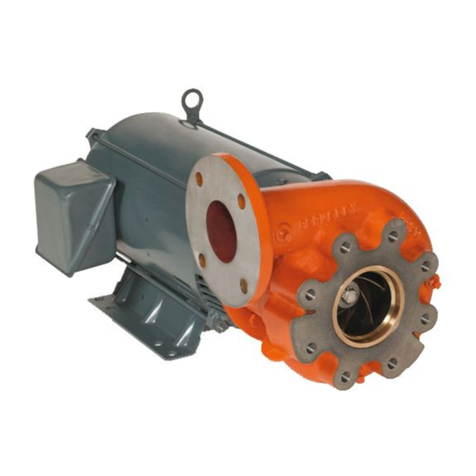
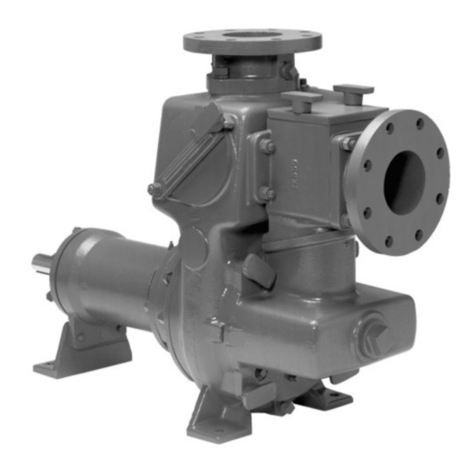
3500 SERIES / MODEL 3550
9
a. When making adjustments, unseat the mechanical seal
from the shaft.
b. Check total clearance. Confirm that it follows the given
instructions.
c. Set the proper operating clearance on the suction side of
the impeller.
Increase the clearance on the suction side of the impeller if
the pumpage temperature exceeds 100°F (38°C). Consult
Appendix I Table I of the manual for proper instructions.
4. Check Rotating Element. To confirm a free-rotating
element, turn the shaft by hand several times (there will be a
degree of resistance due to the bearings and the mechanical
seal). Do not attempt to operate the pump if any rubbing
noise occurs during this process. Instead, readjust the
impeller clearance as outlined in Appendix I, then reset the
mechanical seal according to its instructions.
5. Check Lubrication. Inspect the pump, motor and coupling
for proper lubrication.
AUXILIARIES START-UP: The unit’s auxiliary components
must be turned on where applicable before priming and starting
the pump. Do not start the pump / motor until all the auxiliary
systems are fully operating.
BEARING FRAME COOLING: Turn on the water to the
cooling coil in the bottom of the oil sump if applicable. For
proper flow requirements, consult page 8 of the manual.
MECHANICAL SEAL: Turn on the flush, quench or barrier
fluid to the mechanical seal if applicable. Regulate pressure
and flow according to the seal manufacturer's installation
instructions. Turn on the heating/cooling fluid if the seal flush
includes a heat exchanger.
SEAL CHAMBER JACKET: Turn on the water to the
cooling jacket attached to the seal chamber. For proper flow
requirements, consult page 8 of the manual.
PRIMING:
The pump is now ready to be primed.
1. Close the pump discharge valve.
2. Open the pump suction valve.
3. Confirm that all vent and/or ejector connections are closed
after priming.
START-UP:
NOTICE: Before start-up, confirm that the shaft turns
freely by hand (clockwise when facing the coupling end).
Open the suction valve completely. Start the pump with the
discharge valve open approximately 20% before gradually
opening the valve until reaching design flow point. The
discharge valve should be adjusted to achieve proper process
flow, operating as close to the BEP as possible. The suction line
should not be throttled or restricted at all during the operation.
PUMP PERFORMANCE: Once started, confirm that
the pump is running at or close to the operating point on
the pump performance curve. Throttle the discharge valve if the
pump is overloading the motor or delivering too much flow. A
restriction orifice at the pump discharge may be necessary to
control pump capacity.
Monitor all the flows and pressures to the auxiliary components
and adjust accordingly.
Check the mechanical seal and all other connections for
potential leakage. Tighten where necessary.
Shut down the pump when it has run for one hour and is at
maximum operating temperature. Then, turn the shaft by hand
(in the direction of the rotation arrow) to establish that the
rotating element is not binding and the impeller is not rubbing.
Also check the shaft alignment. Consult page 5 for coupling
alignment.
SHUTDOWN:
To shut down the pump:
1. Turn off the pump and de-energize the motor. Be sure motor
is locked out before attempting to work on the pump.
2. Close the discharge valve and the suction valve.
3. Drain the pump casing.
4. Turn off all auxiliary components in the reverse order from
start-up.
5. To prevent damage from freezing in cold weather, the
entire pump (including all auxiliary components) should be
completely drained.
Warning:
Never operate the pump dry. It is important that the pump
never be subjected to thermal shock. The liquid must be
allowed to enter the pump casing slowly. A centrifugal
pump should never be started until all parts have
been gradually brought to the ultimate intended pump
temperature.
Danger:
Never operate the pump below minimum rated flow and/or
with the discharge valve closed. These operating conditions
could cause extreme temperature rise in the pump and an
explosive hazard. Also, premature failure can result due to
high radial loads and excess vibration.
Warning:
Lock out driver to prevent accidental start-up and physical
injury.